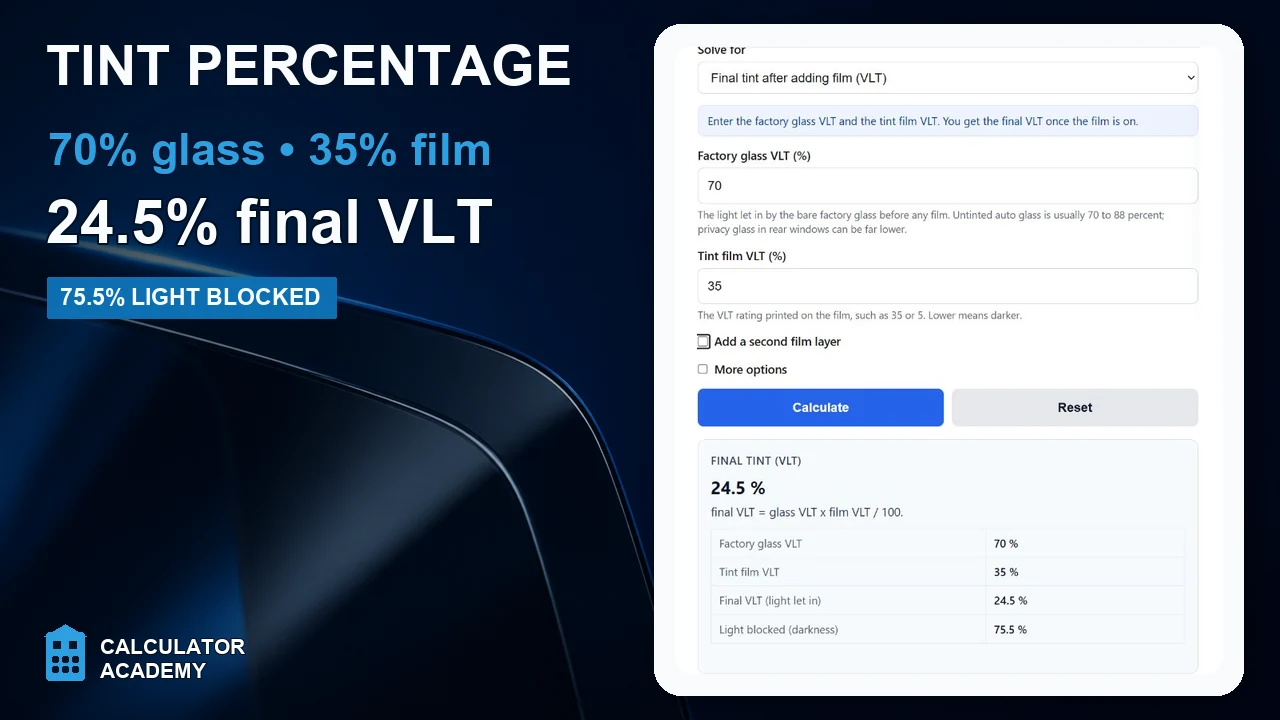
Calculate window tint percentage from film and original glass VLT, or estimate net VLT and legal status by state and window position.
Related Calculators
- Alignment Inches To Degrees Calculator
- Scrub Radius Calculator
- Tire Pressure Temperature Calculator
- Road Noise Calculator
- All Automotive Calculators
VLT Level Reference
Higher VLT = more light through. Most states set front-side window minimums between 24% and 70% VLT. Rear windows in many states have no restriction.
| Net VLT | Appearance | Typical Legal Status (Front Windows) | Privacy Level |
|---|---|---|---|
| 70% | Nearly clear | Legal in all states | None |
| 50% | Light tint | Legal in most states | Low |
| 35% | Medium tint | Legal in many states; illegal in CA, NY, PA front | Moderate |
| 20% | Dark tint | Rear windows only in most states | High |
| 5% | Limo tint | Rear only in select states; illegal on front everywhere | Maximum |
Tint Percentage Formula
- TP = Net Tint Percentage (%)
- VLTt = VLT of the window tint film (%)
- VLTg = VLT of the original glass (%)
Typical Factory Glass VLT by Window Position
The original glass VLT is the value to enter as the starting point. Most front glass is clear-grade (70%+) while most factory privacy glass on SUVs, trucks, and minivans sits at 15 to 26%. If you apply a 35% film to a rear window already at 20% factory glass, your net VLT drops to 7%, which is illegal nearly everywhere for rear side windows with minimum requirements.
| Window Position | Typical OEM VLT Range | Notes |
|---|---|---|
| Windshield | 74 to 85% | UV-blocking laminated glass; many include a blue or green tint band across the top |
| Front side windows | 70 to 74% | Tempered glass; most states require 70%+ net VLT after film |
| Rear side windows (privacy glass) | 15 to 26% | Standard on most SUVs, crossovers, and trucks; this is baked-in pigment, not a film |
| Rear windshield | 70 to 85% (clear) or 15 to 26% (privacy) | Sedans typically clear; SUVs and trucks often privacy glass depending on trim |
Film Technology and Heat Rejection
VLT only measures visible light. Heat (infrared radiation) is a separate spectrum, meaning two films at the same VLT can differ dramatically in heat rejection depending on film technology. A ceramic 35% film blocks up to 95% of infrared versus roughly 0% for a dyed 35% film.
| Film Type | IR (Heat) Blocking | UV Blocking | Signal Interference | Durability |
|---|---|---|---|---|
| Dyed | Low; absorbs heat and re-radiates into cabin | ~99% | None | Fades; can turn purple over time |
| Metalized | Moderate; reflects infrared | ~99% | Blocks GPS, cell, and radio signals | Good |
| Carbon | ~40% IR blocked | ~99% | None | Good; matte finish resists fading |
| Ceramic | Up to 95% IR blocked | ~99.9% | None | Best; no color shift or signal loss |