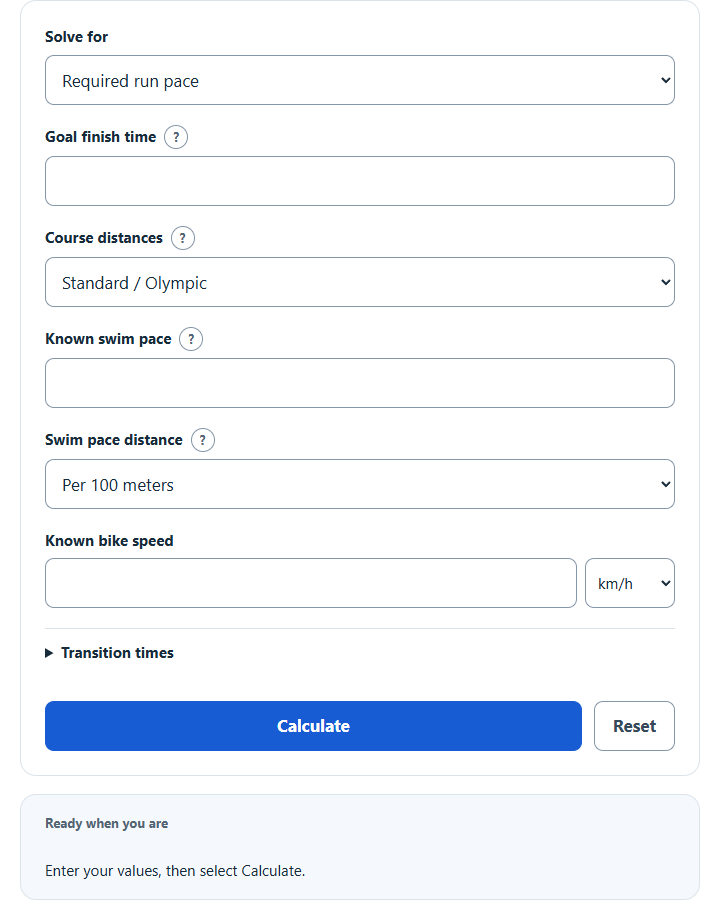
Solve the swim pace, bike speed, or run pace required to reach a triathlon goal after accounting for the other two disciplines and both transitions.
How the Goal-Pacing Solver Works
This calculator reserves time for both transitions and the two known disciplines, then assigns every remaining second to the discipline selected under Solve for. It answers one planning question: what swim pace, bike speed, or run pace would make the entered finish goal possible? The Finish time from paces mode works the other way and adds your splits and transitions into a finish time.
| Solve target | Known discipline inputs | Primary output |
|---|---|---|
| Swim pace | Bike speed and run pace | Time per 100 m and 100 yd |
| Bike speed | Swim pace and run pace | km/h and mph |
| Run pace | Swim pace and bike speed | Time per km and mile |
Formula
Available discipline time equals goal time minus T1, T2, and both known discipline times. Swim pace divides that remainder by the number of 100-meter lengths. Bike speed divides bike distance by the remaining hours. Run pace divides the remainder by run distance.
Worked Standard-Distance Example
For a 2:30:00 goal, a 30:00 swim, 1:20:00 bike, 3:00 T1, and 2:00 T2 leave 35:00 for the 10 km run. That requires 3:30 per kilometer, equivalent to 5:37.962 per mile. The checkpoint rows extend the solved target to useful intermediate distances.
Unit Handling
Each pace or speed control names its actual unit next to the value. Enter times as h:mm:ss, m:ss, or decimal minutes; blank transitions count as zero. Speed and custom-distance unit controls convert the entered quantity. Changing a pace-distance selector reinterprets the clock value. A pace entered per 100 yards is converted to a per-100-meter basis for calculation, miles per hour are converted to kilometers per hour, and minutes per mile are converted to seconds per kilometer. Results show both systems. The 70.3 and full presets use the nominal mile values 1.2/56/13.1 and 2.4/112/26.2 respectively; use custom distances when an event guide differs.
Assumptions and Limitations
The schedule holds each entered or solved pace constant over its discipline. It does not model hills, currents, wind, aid-station stops, fatigue, penalties, or course-specific distance differences. A goal that leaves no positive time for the selected discipline is rejected instead of returning an impossible pace.
Sources
World Triathlon, Age-Group Racing. IRONMAN, 2026 Gulf Coast official event description and IRONMAN California official event announcement. Preset distances are nominal.