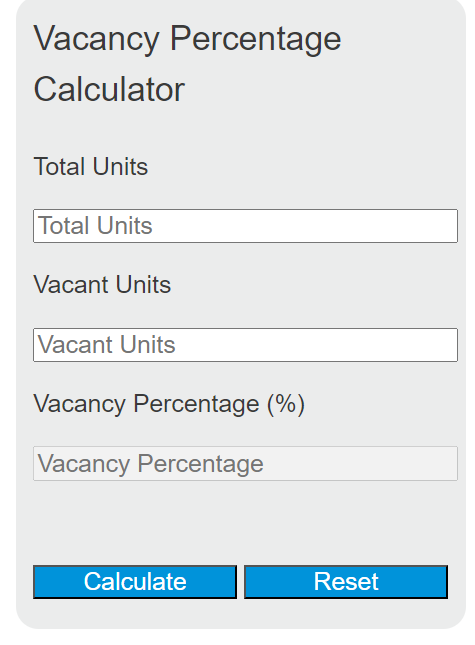
Calculate vacancy and occupancy percentages by vacant units or unit-days, then estimate occupied capacity and optional rental income lost to vacancy.
Related Calculators
- Vacancy Rate Calculator
- Occupancy Percentage Calculator
- Economic Occupancy Calculator
- Occupancy Rate Index Calculator
- Rent Per Sq Ft Calculator
- All Business Calculators
Vacancy Percentage Formula
Vacancy percentage shows the share of a property’s total units that are currently unoccupied. It is commonly used by landlords, property managers, and investors to monitor leasing performance, compare periods, and estimate revenue pressure from empty units.
- VP = vacancy percentage
- VU = vacant units
- TU = total units
The calculator can also be used in reverse when you know any two values and need the third.
| Unknown | Formula |
|---|---|
| Vacancy Percentage | VP = ((VU) / (TU)) × 100 |
| Vacant Units | VU = TU × (VP) / (100) |
| Total Units | TU = (VU × 100) / (VP) |
How to Calculate Vacancy Percentage
- Determine the total number of rentable units in the property.
- Count how many of those units are vacant.
- Divide vacant units by total units.
- Multiply by 100 to convert the result to a percentage.
Use the same counting rules every time you calculate vacancy. If you exclude units under renovation or owner-held units from one report, exclude them from all comparable reports so the trend stays meaningful.
Example
A property has 84 total units and 7 vacant units.
The vacancy percentage is 8.33%. That means just over eight out of every one hundred units are currently unoccupied.
Why Vacancy Percentage Matters
- Revenue planning: More vacant units usually mean lower rental income.
- Pricing decisions: Rising vacancy can signal that rents are too high for current demand.
- Operational performance: High vacancy may point to turnover, maintenance delays, or weak marketing.
- Market comparison: Owners often compare vacancy trends across buildings, neighborhoods, or time periods.
- Investment analysis: Vacancy affects net operating income, cash flow, and valuation.
Vacancy Percentage vs. Occupancy Rate
Vacancy percentage and occupancy rate are complementary metrics. If one goes up, the other goes down.
- OR = occupancy rate
- A vacancy percentage of 8% implies an occupancy rate of 92%.
This calculator measures physical vacancy, meaning empty units. It does not measure economic vacancy, which reflects lost rent from concessions, delinquency, or units leased below market.
Common Input Mistakes
- Using occupied units instead of total units as the denominator.
- Mixing units that are intentionally offline with units that are available for rent.
- Comparing monthly vacancy in one period to quarterly or annual vacancy in another.
- Rounding unit counts before calculating the percentage.
- Averaging percentages across multiple properties instead of combining the actual unit totals.
Portfolio Calculation
When analyzing several properties together, add all vacant units and all total units first, then calculate one combined percentage.
This method gives a more accurate portfolio-wide result than taking a simple average of individual property percentages.
Interpretation Tips
- A lower vacancy percentage usually indicates stronger occupancy and leasing demand.
- A higher vacancy percentage can indicate turnover, weak demand, pricing issues, or operational problems.
- A sudden increase may be caused by seasonality, new competing supply, renovations, or tenant move-outs.
- The most useful comparison is often against the property’s own history and similar nearby properties.
Frequently Asked Questions
Can vacancy percentage be greater than 100%?
No. Vacant units cannot exceed total units in a valid property count.
What if total units equals 0?
The calculation is undefined because there is no property inventory to measure against.
Should unrentable units be counted as vacant?
That depends on your reporting policy. Some operators exclude units under major renovation from total inventory, while others include them. The key is to stay consistent from period to period.
Is a lower vacancy percentage always better?
Usually yes, but context matters. Extremely low vacancy can also suggest rents may be below market or turnover is unusually low for the property type.