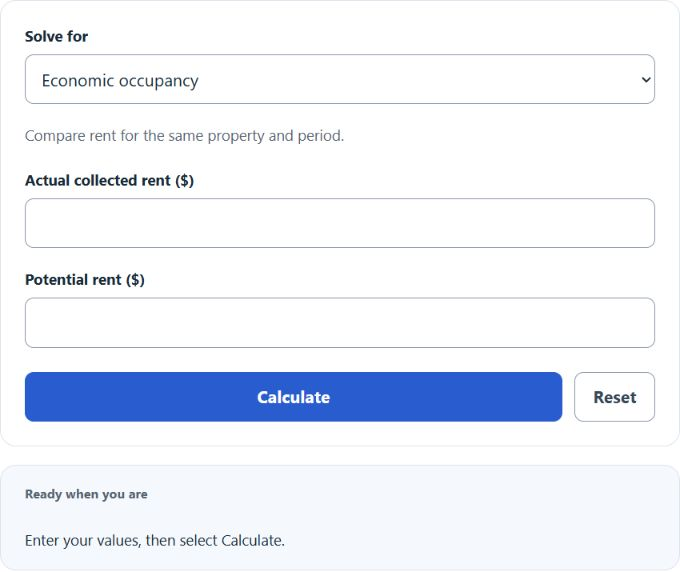
Calculate economic occupancy by comparing actual collected rent to potential rent, or solve for missing rent values from occupancy percentage.
Related Calculators
- Fill Rate Calculator
- Effective Capacity Calculator
- Implied Utilization Calculator
- Operating Expense Gross Up Calculator
- All Business Calculators
Economic Occupancy Formula
The following equation is used to calculate the Economic Occupancy.
- Where EO is the Economic Occupancy ratio; multiply by 100 to express it as a percentage
- ARC is the Actual Rent Collected ($)
- TPR is the Total Potential Rent ($)
To calculate economic occupancy, divide actual rent collected by total potential rent for the same property and period, then multiply by 100 for a percentage. Select the value to solve for in the calculator; potential rent must be greater than zero.
What is Economic Occupancy?
Definition:
Economic occupancy measures how effectively a property is generating income relative to its maximum earning potential. It considers rent concessions, vacant units, and unpaid balances to provide a clear understanding of the property’s financial performance.
How to Calculate Economic Occupancy?
Example Problem:
The following example outlines the steps and information needed to calculate the Economic Occupancy.
First, determine the total potential rent. Assume a property has 20 units each renting for $1,000, for a total potential rent of $20,000.
Next, determine the actual rent collected. In this example, you collected $16,000 in rent for the month.
Finally, calculate the economic occupancy using the formula above:
EO = ARC / TPR
EO = $16,000 / $20,000
EO = 0.80 or 80%
FAQ
What factors can affect the economic occupancy?
The economic occupancy can be influenced by a variety of factors, including the level of physical occupancy, the rental rates being charged, the presence of rent concessions or discounts, and the amount of unpaid or delinquent rent. Market conditions, property management practices, and tenant turnover can also play significant roles.
How can I increase my property’s economic occupancy?
To increase economic occupancy, focus on minimizing vacancies and reducing concessions, properly screening tenants to reduce delinquencies, and maintaining competitive but profitable rental rates. Good property management, regular maintenance, and prompt communication with tenants will also encourage timely rent payments and longer lease terms.
Is economic occupancy always the best measure of profitability?
While economic occupancy is a valuable metric to gauge how much of the potential rent is actually being collected, it’s not the sole indicator of profitability. Other factors such as operating expenses, capital expenditures, and overhead costs must be considered to get a complete picture of a property’s financial health.