Check whether a car fits the 20/4/10 rule: 20% down, a loan of 4 years or less and car costs under 10% of income, or find the most car you can afford.
- All Automotive Calculators
- Home Affordability Calculator (28/36 rule)
- Car Depreciation Calculator (% per year)
- 20 30 50 Rule Calculator
Calculator Functions
| Function | What it does | What it requires |
|---|---|---|
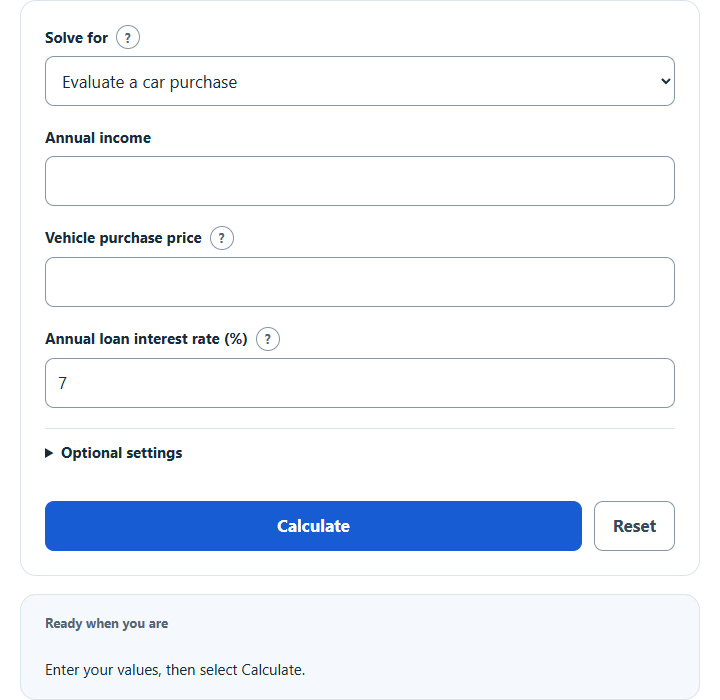
| Evaluate a car purchase | Checks a car purchase against the 20% down, 48-month and 10% of income guidelines | Requires the annual income, the vehicle purchase price and the annual loan interest rate |
| Find maximum car price | Finds the highest vehicle price whose monthly costs fit the selected budget | Requires the annual income and the annual loan interest rate |
| Find required annual income | Finds the annual income at which a car’s monthly costs equal the selected budget | Requires the vehicle purchase price and the annual loan interest rate |
The interest rate starts at 7% and can be replaced with a quoted rate, or with 0 for a loan with no interest. Optional settings apply to every function: the income basis (gross or take-home), the down payment (20% if left blank), the loan term (48 months), other monthly vehicle costs (0) and the selected budget (10% of monthly income). Each result lists the down payment, amount financed, monthly loan payment, total monthly transportation cost, share of income, total loan interest and a pass or fail line for each guideline.
20/4/10 Rule Formulas
[1 − (1 + r)−n] [2]
| PMT | Monthly loan payment ($) |
| P | Amount financed ($): vehicle price × (1 − down payment) |
| r | Monthly interest rate: annual rate in percent ÷ 1,200 |
| n | Loan term (months) |
The 20/4/10 rule asks for at least 20% of the price as a down payment, a loan of four years or less, and monthly transportation costs of no more than 10% of gross monthly income [1]. The loan payment comes from the amortization formula for equal monthly payments [2]. At 0% interest the payment is P ÷ n.
Evaluate a car purchase
Other costs are insurance, fuel, maintenance, registration and recurring fees. Three fixed checks follow: the down payment is at least 20%, the term is 48 months or less, and the total is no more than 10% of monthly income. A $25,000 car with 20% down leaves $20,000 financed, and at 6% over 48 months the payment is $469.70. With $300 of other costs the total is $769.70 a month. On a $90,000 gross income that is 10.26% of monthly income, so the 10% check fails; on $100,000 it is 9.24% and all three checks pass. A fourth line compares the total with the selected budget, and changing that budget never changes the fixed 10% check.
Find maximum car price
k ÷ (1 − down payment)
B is the monthly budget, monthly income × the selected budget percentage, and k = r ÷ [1 − (1 + r)−n] is the payment per dollar financed. On $90,000 a year the 10% budget is $750 a month. After $300 of other costs, $450 is left for the loan, which supports $19,161.14 financed at 6% over 48 months and a price of $23,951.43 with 20% down.
Find required annual income
budget percentage
For the $25,000 car above, $769.70 ÷ 0.10 × 12 = $92,364.07 a year. With no interest and no other costs, the payment is $416.67 and the income needed is $50,000.
Limits of This Estimate
- This is a planning estimate, not a loan approval or a lending decision. The 20/4/10 rule is a guideline, not a formula that fits every budget [1].
- The payment assumes equal monthly payments at a fixed rate, with no balloon payment and no financed loan fees. A contract interest rate can differ from a fee-inclusive APR, and daily-interest contracts and payment rounding can move the result by a few cents.
- The purchase price should include any financed taxes and purchase fees. Trade-in equity and rebates are not modeled separately.
- The 7% starting rate is a placeholder. The Federal Reserve reported an average of 7.65% on 60-month new-car loans at commercial banks for 2025 and 7.54% in August 2026, as of its November 6, 2026 release [3]. Actual rates depend on credit, lender and term.
- The rule is stated on gross income [1]. The take-home option is a stricter comparison on the amount entered, not a tax calculation.
Sources
- Chase, Buying a car? Know the 20/4/10 rule: the three parts of the rule, and gross income as the basis for the 10% limit
- LibreTexts Mathematics, Math for Liberal Arts (Las Positas College), Section 8.5: Amortized Loans: the payment formula for a loan repaid in equal installments
- Federal Reserve Board, Consumer Credit (G.19), release of November 6, 2026: average interest rates on new-car loans at commercial banks