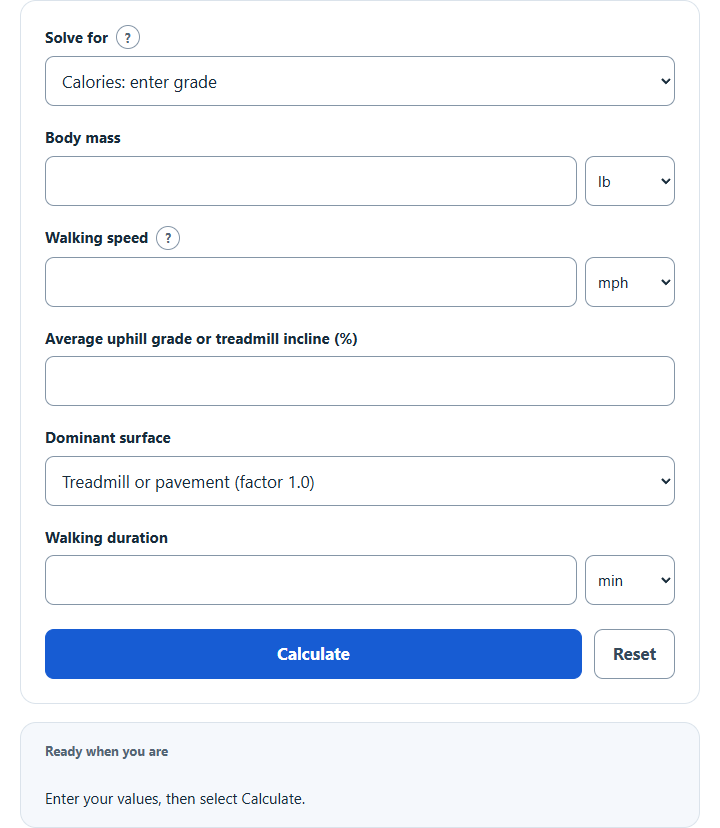
Estimate calories burned walking uphill or on an incline treadmill from your weight, speed, grade or elevation gain and time, or the time to burn a target.
How the Walking Uphill Calorie Calculator Works
This calculator models outdoor uphill walking with the unloaded Pandolf equation and a controlled terrain factor. Average grade can be entered directly or derived from elevation gain divided by horizontal route distance.
Formula: M = 1.5W + terrain factor x W x (1.5V2 + 0.35VG), in watts. W is body mass in kg, V is walking speed in m/s, and G is grade in percent. Gross kcal = M x60xminutes/4184. The energy-based MET-equivalent uses1.05 kcal/kg/hour per conventional MET; it is not measured oxygen consumption.
What the Results Show
The primary result is uphill calories or time for a target. Supporting outputs show distance, calorie rate, a model MET-equivalent, average grade, terrain, and the added modeled cost versus pavement.
Why This Calculator Is Different
The grade-from-elevation workflow and surface comparison are designed for outdoor routes. Incline treadmill walking uses a different ACSM machine-grade equation.
Assumptions and Limitations
Level and uphill travel from 0 to 20% are modeled, with zero external load. Gross energy includes the standing/support term. Supported inputs are 25–300 kg and 1–5 mph; these interface bounds do not establish validity for every person or condition. Average grade smooths a variable route into one steady segment. Route interruptions, altitude, wind, poles, carried load, and downhill correction are excluded.
Browse the complete Running & Walking calorie calculator collection or return to the Sports & Fitness Calculators hub.
Sources
Walking economy: comparison of published equations; field validation and categorical terrain factors.
Pandolf, Givoni, and Goldman. Predicting energy expenditure with loads while standing or walking very slowly. Journal of Applied Physiology, 1977.
Soule and Goldman. Terrain coefficients for energy cost prediction. Journal of Applied Physiology, 1972.
U.S. Army Borden Institute. Medical Aspects of Harsh Environments, load carriage and terrain discussion.