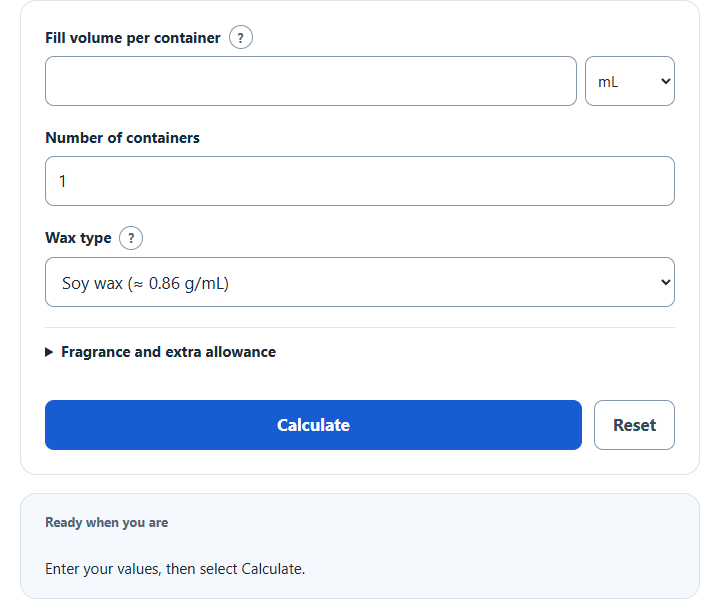
Estimate how much wax and fragrance oil you need for candle containers from fill volume and count, using typical soy, paraffin or beeswax densities.
Related Calculators
- Mass to Volume Calculator
- Weight to Volume Calculator
- Grams to Volume Calculator
- Liquid Density Calculator
- Specific Gravity to Density Calculator
- Net Weight Calculator
- All Everyday Life and Education Calculators
Wax Weight Formula
The calculator converts usable fill volume to milliliters and multiplies by container count and your estimated density. It then splits this estimated fill mass into wax and fragrance oil. Fragrance load is oil mass as a percentage of wax mass. Because adding oil changes blend density and volume, this is a planning estimate; verify with a test pour.
- C = container capacity entered by you
- U = unit conversion factor to milliliters
- Vml = capacity of one container in milliliters
- Q = number of containers
- Vtotal = total container volume in milliliters
- D = wax density in grams per milliliter
- Wfill = total fill weight, including wax and fragrance
- F = fragrance load percentage
- Wwax = wax needed before extra allowance
- Wfragrance = fragrance oil needed
- E = extra wax allowance percentage
- Wextra = wax needed after extra allowance
Total Fill Weight is the estimated finished candle weight for all containers. It includes wax and fragrance oil.
Wax Needed is the amount of wax required after accounting for fragrance load.
Fragrance Oil Needed is the part of the total fill weight made up by fragrance oil.
Wax Needed with Extra Allowance adds your extra percentage to the wax amount. This helps cover wax left on tools, pouring loss, or small measuring differences. The allowance adds wax only; if extra scented blend is required, increase both wax and oil proportionally.
Useful Tables
These illustrative density estimates vary with formulation and temperature. Use supplier or measured values for your actual wax or blend, and follow its fragrance limits. Table volume units are US customary.
| Wax Type | Typical Density | Common Use |
|---|---|---|
| Soy wax | 0.86 g/mL | Container candles |
| Paraffin wax | 0.80 to 0.90 g/mL | Containers, pillars, melts |
| Coconut wax blend | 0.85 to 0.90 g/mL | Container candles |
| Beeswax | 0.95 to 0.97 g/mL | Pillars, tapers, specialty candles |
| Input Unit | Conversion to mL | Example |
|---|---|---|
| Milliliters | 1 mL = 1 mL | 250 mL stays 250 mL |
| Fluid ounces | 1 fl oz = 29.5735 mL | 8 fl oz = 236.59 mL |
| Cups | 1 cup = 236.5882 mL | 2 cups = 473.18 mL |
| Liters | 1 L = 1000 mL | 0.5 L = 500 mL |
Example Wax Weight Calculations
Example 1: One 8 fl oz candle with 8% fragrance
You have one 8 fl oz container, wax density is 0.86 g/mL, and fragrance load is 8%.
8 fl oz equals 236.59 mL. Total fill weight is 236.59 × 0.86 = 203.47 g.
Wax needed is 203.47 / 1.08 = 188.40 g. Fragrance oil needed is 203.47 – 188.40 = 15.07 g.
Example 2: Twelve 250 mL candles with 5% extra wax
You have twelve 250 mL containers, wax density is 0.86 g/mL, fragrance load is 8%, and extra allowance is 5%.
Total volume is 250 × 12 = 3,000 mL. Total fill weight is 3,000 × 0.86 = 2,580 g.
Wax needed is 2,580 / 1.08 = 2,388.89 g. With 5% extra allowance, wax needed is 2,388.89 × 1.05 = 2,508.33 g.