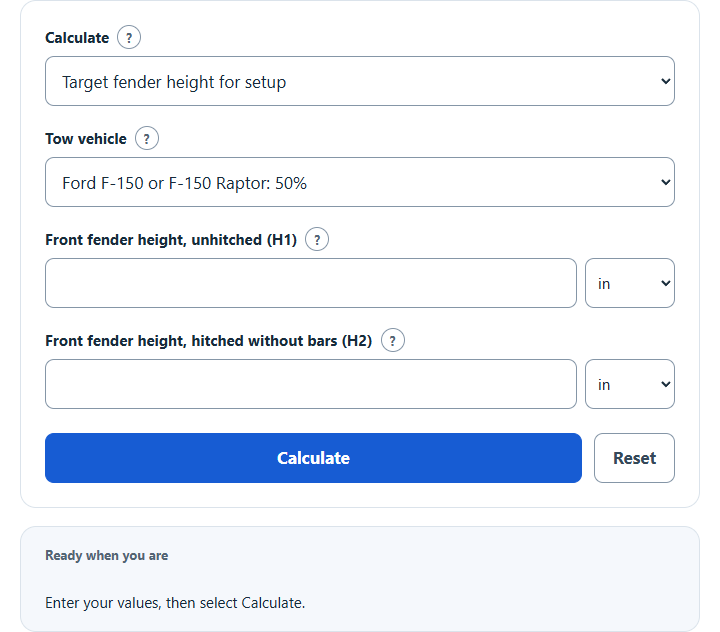
Find the target fender height for setting a weight distribution hitch, the axle loads it shifts, or the front axle load restored from scale weights.
- All Automotive Calculators
- Trailer Tongue Weight Calculator
- GVWR (Gross Vehicle Weight Rating) Calculator
- Trailer Load Capacity Calculator
- Weight Distribution Calculator
Calculator Functions
A weight distribution hitch uses spring bars to move part of a trailer's tongue weight off the tow vehicle's rear axle and onto its front axle and the trailer's axles. The calculator covers setting the hitch up and checking what it does.
| Function | Use it when | You enter |
|---|---|---|
| Target fender height for setup | You're adjusting the spring bars with a tape measure | The tow vehicle and the front fender height unhitched and hitched without bars |
| Axle loads from hitch geometry | You want to see how a tongue weight loads each axle before you tow | Tongue weight, wheelbase, rear axle to ball, ball to trailer axle, and the share to restore |
| Front axle load restored, from scale weights | You've weighed the rig on a truck scale | Front axle weight alone, hitched without bars and hitched with bars |
To find the tongue weight itself, use the Trailer Tongue Weight Calculator. To check the loaded vehicle against its ratings, use the GVWR Calculator.
Weight Distribution Hitch Formulas
| T | Target height of the front fender lip with the bars set |
| H1 | Front fender height with the trailer not connected |
| H2 | Front fender height with the trailer on the ball and no bars attached |
| CF | Correction factor for the tow vehicle, as a decimal: 0.5 for 50% |
This is Ford's setup method [1]. Load the trailer and the tow vehicle as for the trip and park on level ground. Measure from the ground to the top of the front fender lip above the wheel centre before hitching (H1), then again with the trailer on the ball, the tongue jack up and no bars attached (H2). The tongue weight lifts the front, so H2 is the larger figure. Tension the bars until the fender comes down to the target. For an F-150 with H1 = 37 in and H2 = 38 in, the rise is 1 in, half of it is 0.5 in, and the target is 38 − 0.5 = 37.5 in.
| 2026 Ford model | Correction factor |
|---|---|
| Expedition, F-150, F-150 Raptor | 50% |
| F-250 and F-350 Super Duty pickups | 50% |
| F-450 Super Duty pickup, regular cab | 25% |
| F-450 Super Duty pickup, crew cab | 50% |
| Super Duty chassis cab | 50% |
| Mustang, Bronco Sport, Escape, Bronco, Explorer, Maverick, Ranger | Not required |
| Transit | Use not recommended |
Axle loads from hitch geometry
ΔT = f × TW × a ÷ (L + a)
ΔR = TW − ΔF − ΔT
TW is the tongue weight, WB the wheelbase, a the distance from the rear axle to the hitch ball, L the distance from the ball to the middle of the trailer's axles, and f the share of the front axle load that the bars restore. ΔF, ΔR and ΔT are the changes in load on the front axle, the rear axle and the trailer axles. With no bars f is 0: the tongue weight hangs behind the rear axle, so it takes TW × a ÷ WB off the front axle and puts TW × (1 + a ÷ WB) on the rear. The figures come from balancing torques, each a force times its distance from the pivot [2], about the axles.
Tensioned bars lift some of the weight from the rear wheels and transfer it to the other wheels of the vehicle and trailer [1]. Take an 800 lb tongue weight on a truck with a 145 in wheelbase, 65 in from rear axle to ball, and 240 in from ball to trailer axles. Without bars the front axle loses 359 lb and the rear gains 1,159 lb. With half of the front axle load restored, the front is down 179 lb, the rear is up 894 lb, and 85 lb has moved to the trailer axles.
Front axle load restored from scale weights
(F1 − F2) × 100
F1, F2 and F3 are the front axle weights of the tow vehicle alone, hitched without bars, and hitched with the bars set. FALR, front axle load restoration, is the share of the lost front axle load that the bars put back. Where load bars are used, Ford recommends 50% for its trucks [1]. With 3,200 lb alone, 2,860 lb hitched without bars and 3,040 lb with bars, hitching removed 340 lb, the bars returned 180 lb, and FALR = 180 ÷ 340 × 100 = 53%.
Add the rear axle weights and the calculator also gives the tongue weight: the hitched total without bars minus the total alone. With the trailer axle weight it gives the trailer weight and the tongue's share of it. Ford's figure for a conventional trailer over 2,000 lb is a tongue load of 10% of the loaded trailer weight [1].
Limits of This Estimate
- The correction factors and the 50% restoration figure are Ford's for its 2026 models. Other makers set their own, and Ford advises against a weight distribution hitch on the Transit [1], so use the owner's manual for any other vehicle.
- The geometry function treats the vehicle and trailer as rigid and level. Suspension travel, bar stiffness and hitch head tilt change the real split, which only a scale shows. These estimates are based on the best available data and estimations.
- Nothing here checks ratings. The tongue load must not push the tow vehicle past its gross vehicle weight rating or rear axle rating [1], and the hitch receiver, ball and bars have limits of their own.
- Set the bars by the hitch maker's instructions and finish with the trailer level or slightly nose down [1].
Sources
- Ford Motor Company, 2026 RV & Trailer Towing Guide: the hitch setup steps, the correction factors, the 50% front axle load restoration, the 10% tongue load and the rating limits
- NASA Glenn Research Center, Torque (Moment): torque as force times distance from the pivot, and the balance of torques in equilibrium