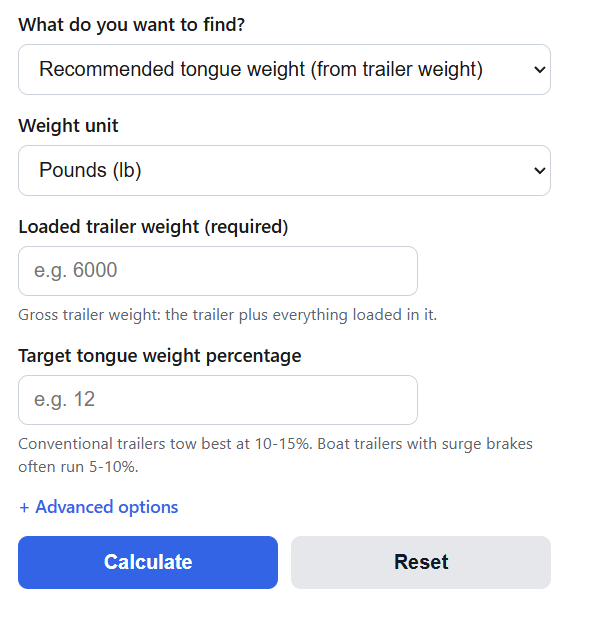
Calculate trailer tongue weight from gross trailer weight, load position, or a bathroom scale reading, and check it against the safe 10-15% towing range.
- All Automotive Calculators
- Trailer Tongue Weight Calculator
- Trailer Offtracking Calculator
- Trailer Gain Calculator
Trailer Tongue Weight Formula
TW = GTW * (P / 100)
TW% = (TW / GTW) * 100
TW = GTW * (A - L) / A
TW = R * S / D
- TW is the tongue weight, the downward force the coupler puts on the hitch ball (lb or kg)
- GTW is the gross trailer weight, the trailer plus everything loaded on it (lb or kg)
- P is the target tongue weight percentage (10-15% for conventional trailers)
- A is the distance from the coupler to the axle center (or the midpoint between tandem axles)
- L is the distance from the coupler to the center of mass of the loaded trailer
- R is the bathroom scale reading, S is the distance between the scale and the opposite support, and D is the distance from the coupler to that support
The first formula gives you a target tongue weight before you load the trailer: multiply gross trailer weight by your chosen percentage. The second works in reverse, converting a measured tongue weight into a percentage so you can check whether your current setup falls in the safe range. The third estimates tongue weight from load placement using a simple lever balance around the axle: the closer the load center sits to the coupler, the more weight lands on the tongue. The fourth converts a bathroom scale reading into true tongue weight when you measure with a beam-and-scale setup, since the lever arrangement means the scale only sees a fraction of the real load.
Recommended Tongue Weight by Trailer Type
Not every trailer targets the same percentage. Conventional bumper-pull trailers aim for 10-15%, but boat trailers with surge brakes run lighter so the brake actuator can work properly. The table below shows typical loaded weights and the tongue weight range to aim for.
| Trailer type | Typical loaded weight | Target % | Target tongue weight |
|---|---|---|---|
| Jet ski / small utility | 1,000 – 1,500 lb | 10-15% | 100 – 225 lb |
| Single-axle utility | 2,000 – 3,000 lb | 10-15% | 200 – 450 lb |
| Boat trailer (surge brakes) | 3,000 – 8,000 lb | 5-10% | 150 – 800 lb |
| Car hauler | 5,000 – 7,000 lb | 10-15% | 500 – 1,050 lb |
| Travel trailer | 5,000 – 9,000 lb | 10-15% | 500 – 1,350 lb |
| Toy hauler / large enclosed | 8,000 – 12,000 lb | 10-15% | 800 – 1,800 lb |
Once you know your tongue weight percentage, this table tells you what it means and what to do about it. Tongue weight also counts against your tow vehicle’s payload capacity, so heavier tongues may require a weight distribution hitch even when the percentage is correct.
| Tongue weight % | What it means | Fix |
|---|---|---|
| Below 0% | Tongue lifts the hitch; extremely dangerous | Move cargo well forward of the axle |
| 0-9% | High sway risk at highway speed | Shift cargo forward until 10%+ is reached |
| 10-15% | Ideal for conventional trailers | None |
| Over 15% | Rear axle and hitch overload, light steering | Shift cargo rearward or reduce load |
| Over 500 lb (any %) | Approaching many bumper hitch limits | Consider a weight distribution hitch |
Trailer Tongue Weight Example Problems
Example 1: You are loading a travel trailer with a gross trailer weight of 6,000 lb and want a 12% tongue weight. TW = 6,000 * (12 / 100) = 720 lb. The acceptable range for this trailer is 600 lb at 10% up to 900 lb at 15%, so anything between those values keeps the trailer stable.
Example 2: You measure tongue weight with a bathroom scale using a beam supported by the scale on one end and a brick 3 ft away on the other, with the coupler resting 1 ft from the brick. The scale reads 250 lb. TW = 250 * 3 / 1 = 750 lb. If the trailer weighs 6,000 lb loaded, that is 750 / 6,000 * 100 = 12.5%, which falls inside the 10-15% target.
Trailer Tongue Weight Frequently Asked Questions
What happens if tongue weight is too low? Too little tongue weight is the leading cause of trailer sway. With less than about 10% of the trailer’s weight pressing down on the hitch, the trailer can begin to oscillate side to side at highway speed, and the oscillation grows instead of damping out. Sway that starts this way can jackknife or roll the trailer. If you ever feel sway, do not steer against it; ease off the throttle, apply the trailer brakes manually if you can, and stop to move cargo forward.
Does tongue weight count against my truck’s payload? Yes. Tongue weight rides on the tow vehicle, so it counts against both payload capacity and rear axle rating, along with passengers and cargo. A truck with 1,500 lb of payload carrying 400 lb of people and gear only has about 1,100 lb left for the tongue. This is why a vehicle can be rated to tow a trailer’s total weight and still be overloaded at the hitch.
How do I adjust tongue weight without unloading the trailer? Move cargo relative to the axle. Weight placed forward of the axle adds tongue weight; weight behind the axle subtracts from it. Because the trailer acts as a lever, small moves of heavy items near the rear have a large effect. Aim to place about 60% of cargo weight ahead of the axle, keep loads low and centered side to side, and strap everything down so it cannot shift while towing.