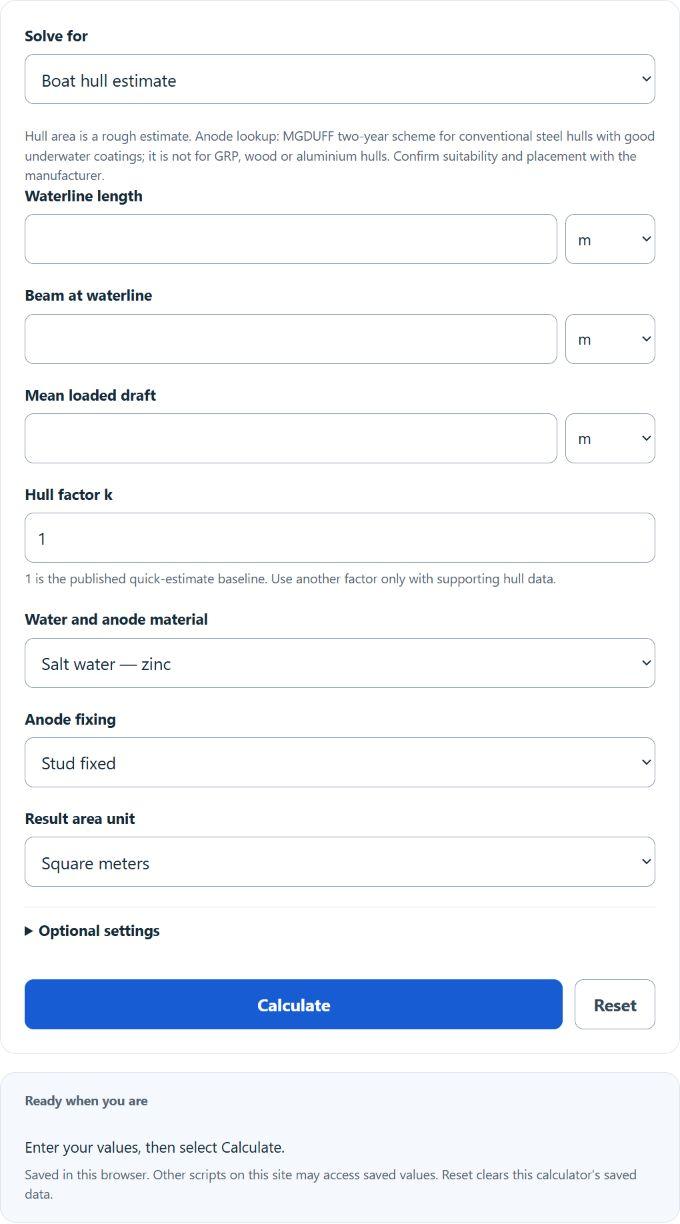
Estimate boat hull or cylindrical curved wetted area from dimensions and circumference coverage. The separate anode lookup uses MGDUFF’s two-year scheme for conventional steel hulls with good underwater coatings; confirm its applicability with the manufacturer.
Related Calculators
- Boat Draft Calculator
- Hull Speed Calculator
- Block Coefficient Calculator
- Displacement to Length Ratio Calculator
- Drag Equation Calculator
- Float Weight Calculator
- All Physics Calculators
Wetted Surface Area Formula
There is no single exact closed-form formula for a boat’s wetted surface area because it depends strongly on hull shape. The formula below is the MGDUFF quick-estimate baseline at k = 1, used here with an optional user-supported hull factor. It estimates underwater hull area; add separately measured appendage area only when it is not already included.
Variables:
- WSA is the wetted surface area (e.g., ft² or m²)
- LWL is the waterline length
- B is the beam at the waterline
- T is the draft
- k is a dimensionless adjustment factor; the default 1 reproduces the published baseline. Other values require supporting hull data.
To estimate wetted surface area with this rule-of-thumb, multiply the waterline length by the sum of the beam and draft, then multiply by the hull factor k.
How to Calculate Wetted Surface Area?
The following steps outline how to calculate the Wetted Surface Area.
- First, determine the waterline length (LWL).
- Next, determine the beam at the waterline (B).
- Next, determine the draft (T).
- Next, gather the formula from above: WSA ≈ LWL × (B + T) × k.
- Finally, calculate the Wetted Surface Area.
- After inserting the variables and calculating the result, check your answer with the calculator above.
Example Problem:
Use the following variables as an example problem to test your knowledge.
Waterline length, LWL (ft) = 20
Beam, B (ft) = 10
Draft, T (ft) = 5
WSA ≈ LWL × (B + T) × k (using k = 1.00) = 20 × (10 + 5) × 1.00 = 300 ft²