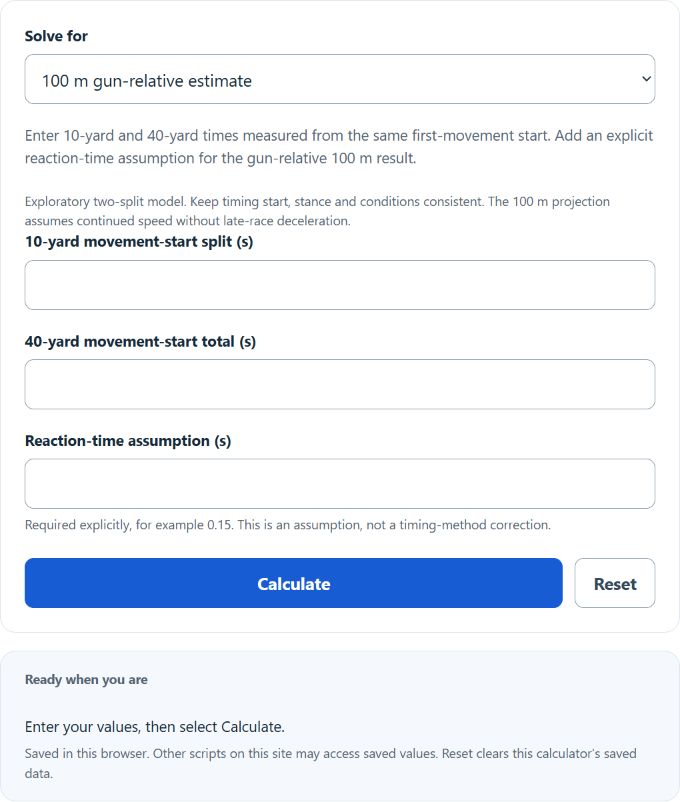
Estimate a 100 m FAT performance from 10-yard and 40-yard splits, or estimate a 40-yard time from 20 m and 100 m splits, using a split-calibrated acceleration model.
40-Yard Dash to 100m Formula or Method
The estimator fits a mono-exponential horizontal sprint profile to two measured splits, derives acceleration time constant and maximum-velocity parameters, and numerically solves for the requested distance.
How the Calculation Works
Select the target event to display its required source splits. Enter a reaction-time assumption explicitly. A result appears only after Calculate; editing an input marks the previous result as out of date.
How to Use This Calculator
- Select the result you want in the Solve for menu.
- Enter only the visible source values and their explicit units.
- Select Calculate and review the primary answer, supporting values, and substituted steps.
- Use Reset before starting a different performance or scenario.
Worked Example
A 1.55 s 10-yard split and 4.50 s 40-yard time, paired with a 0.15 s reaction assumption, fit τ ≈ 0.6437 s and Vmax ≈ 9.4833 m/s. The estimated 100 m FAT is 11.34 s.
Input and Result Guide
| Item | How to use it |
|---|---|
| 10 yd | 9.144 m exactly. |
| 40 yd | 36.576 m exactly. |
| Reaction time | Added to a gun-relative 100 m estimate and removed from entered FAT splits before fitting. |
| Two splits | Required because one total time cannot separately identify acceleration and maximum velocity. |
| Result | A model estimate, not a timing-system conversion or recruiting guarantee. |
Interpreting the Result
Keep timing method, event distance, units, venue conditions, and scoring rules consistent when comparing results.
Assumptions and Limitations
The profile assumes smooth acceleration toward an asymptotic speed and does not model late-race deceleration, surface, footwear, blocks versus a football stance, wind, altitude, or timing-system differences. The 100 m result extrapolates beyond 40 yards. Incompatible split pairs or fits outside the supported τ range of 0.05–5 seconds are rejected; that range is a numerical model restriction, not a confidence interval.
Common Questions
Why did an input disappear when I changed Solve for?
Each mode displays only the source splits required for that model. The result is shown separately after Calculate.
Will my last successful calculation be restored?
Yes. This browser saves the successful source values in a versioned snapshot and recomputes the result when restored. The restored result is labeled and is not a new calculation. Reset clears this calculator’s saved data. Other scripts on this site may access browser storage.
Sources
Healy, Kenny and Harrison (2022) studied a four-split profiling method in elite male sprinters. That study does not validate this calculator’s two-split 40-yard-to-100 m extrapolation or eliminate timing-method differences. The international yard is exactly 0.9144 m.