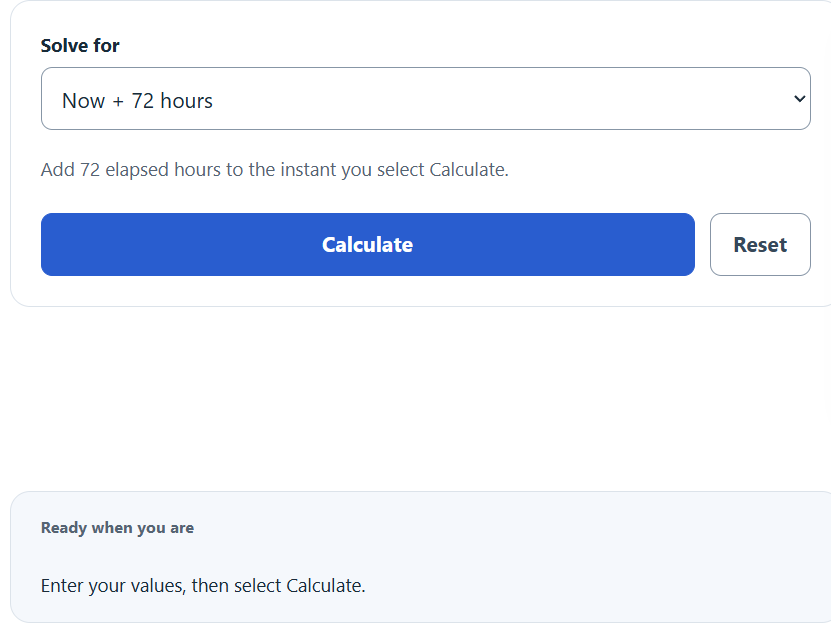
Find the day, date and time 72 hours from now or 72 hours ago, or add or subtract 72 hours from any start or end date and time you choose.
Related Calculators
- Counting Back Days Calculator
- Date Calculator
- 48 Hours From Now Calculator
- 36 Hours From Now Calculator
- 12 Hours From Now Calculator
- 30 Minutes From Now Calculator
- All Everyday Life and Education Calculators
Calculator Functions
| Function | What it does | What it requires |
|---|---|---|
| Now + 72 hours | Finds the day, date and time 72 hours after the current moment | Requires nothing; it reads the device clock |
| Now − 72 hours (72 hours ago) | Finds the day, date and time 72 hours before the current moment | Requires nothing; it reads the device clock |
| End time (+72 hours) | Finds the moment 72 hours after a chosen start | Requires a start date and time |
| Start time (−72 hours) | Finds the moment 72 hours before a chosen end | Requires an end date and time |
| 72 business hours | Finds when 72 working hours have passed on a work schedule | Requires the opening and closing times and the working days; the start date and time is optional |
Entered dates and times are read in the device’s time zone. Every result gives the day of the week, the date and time, the same moment in UTC and a Unix timestamp. An optional setting also shows the result in UTC, New York, Chicago, Denver, Los Angeles, London, Kolkata, Manila or Sydney time. The business hours function is prefilled with Monday–Friday, 9:00 to 17:00, and has an optional list of up to 90 dates to skip.
72 Hours From Now Formulas
| T2 | The end date and time |
| T1 | The start date and time |
| 72 h | 3 days, 4,320 minutes or 259,200 seconds of elapsed time |
Now + 72 hours
The calculator reads the device clock when Calculate is selected and adds 259,200 seconds. At 12:36 PM on Wednesday, November 18, the answer is 12:36 PM on Saturday, November 21.
Now − 72 hours (72 hours ago)
The same 259,200 seconds are subtracted from the current moment. At 12:36 PM on Wednesday, November 18, 72 hours ago was 12:36 PM on Sunday, November 15.
End time (+72 hours)
The entered start takes the place of the current moment. A start of 10:00 AM on Monday, July 6, 2026 ends at 10:00 AM on Thursday, July 9.
The count is in elapsed hours, so a clock change in between moves the clock time by an hour. In the United States clocks skip from 2:00 to 3:00 a.m. on the second Sunday of March and fall back from 2:00 to 1:00 a.m. on the first Sunday of November [1]. From 10:00 AM on Saturday, March 7, 2026, 72 hours later is 11:00 AM on Tuesday, March 10. From 10:00 AM on Saturday, October 31, 2026, it is 9:00 AM on Tuesday, November 3.
Start time (−72 hours)
This works back from a known end, such as a deadline or a departure. An end of 10:00 AM on Thursday, July 9, 2026 gives a start of 10:00 AM on Monday, July 6.
72 business hours
Only time inside the daily work window counts. Starting at the chosen moment, or now when the start is left blank, the calculator adds up the time between opening and closing on each working day until the total reaches 72 hours. Evenings, days outside the chosen working week and any dates entered to skip add nothing. Holidays are counted as working days unless they are entered.
With an eight-hour day, 72 business hours is nine full working days. A start at 9:00 AM on Monday, July 6, 2026 ends at 5:00 PM on Thursday, July 16, and skipping one date in between moves the end to 5:00 PM on Friday, July 17. A start at 3:00 PM on Friday, July 10 uses 2 hours that day, 40 hours the next week and 24 hours on the following Monday to Wednesday, and the last 6 hours end at 3:00 PM on Thursday, July 23.
A work window opens and closes on the same day and must be at least 15 minutes long. When an opening or closing time falls in an hour that is repeated as the clocks go back, the earlier one is used, and a time skipped as the clocks go forward moves ahead by the size of the gap.
What Is 72 Hours From Now?
72 hours from now is the same time of day three days from today, because 72 ÷ 24 = 3 days exactly. If it is 2:00 PM on a Monday, 72 hours from now is 2:00 PM on Thursday. The day of the week always moves forward by three:
| Starting day | 72 hours later | 72 hours earlier |
|---|---|---|
| Monday | Thursday | Friday |
| Tuesday | Friday | Saturday |
| Wednesday | Saturday | Sunday |
| Thursday | Sunday | Monday |
| Friday | Monday | Tuesday |
| Saturday | Tuesday | Wednesday |
| Sunday | Wednesday | Thursday |
The clock time stays the same unless daylight saving time starts or ends in between, in which case it is one hour later or earlier. 72 business hours is much longer: nine working days on an eight-hour schedule.
Limits of This Estimate
- Results depend on the device’s clock and time zone settings. A wrong clock gives a wrong answer.
- A deadline written as “72 hours” or “3 days” in a contract, law or policy may be counted in calendar days, business days or from a set hour. The rule that applies decides the real deadline, not this count.
- The business hours function knows only the schedule entered. Public holidays, half days and breaks are counted as working time unless the dates are skipped or the hours are adjusted.
Sources
- National Institute of Standards and Technology, Daylight Saving Time Rules: when United States clocks move forward and back, and by how much