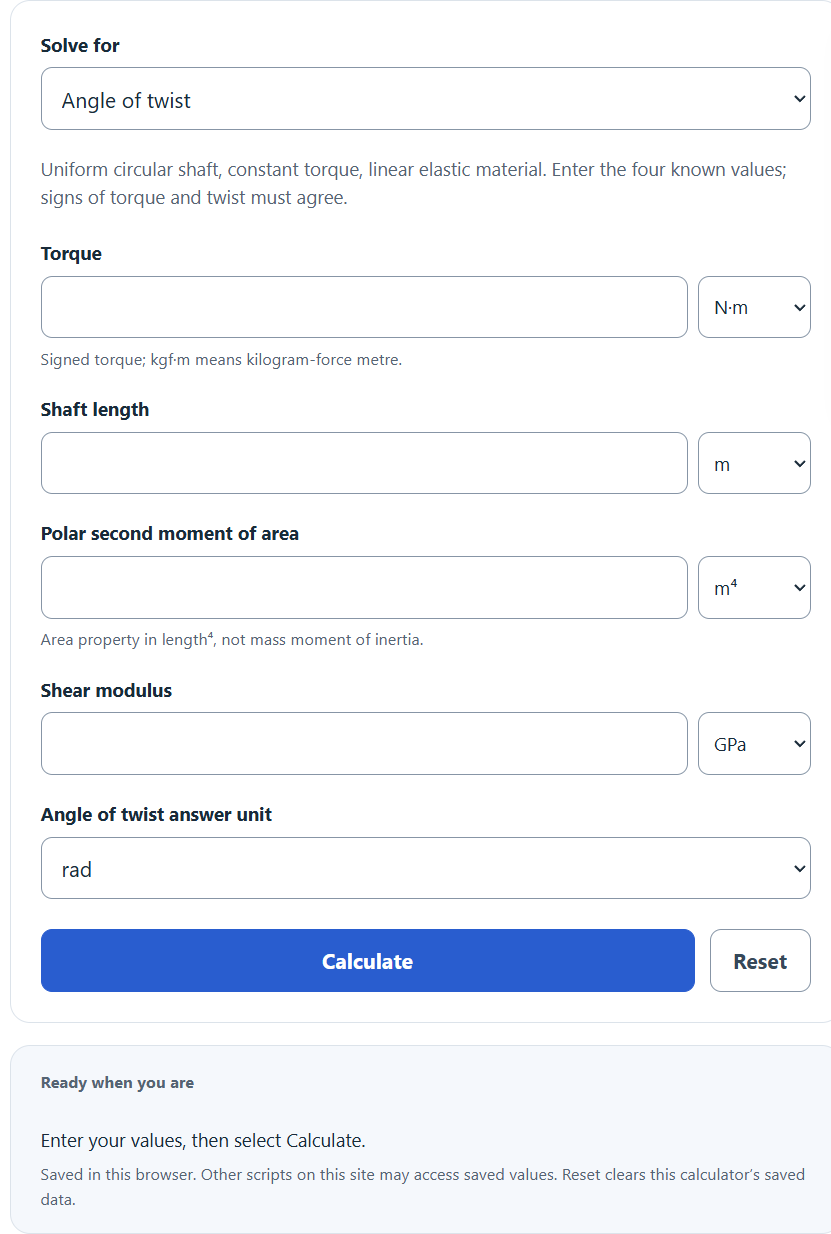
Calculate angle of twist, torque, shaft length, polar second moment of area, or shear modulus from the other four values.
- All Physics Calculators
- Torque Calculator
- Shaft Torque Calculator
- St. Venant Torsional Constant Calculator
- Moment of Force Calculator
- Torque to Force Calculator
Angle of Twist Formula
The angle of twist for a uniform circular shaft under constant torque in linear elastic torsion is calculated from torque, shaft length, polar second moment of area, and shear modulus. This estimate does not check strength, yielding or fatigue.
Rearranged forms:
- θ = angle of twist, usually in radians
- T = applied torque
- L = shaft length
- J = polar moment of inertia of the shaft cross-section
- G = shear modulus of the shaft material
Choose the unknown under Solve for, enter the four visible known values and select Calculate. The calculator converts all units to consistent SI values before solving. Length, polar moment and shear modulus must be positive; signed torque and twist must agree. Zero torque and zero twist do not determine an unknown shaft property.
For consistent engineering units, use torque in N·m, length in m, polar moment in m4, and shear modulus in Pa. The resulting angle is in radians, which can be converted to degrees using:
Common Shear Modulus Values
These are approximate reference ranges, not material specifications. Use the measured or specified shear modulus for the particular alloy, heat treatment and temperature.
| Material | Typical shear modulus | Approximate value in Pa |
|---|---|---|
| Steel | 77 to 82 GPa | 7.7 × 10¹⁰ to 8.2 × 10¹⁰ Pa |
| Aluminum | 25 to 28 GPa | 2.5 × 10¹⁰ to 2.8 × 10¹⁰ Pa |
| Titanium | 40 to 45 GPa | 4.0 × 10¹⁰ to 4.5 × 10¹⁰ Pa |
| Brass | 35 to 40 GPa | 3.5 × 10¹⁰ to 4.0 × 10¹⁰ Pa |
Example Problems
Example 1: Calculate angle of twist
A steel shaft has an applied torque of 500 N·m, a length of 2 m, a polar moment of inertia of 1.2 × 10⁻⁶ m4, and a shear modulus of 79 GPa.
The angle of twist is about 0.01055 rad, or 0.604 degrees.
Example 2: Calculate required torque
A shaft twists 0.02 rad over a length of 1.5 m. Its polar moment of inertia is 2.0 × 10⁻⁶ m4, and its shear modulus is 80 GPa.
The required torque is about 2133 N·m.
FAQ
What does angle of twist mean?
Angle of twist is the amount a shaft rotates because of applied torque. One end of the shaft rotates relative to the other end. It is usually measured in radians, but it is often reported in degrees for easier interpretation.
Why does a longer shaft twist more?
Angle of twist is directly proportional to length. If torque, material, and cross-section stay the same, doubling the shaft length doubles the angle of twist.
What is the difference between polar moment of inertia and shear modulus?
Polar moment of inertia describes the torsional stiffness of the shaft shape and size. A larger shaft diameter usually gives a much larger polar moment of inertia. Shear modulus describes the stiffness of the material itself. Steel has a higher shear modulus than aluminum, so a steel shaft usually twists less than an aluminum shaft with the same dimensions and torque.