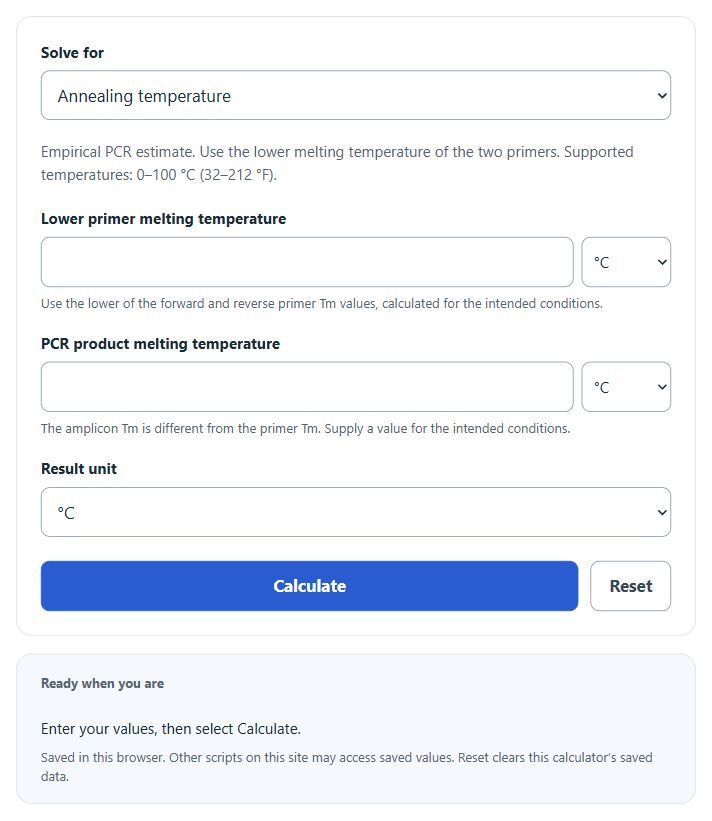
Select Solve for, enter the two temperatures in °C or °F, and select Calculate. This empirical PCR equation estimates annealing temperature or algebraically solves for a melting temperature; it does not calculate melting temperature from a DNA sequence.
- All Chemistry Calculators
- Boiling Point Calculator (Water)
- Specific Humidity Calculator
- Freezing Point Calculator
- Ice Melting Time Calculator
Annealing Temperature Formula
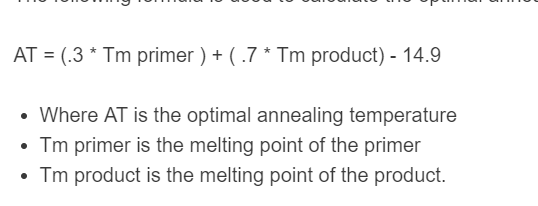
Use the lower of the two primer melting temperatures. The relationship is documented by MacVector, citing Rychlik, Spencer and Rhoads (1990).
The annealing temperature calculator uses an empirical PCR annealing temperature equation that combines the primer melting temperature and the PCR product, or amplicon, melting temperature. The constant 14.9 is based on temperatures in degrees Celsius, so Fahrenheit inputs are converted to Celsius before the formula is applied.
To calculate the primer melting temperature instead:
To calculate the PCR product melting temperature instead:
- Ta = annealing temperature
- Tm(primer) = lower melting temperature of the forward and reverse primers
- Tm(product) = melting temperature of the PCR product, also called the amplicon
- 14.9 = empirical temperature adjustment used by this equation, in degrees Celsius
If you enter the primer melting temperature and the PCR product melting temperature, the calculator finds the annealing temperature. If you enter the annealing temperature and one melting temperature, it rearranges the same equation to solve for the missing melting temperature. Inputs can be entered in °C or °F, but the calculation is performed in °C and then converted back to the selected output unit.
Typical PCR Temperature Ranges
These ranges are general reference values, not validation limits or recommendations for every reaction. Actual PCR conditions vary by polymerase, buffer chemistry, primer design, target sequence, and cycling protocol. The calculator supports inputs and results from 0 to 100 °C; that numerical scope does not establish the empirical equation’s validity for a particular reaction.
| PCR value | Common range | Notes |
|---|---|---|
| Primer Tm | 50 to 65 °C | Forward and reverse primers are usually designed with similar melting temperatures. |
| Annealing temperature | 50 to 65 °C | Often optimized by gradient PCR if nonspecific bands or weak amplification occur. |
| Amplicon Tm | Depends on length and GC content | Longer and GC-rich products usually have higher melting temperatures. |
Annealing Temperature Examples
Example 1: Calculate annealing temperature
Suppose the primer melting temperature is 60 °C and the PCR product melting temperature is 75 °C.
The estimated annealing temperature is 55.60 °C.
Example 2: Calculate primer melting temperature
Suppose the annealing temperature is 58 °C and the PCR product melting temperature is 78 °C.
The lower primer melting temperature implied by the equation is 61.00 °C; this is not a measured or sequence-derived Tm.
Annealing Temperature FAQ
What is annealing temperature in PCR?
Annealing temperature is the temperature during PCR where primers bind to the template DNA. If the temperature is too low, primers may bind nonspecifically. If it is too high, primers may not bind efficiently, which can reduce or prevent amplification.
Should the annealing temperature be lower than the primer Tm?
In many PCR setups, the annealing temperature is set a few degrees below the primer melting temperature. This calculator uses a formula that also includes the PCR product melting temperature, so the result may not equal a simple fixed offset below primer Tm.
What should you do if the calculated annealing temperature does not work well?
Follow the polymerase manufacturer’s protocol and validate conditions experimentally; this equation does not account for polymerase, buffer or reagent concentrations. See NEB’s annealing-temperature guidance. If amplification is weak, you may test slightly lower annealing temperatures. If nonspecific products appear, you may test slightly higher annealing temperatures. A gradient PCR is a common way to test several annealing temperatures in one run.