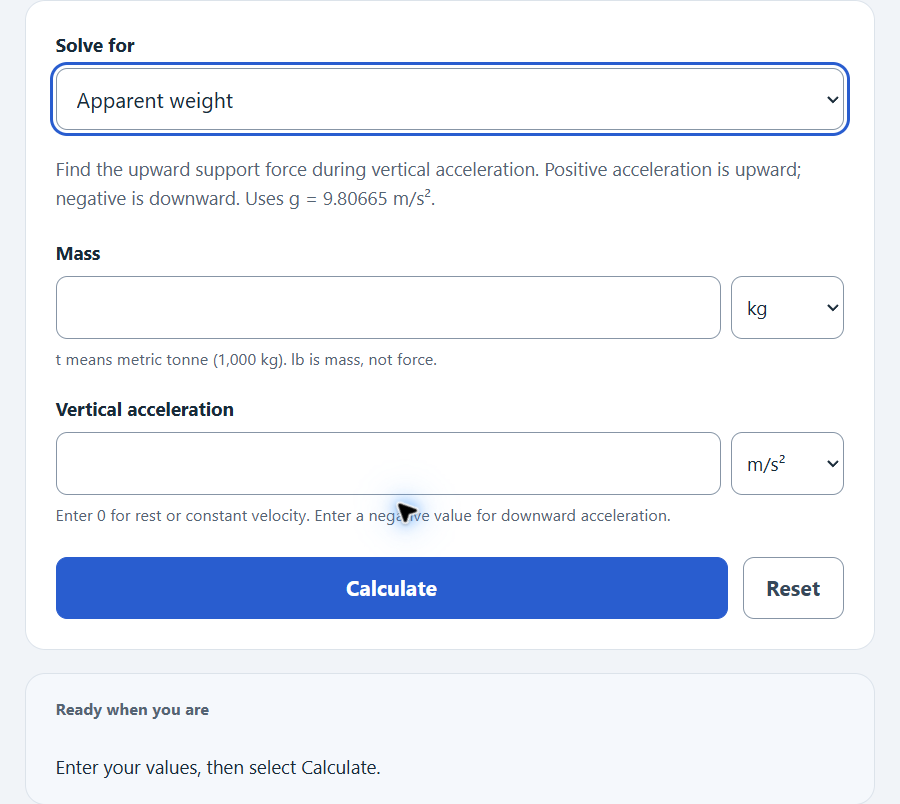
Calculate apparent weight from mass and acceleration, or solve for mass or acceleration using units like kg, lb, g, m/s², lbF, kgf, and N.
- All Physics Calculators
- Mass to Weight Calculator
- Power to Weight Ratio Calculator
- Weight to Mass Calculator
- Weight to Force Calculator
- Net Force Calculator
- Acceleration Calculator
Apparent Weight Formula
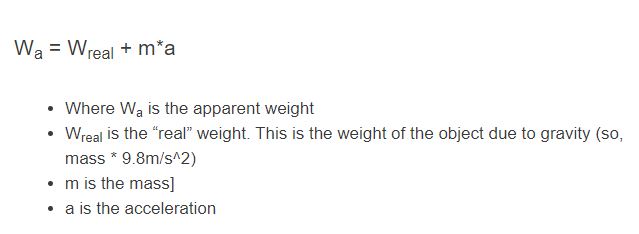
The apparent weight calculation is based on the force a scale or support would read when an object is accelerating vertically. The calculator uses standard SI base units internally: kilograms for mass, meters per second squared for acceleration, and newtons for apparent weight.
- W = apparent weight, in newtons (N)
- m = mass, in kilograms (kg)
- g = acceleration due to gravity, 9.80665 m/s²
- a = signed vertical acceleration, in m/s², positive upward
When apparent weight is missing, the calculator uses:
When mass is missing, the calculator rearranges the formula as:
When acceleration is missing, the calculator rearranges the formula as:
Select Apparent weight, Mass, or Vertical acceleration under Solve for. Mass units are kg, lb, g, or metric tonnes (t); acceleration units are m/s², ft/s², or g. Force inputs use N, lbf, kgf, or US short ton-force. Results show the alternate units. Positive acceleration is upward and negative is downward.
Common Gravity and Force Unit Values
These values are useful when checking the size of your result or converting between common units.
| Quantity | Value | Meaning |
|---|---|---|
| Standard gravity | 9.80665 m/s² | The value of g used in the calculator |
| 1 g acceleration | 9.80665 m/s² | Acceleration equal to standard gravity |
| 1 ft/s² | 0.3048 m/s² | Acceleration conversion |
| Force Unit | Equivalent in Newtons |
|---|---|
| 1 lbF | 4.4482216152605 N |
| 1 kgf | 9.80665 N |
| 1 US short ton-force | 8896.443230521 N |
Examples
Example 1: Find apparent weight
Suppose an object has a mass of 70 kg and accelerates upward at 2 m/s².
The apparent weight is about 826.47 N.
Example 2: Find acceleration
Suppose an object has a mass of 50 kg and an apparent weight of 600 N.
The acceleration is about 2.19 m/s².
FAQ
What is apparent weight?
Apparent weight is the force that a scale, floor, cable, or other support exerts on an object. It is not always the same as normal weight. If you are accelerating upward, apparent weight increases. If you are accelerating downward, apparent weight decreases.
Why does the formula use g plus acceleration?
The formula uses g + a because the calculator treats the entered acceleration as part of the vertical acceleration affecting the support force. A positive acceleration increases apparent weight. A negative acceleration reduces apparent weight.
Can apparent weight be zero?
Yes. Apparent weight becomes zero when the downward acceleration equals gravity, such as in free fall. In the formula, that means a = -9.80665 m/s², so g + a = 0. Zero force at free fall cannot determine a unique mass. Accelerations below this boundary require a different contact or restraint model and are rejected.