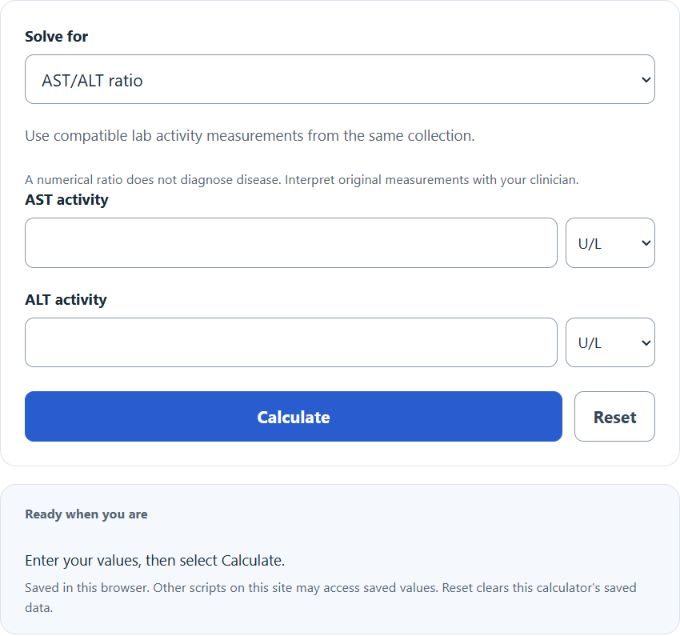
Calculate the AST-to-ALT activity ratio or reverse-solve one enzyme value after normalizing compatible activity units.
Related Liver & Gastrointestinal Calculators
- ALT/LDH Ratio Calculator
- Child-Pugh Score Calculator
- Albumin/Globulin (A/G) Ratio Calculator
- Lille Score Calculator
- Maddrey Score Calculator
- All Liver & Gastrointestinal Calculators
Adjacent Calculators
- Hemolysis Index Calculator — Review specimen hemolysis separately because it can elevate AST and confound interpretation; the hemolysis index neither calculates nor diagnoses from AST/ALT.
- AUDIT-C Alcohol Screening Calculator — Screen alcohol-use patterns separately; AUDIT-C does not diagnose alcohol-associated liver disease, establish causation, or replace AST/ALT interpretation.
AST/ALT Ratio Formula
The AST/ALT ratio, also called the De Ritis ratio, compares the catalytic activity of aspartate aminotransferase (AST) with alanine aminotransferase (ALT). The calculator first expresses both activities in equivalent units and then uses:
The equation can be rearranged to check an implied enzyme activity:
Variables:
- AST/ALT Ratio is the unitless result after unit normalization.
- AST is the reported aspartate aminotransferase activity.
- ALT is the reported alanine aminotransferase activity.
U/L and IU/L are treated as equivalent activity labels in this calculator. For µkat/L, 1 µkat/L equals 60 U/L. Unlike a simple same-unit ratio tool, this calculator allows AST and ALT to use different supported units because it normalizes them before division.
What Is the AST/ALT Ratio?
The AST/ALT ratio describes which enzyme activity is numerically larger and by how much. A ratio above 1 means AST is numerically higher than ALT after unit normalization; a ratio below 1 means ALT is higher; and a ratio of 1 means the two activities are equal. Those statements are arithmetic descriptions, not disease categories.
AST and ALT are commonly discussed together during evaluation of abnormal liver chemistries, but they do not have identical tissue distributions. AST activity can reflect liver, skeletal muscle, cardiac, and other tissue sources. ALT is more closely associated with liver injury but is still not a direct measurement of liver functional capacity. The original enzyme values, not only their quotient, are therefore essential.
For example, AST of 40 U/L and ALT of 20 U/L produce the same ratio as AST of 400 U/L and ALT of 200 U/L. The ratio is 2 in both cases, but the magnitude of the measured activities is very different. A ratio cannot show whether either result is inside the reporting laboratory’s reference interval.
How to Use the AST/ALT Ratio Calculator
- Select whether to calculate the AST/ALT ratio, reverse-solve AST activity, or reverse-solve ALT activity.
- Choose the unit reported for AST and the unit reported for ALT. The two menus may differ.
- Enter every visible value as a positive, finite number. ALT and the ratio must remain above zero because each can appear in a denominator.
- Select Calculate. The result shows the activities in the selected units and the normalized ratio.
- Read the result as numerical predominance only. Use the original values, local reference intervals, timing, symptoms, history, and other tests for clinical interpretation.
Worked Examples
Example 1: Calculate a Same-Unit Ratio
Suppose AST is 72 U/L and ALT is 48 U/L.
The result is 1.5, meaning AST is numerically 1.5 times ALT for this measurement pair. The calculator does not attach a diagnosis to that number.
Example 2: Normalize Different Units
Suppose AST is 1.2 µkat/L and ALT is 48 U/L. Convert AST before dividing:
The normalized result is again 1.5. Dividing 1.2 directly by 48 would be incorrect because the units are not equivalent.
Example 3: Reverse-Solve AST
For an arithmetic check, a ratio of 1.5 and ALT of 48 U/L imply:
A reverse-solved activity is not a laboratory measurement and should not be substituted for one in clinical care.
Research Context and Interpretation Limits
De Ritis, Coltorti, and Giusti first described the relationship between serum transaminase activities in work published in 1957. Later studies evaluated the ratio in particular liver-disease cohorts. In a 1988 biopsy study of 177 people with nonalcoholic chronic liver disease, Williams and Hoofnagle found that the ratio was associated with cirrhosis in that population, but they also warned that cirrhosis made simple etiologic separation less reliable.
That history explains why the ratio may appear in clinical discussions, but it does not create one universal diagnostic cutoff. Reviews of the De Ritis ratio note that simplified rules can fail because the result changes with disease stage, timing, enzyme kinetics, and assay method. Current evaluation of abnormal AST and ALT considers the degree and pattern of elevation, alkaline phosphatase and bilirubin, medication and supplement use, alcohol history, metabolic risk, viral testing when appropriate, symptoms, and examination.
The calculator intentionally reports only whether AST or ALT is numerically predominant. It does not classify alcohol-associated hepatitis, fibrosis, cirrhosis, viral hepatitis, muscle injury, ischemic injury, or another condition. A clinical criterion that includes an AST/ALT relationship also requires its other specified findings and exclusion of competing causes.
Factors That Can Change or Confound the Ratio
- Absolute enzyme activities: the same ratio can accompany very different AST and ALT values.
- Timing: values drawn at different stages of an illness or recovery are not interchangeable.
- Reference intervals and assay methods: upper limits and measurement procedures vary among laboratories.
- Non-liver sources: AST can rise with skeletal-muscle or other tissue injury, so numerical AST predominance is not automatically hepatic.
- Specimen hemolysis: hemolysis can interfere with AST and other analytes, including LDH. Review laboratory flags before interpreting a surprising result.
- Clinical context: medications, supplements, alcohol exposure, metabolic conditions, infection risks, symptoms, and other laboratory findings can change the appropriate evaluation.
Frequently Asked Questions
Does a ratio above or below 1 diagnose a condition?
No. It tells you only which normalized enzyme activity is numerically higher. Many hepatic and nonhepatic situations can produce either pattern, and a person may have clinically important disease with a ratio on either side of 1.
Is AST/ALT the same as ALT/AST?
No. They are reciprocals. If AST/ALT is 2, ALT/AST is 0.5. Confirm the order used by a paper, calculator, or laboratory before comparing results.
Can I calculate the ratio when AST and ALT use different units?
Yes, if the units are converted correctly. This calculator normalizes U/L, IU/L, and µkat/L. It does not make two results comparable if they came from incompatible measurement procedures or different collection times.
Does a normal AST or ALT rule out liver disease?
No. The ACG abnormal-liver-chemistries guideline notes that a normal ALT may not exclude significant liver disease. Interpretation depends on the entire clinical assessment, not one enzyme or ratio.
Does the ratio measure liver function?
No. AST and ALT are better described as liver chemistries associated with cellular injury. The AST/ALT ratio does not directly measure synthetic or excretory function and cannot replace a clinician’s interpretation of bilirubin, coagulation, albumin, symptoms, and examination.
Primary Sources and Clinical Guidance
- De Ritis F, Coltorti M, Giusti G. An enzymic test for the diagnosis of viral hepatitis: the transaminase serum activities. Historical republication of the 1957 article.
- Williams AL, Hoofnagle JH. Ratio of serum aspartate to alanine aminotransferase in chronic hepatitis: relationship to cirrhosis. Gastroenterology. 1988.
- Botros M, Sikaris KA. The De Ritis ratio: the test of time. Clin Biochem Rev. 2013.
- Kwo PY, Cohen SM, Lim JK. ACG Clinical Guideline: Evaluation of Abnormal Liver Chemistries. Am J Gastroenterol. 2017.
- Jophlin LL, et al. ACG Clinical Guideline: Alcohol-Associated Liver Disease. Am J Gastroenterol. 2024.
- BIPM. Resolution 12 of the 21st CGPM: the katal and the enzyme-activity unit.