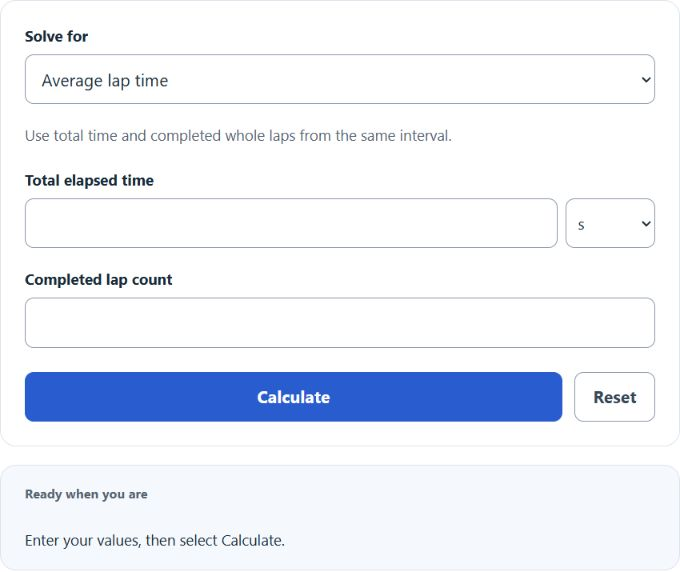
Calculate an average lap time, total elapsed time, or equivalent lap count from the other two values.
Average Lap Time Formula
Average lap time = total elapsed time ÷ lap count
Use a Matching Time and Lap Count
The elapsed time and lap count must describe the same start and finish. Ten completed laps in 900 seconds average 90 seconds per lap, displayed as 1:30.000. If a timing record includes the standing start, a stopped period, or time in the pits, the resulting average includes that time. For an average of flying laps only, use the total and count from those flying laps.
Solve for Total Time or Laps
Total time equals average lap time multiplied by the number of laps. At 92.5 seconds per lap, 12 laps take 1,110 seconds, or 18:30.000. Equivalent lap count equals total elapsed time divided by average lap time. A 1,000-second interval at a 90-second average equals 11.1111 laps. The result retains the fraction and separately reports 11 complete laps at that assumed average. It does not assert that a timing system recorded a partial lap.
Clock Format and Unit Selection
Numeric time inputs accept seconds, minutes, or hours using the adjacent selector. Enter 1.5 and choose Minutes to represent 90 seconds. These fields do not accept a colon. The answer uses minutes:seconds.milliseconds, adding an hours field when needed. Very small or large durations are shown in seconds. Values are converted before arithmetic and rounded for display only. A result of 1:00.000 is 60 seconds, not one hundred seconds. The supporting output also reports average lap time in decimal seconds.
Averages across Sessions
To combine sessions, add their elapsed times and lap counts, then divide the combined time by the combined laps. Do not average two session averages unless both sessions contain the same number of laps. For example, two laps averaging 80 seconds and eight laps averaging 100 seconds give (160 + 800) ÷ 10 = 96 seconds per lap. The simple average of 80 and 100 would incorrectly give each session equal weight.
Interpreting Differences
A mean describes total time per lap and does not show how spread out the individual laps were. Ten identical 90-second laps and five 80-second laps plus five 100-second laps both average 90 seconds. Use individual recorded laps when assessing variability. Entered lap counts must be whole numbers from 1 to 10,000,000, while a solved count may be fractional. All input times must be positive. Comparisons assume the same course configuration and a consistent treatment of incomplete, pit, and stopped laps.
Reference Table
| Input | Calculation | Result |
|---|---|---|
| 900 s, 10 laps | 900 ÷ 10 | 90 s per lap |
| 92.5 s per lap, 12 laps | 92.5 × 12 | 18 min 30 s |
| 1,000 s, 90 s per lap | 1,000 ÷ 90 | 11.1111 equivalent laps |
| 160 s / 2 laps + 800 s / 8 laps | 960 ÷ 10 | 96 s combined average |