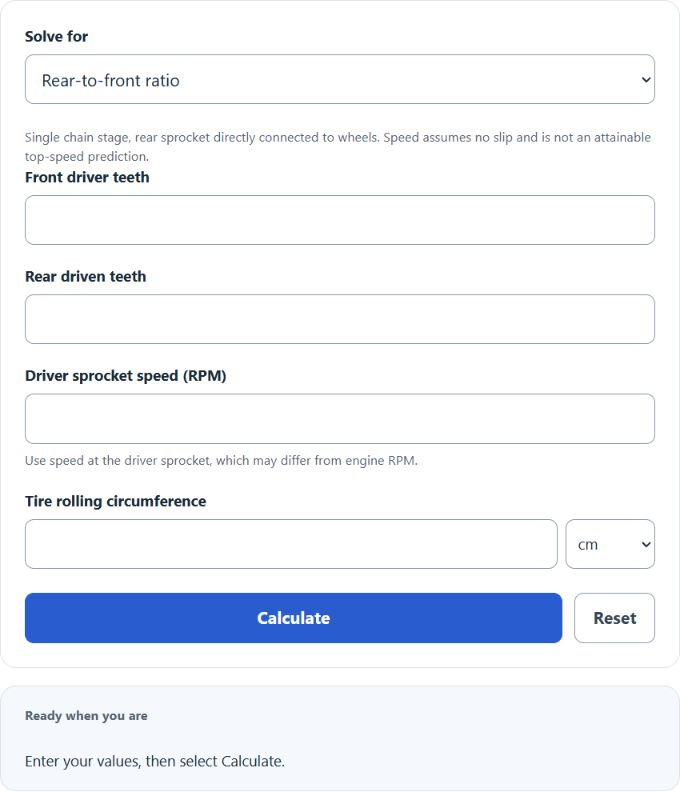
Calculate a kart sprocket ratio or ideal tooth count and compare wheel speed, theoretical vehicle speed, and rollout.
Kart Sprocket Ratio Formula
Reduction ratio = rear driven teeth ÷ front driver teeth; wheel RPM = driver sprocket RPM ÷ ratio
Define the Driver and Driven Sprockets
The front sprocket drives the chain and the rear sprocket turns the axle. A 12-tooth driver and 72-tooth rear sprocket produce a 6:1 reduction: the driver makes six turns for one axle turn. This convention is rear teeth divided by front teeth. Reversing that fraction gives the reciprocal and reverses the meaning. The calculation assumes a single chain stage and direct connection between the driven sprocket and wheels.
Solve for Teeth
Ideal rear teeth equal target ratio multiplied by front teeth. Ideal front teeth equal rear teeth divided by target ratio. A 6.2 target with a 12-tooth front requires 74.4 ideal rear teeth. Since a sprocket needs whole teeth, the calculator also evaluates the neighboring counts. A 74-tooth rear gives 6.1667:1, approximately 0.538% below the target; 75 teeth gives 6.25:1, approximately 0.806% above. These are arithmetic comparisons, not a catalog or fitment check.
Wheel Speed and Rollout
With 6,000 driver-sprocket revolutions per minute and a 6:1 ratio, wheel speed is 1,000 revolutions per minute. An 85-centimeter rolling circumference gives 850 meters per minute, or 51 kilometers per hour. Rollout per driver revolution is circumference divided by ratio: 85 ÷ 6 = 14.1667 centimeters. The circumference should describe distance traveled in one wheel revolution. It is not tire diameter.
Changing the Ratio
Increasing rear teeth or reducing front teeth increases the reduction ratio. At unchanged driver RPM and tire circumference, wheel RPM and geometric speed decrease. Theoretical speed is inversely proportional to the ratio. The reference table holds all other inputs fixed so this effect can be compared directly. Acceleration and achievable engine speed require information about torque, load, grip, and losses that is not included here.
Use the Correct RPM and Tire Measurement
The RPM input is at the driver sprocket. It can differ from engine RPM when there is an intermediate gearbox, belt drive, clutch slip, or another reduction. The calculation assumes no tire slip, no clutch slip, and constant rolling circumference. It does not identify the attainable top speed, recommend a sprocket for a specific track, or establish chain clearance. Enter source tooth counts as whole numbers from 2 to 500. Zero RPM is allowed and produces zero speed. Fractional solved tooth counts remain visible so rounding does not conceal the target error.
Reference Table
| Front / rear teeth | Ratio | Wheel RPM | Theoretical speed |
|---|---|---|---|
| 12 / 60 | 5:1 | 1,200 | 61.2 km/h |
| 12 / 66 | 5.5:1 | 1,090.909 | 55.636 km/h |
| 12 / 72 | 6:1 | 1,000 | 51 km/h |
| 12 / 78 | 6.5:1 | 923.077 | 47.077 km/h |
Sources
KHK Gears, Technical Reference, gear-ratio and rotational-speed relationships, accessed 2026. Single-stage sprocket and rollout examples use the stated tooth counts and tire circumference.