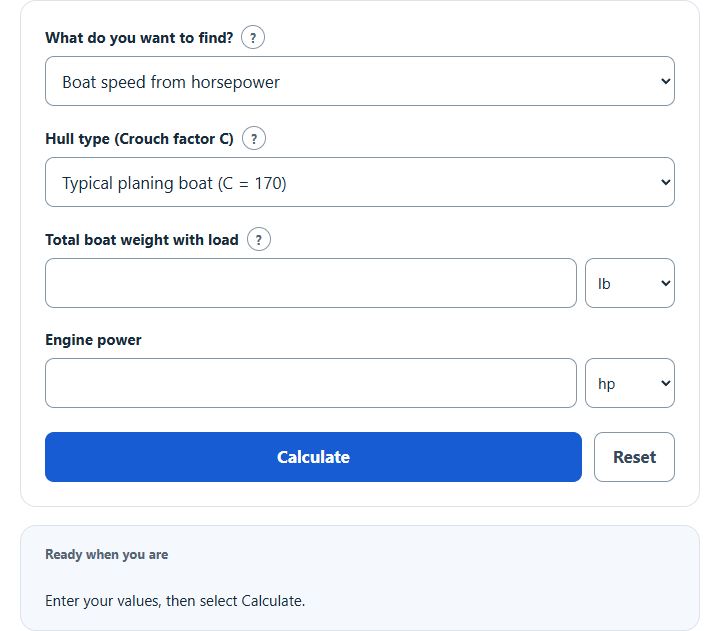
Estimate planing-boat speed from horsepower, loaded weight, and a Crouch hull factor, or calculate horsepower needed for a target speed.
Related Calculators
- Displacement to Length Ratio Calculator
- Hull Speed Calculator
- Propeller Slip Calculator
- Propeller Pitch Speed Calculator
- Boat Fuel Consumption Calculator
- Boat Travel Time Calculator
- All Physics Calculators
Calculator Functions
| Function | What it does | What it requires |
|---|---|---|
| Boat speed from horsepower | Estimates the top speed of a planing boat | Requires the hull type, the total boat weight with load and the engine power |
| Horsepower needed for a target speed | Estimates the engine power a planing boat needs to reach a speed | Requires the hull type, the total boat weight with load and the target speed |
Hull type sets the Crouch factor C, from 150 for a heavy cruiser to 225 for a high-performance hull, or a custom factor up to 400. Weight can be entered in pounds or kilograms, power in hp or kW, and target speed in mph, knots or km/h. Speed results are shown in mph, knots and km/h with the weight per horsepower.
Boat HP to Speed Formulas
| V | Top speed (mph) |
| C | Crouch hull factor for mph, hp and lb |
| P | Engine power (hp) |
| W | Total boat weight with motor, fuel, people and gear (lb) |
This is Crouch’s formula for planing boats. It rests on the observation that, for one hull, resistance per unit of weight rises roughly in step with speed over a useful speed range [1].
| Hull type in the calculator | Crouch factor C |
|---|---|
| Heavy cruiser | 150 |
| Typical planing boat | 170 |
| Average runabout | 180 |
| Performance hull | 200 |
| High-performance hull | 225 |
Boat speed from horsepower
The formula above applies directly. A 3,000 lb loaded boat with 200 hp and C = 170 gives 170 × √(200 ÷ 3,000) = 43.9 mph, which is 38.1 knots or 70.6 km/h. Power in kW is divided by 0.7457 to get hp, and weight in kilograms is multiplied by 2.20462 to get pounds [2].
Horsepower needed for a target speed
The same 3,000 lb boat needs 3,000 × (40 ÷ 170)² = 166.1 hp to reach 40 mph. A target in knots is multiplied by 1.150779 to get mph first, and a target in km/h is divided by 1.609344 [2].
Limits of This Estimate
- Crouch’s formula is a quick preliminary estimate for planing boats, not a substitute for a full performance calculation [1]. It does not apply to displacement hulls.
- C is not a physical constant. Its value depends on the units, the hull type, the drive and even the engine mounting height, and it tends to be higher for longer hulls [1]. The hull factors in the table are rules of thumb for mph, hp and lb. These estimates are based on the best available data and estimations.
- The most reliable C comes from a similar boat with a known speed: C = V × √(W ÷ P) [1]. Enter it as the custom factor.
- Weight must be the full weight on the water, including fuel, crew and gear. Outboards are usually rated at the propeller, while inboard ratings are at the flywheel and lose a few percent in the drive train [1]. Propeller, trim and sea state also change the real speed.
Sources
- Lorne Campbell, The Crouch Formula: Quick Preliminary Performance Estimates for Fast Planing Craft, High Speed Boat Operations Forum 2016: formula, its basis, what changes C and its limits
- NIST, Special Publication 811, Appendix B.8: horsepower, pound, knot and mile per hour conversion factors