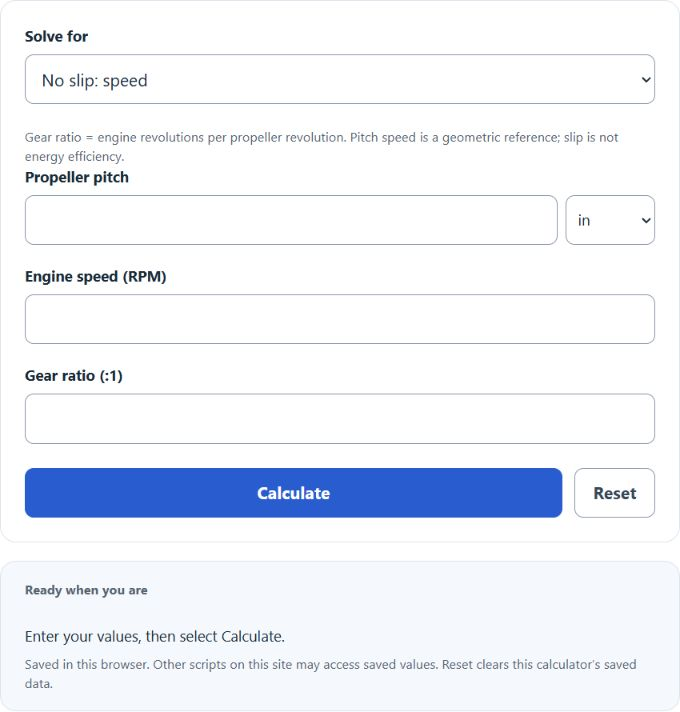
Calculate boat propeller pitch speed from prop pitch, engine RPM and gear ratio, or work out prop slip, the pitch or RPM needed for a speed, or gear ratio.
- Propeller Angle Calculator
- Propeller Slip Calculator
- Propeller Thrust Calculator
- Propeller Torque Calculator
- Propeller Advance Ratio Calculator
- Boat HP to Speed Calculator
- Hull Speed Calculator
- All Physics Calculators
Calculator Functions
| Function | What it does | What it requires |
|---|---|---|
| No slip: speed | Finds the theoretical speed of a propeller that advances its full pitch every turn | Requires the propeller pitch, the engine speed in RPM and the gear ratio |
| No slip: pitch | Finds the pitch that gives a speed with no slip | Requires the speed, the engine speed in RPM and the gear ratio |
| No slip: engine RPM | Finds the engine speed that gives a speed with no slip | Requires the speed, the propeller pitch and the gear ratio |
| No slip: gear ratio | Finds the gear ratio that gives a speed with no slip | Requires the speed, the propeller pitch and the engine speed in RPM |
| With slip: actual speed | Estimates boat speed after slip is taken off | Requires the propeller pitch, the engine speed in RPM, the gear ratio and the slip as a percentage |
| With slip: pitch | Finds the pitch needed to reach a speed at a known slip | Requires the speed, the engine speed in RPM, the gear ratio and the slip as a percentage |
| With slip: engine RPM | Finds the engine speed needed to reach a speed at a known slip | Requires the speed, the propeller pitch, the gear ratio and the slip as a percentage |
| With slip: gear ratio | Finds the gear ratio needed to reach a speed at a known slip | Requires the speed, the propeller pitch, the engine speed in RPM and the slip as a percentage |
| Apparent slip | Finds the slip from a measured speed | Requires the measured speed, the propeller pitch, the engine speed in RPM and the gear ratio |
Pitch can be entered in inches, centimeters or meters, and speed in knots, mph, km/h or m/s. The gear ratio is engine revolutions per propeller revolution, with 1.36, 1.50, 1.62, 1.75 and 2.00 offered as suggestions. Speed answers are given in knots, mph, km/h and m/s, along with the propeller shaft speed.
Propeller Pitch Speed Formulas
| v | Theoretical pitch speed (m/s when P is in meters) |
| P | Propeller pitch, the distance the propeller would advance in one turn with no slip |
| RPM | Engine speed (revolutions per minute) |
| G | Gear ratio, engine revolutions per propeller revolution |
Engine RPM ÷ G is the propeller speed, and dividing by 60 turns minutes into seconds. One inch is 0.0254 m, one knot is 0.5144444 m/s and one mph is 0.44704 m/s [2]. With pitch in inches, the same formula in mph is pitch × RPM ÷ (G × 1,056), because a mile is 63,360 inches and 63,360 ÷ 60 = 1,056.
No slip: speed
The formula above applies directly. A 15-inch pitch at 5,000 RPM through a 2.5:1 gear turns the propeller at 2,000 RPM and gives 0.381 × 5,000 ÷ (60 × 2.5) = 12.70 m/s, which is 24.69 knots or 28.41 mph.
No slip: pitch
Reaching 30 knots (15.433 m/s) at 5,000 RPM with a 2:1 gear needs a pitch of 60 × 2 × 15.433 ÷ 5,000 = 0.3704 m, or 14.58 inches.
No slip: engine RPM
A 19-inch pitch (0.4826 m) with a 1.75:1 gear reaches 40 mph (17.8816 m/s) at 60 × 1.75 × 17.8816 ÷ 0.4826 = 3,891 RPM.
No slip: gear ratio
A 21-inch pitch (0.5334 m) at 5,500 RPM matches 45 mph (20.1168 m/s) with a gear ratio of 0.5334 × 5,500 ÷ (60 × 20.1168) = 2.43:1.
With slip: actual speed
÷ (60 × G)
S is the slip as a percentage. The 15-inch example above with 10% slip gives 12.70 × 0.90 = 11.43 m/s, or 22.22 knots.
With slip: pitch
[RPM × (1 − S ÷ 100)]
Slip raises the pitch needed. Thirty knots at 5,000 RPM with a 2:1 gear and 10% slip takes 16.20 inches of pitch, up from 14.58 inches with no slip.
With slip: engine RPM
[P × (1 − S ÷ 100)]
The 19-inch, 1.75:1 setup needs 4,421 RPM for 40 mph once 12% slip is allowed for.
With slip: gear ratio
÷ (60 × v)
With 10% slip, the 21-inch pitch at 5,500 RPM matches 45 mph at a gear ratio of 2.19:1.
Apparent slip
Slip compares the measured speed with the theoretical pitch speed [1]. A boat doing 22 knots on the 15-inch example has a slip of (1 − 22 ÷ 24.69) × 100 = 10.9%. Most setups run between 5 and 20%, and a negative result usually means the gear ratio, pitch or tachometer reading is wrong [1].
Limits of This Estimate
- Pitch speed is a geometric reference. Real speed depends on the hull, load, propeller design and water conditions.
- Slip is not a measure of propeller efficiency [1]. A propeller with no slip would produce no thrust.
- Speed and RPM must come from the same moment, with speed from GPS. Current, a worn or re-pitched propeller and tachometer error all shift the result.
- The speed formula is the geometry of pitch and shaft speed. These estimates are based on the best available data and estimations.
Sources
- Mercury Racing, Prop Slip Calculator: what slip is, the usual 5 to 20% range and what a negative result means
- NIST Special Publication 811, Guide for the Use of the SI, Appendix B.8: inch, mile per hour and knot in SI units