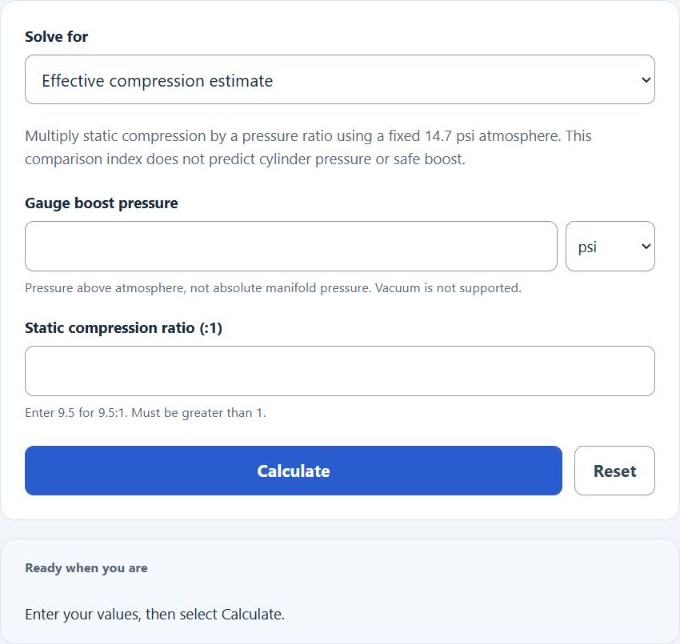
Estimate a pressure-scaled compression comparison index, solve for gauge boost, or infer static compression ratio. Boost units include psi, bar, kPa, and atm. This simplified index does not predict cylinder pressure or safe operating limits.
Related Calculators
- Bore To Stroke Ratio Calculator
- Drivetrain Loss Calculator
- WHP to HP (BHP/Crank HP) Calculator
- Engine kW to Wheel kW Calculator
- All Automotive Calculators
Boost / Compression Ratio Formula
The calculator uses a fixed approximate sea-level atmospheric pressure of 14.7 psi as the reference pressure. If you enter boost in bar, kPa, or atm, the boost value is first converted to psi for the compression ratio formula.
- ECR = effective compression estimate (a pressure-scaled comparison index)
- SCR = static compression ratio
- B_psi = gauge boost pressure in psi above atmosphere
- 14.7 = approximate sea-level atmospheric pressure in psi
Effective compression estimate mode: enter boost and static compression ratio to estimate the effective compression ratio under boost.
Boost for a target estimate mode: enter static compression ratio and a target effective compression ratio to find the gauge boost pressure that gives that target in this formula. The target must be at least the static ratio; vacuum is not supported.
Static Compression Ratio mode: enter boost and a target effective compression ratio to estimate the static compression ratio that would produce that target in this formula. The inferred static ratio must exceed 1:1.
Boost Unit Conversion Factors
These rounded conversion factors summarize the conversions. The calculator retains more precision internally.
| Unit | To psi | From psi |
|---|---|---|
| psi | 1 | 1 |
| bar | 14.5038 | 0.0689476 |
| kPa | 0.145038 | 6.89476 |
| atm | 14.6959 | 0.0680459 |
Illustrative Comparison Index Bands
| Effective Compression Ratio | Interpretation Limit |
|---|---|
| Under 12:1 | An index below 12 does not establish safe boost or knock resistance. |
| 12:1 to 16:1 | This index band alone does not identify suitable fuel, parts, or tuning. |
| 16:1 to 20:1 | A larger index is not a prediction of cylinder pressure. |
| Over 20:1 | No universal operating recommendation follows from this index. |
Example Problems
Example 1: Find effective compression ratio
You have 10 psi of boost and a 9.5:1 static compression ratio.
The effective compression ratio is about 15.96:1.
Example 2: Find required boost
You have an 8.5:1 static compression ratio and want a 15:1 effective compression ratio.
The required boost is about 11.24 psi.
FAQ
Is effective compression ratio the same as actual cylinder pressure?
No. Effective compression ratio is a simplified estimate that combines static compression ratio and boost pressure. Actual cylinder pressure also depends on cam timing, volumetric efficiency, intake temperature, intercooling, exhaust backpressure, altitude, fuel, ignition timing, and engine speed.
Why does the formula use 14.7 psi?
The formula uses a fixed approximate sea-level reference of 14.7 psi. It does not correct for altitude. At the same gauge boost, lower local atmospheric pressure gives a larger actual pressure ratio than this fixed-reference calculation.
Can a higher static compression ratio use less boost for the same effective compression ratio?
Yes. For the same target effective compression ratio, a higher static compression ratio needs less boost. A lower static compression ratio needs more boost to reach the same target. This does not mean both setups behave the same, since combustion efficiency, knock resistance, turbo response, and tuning can differ.