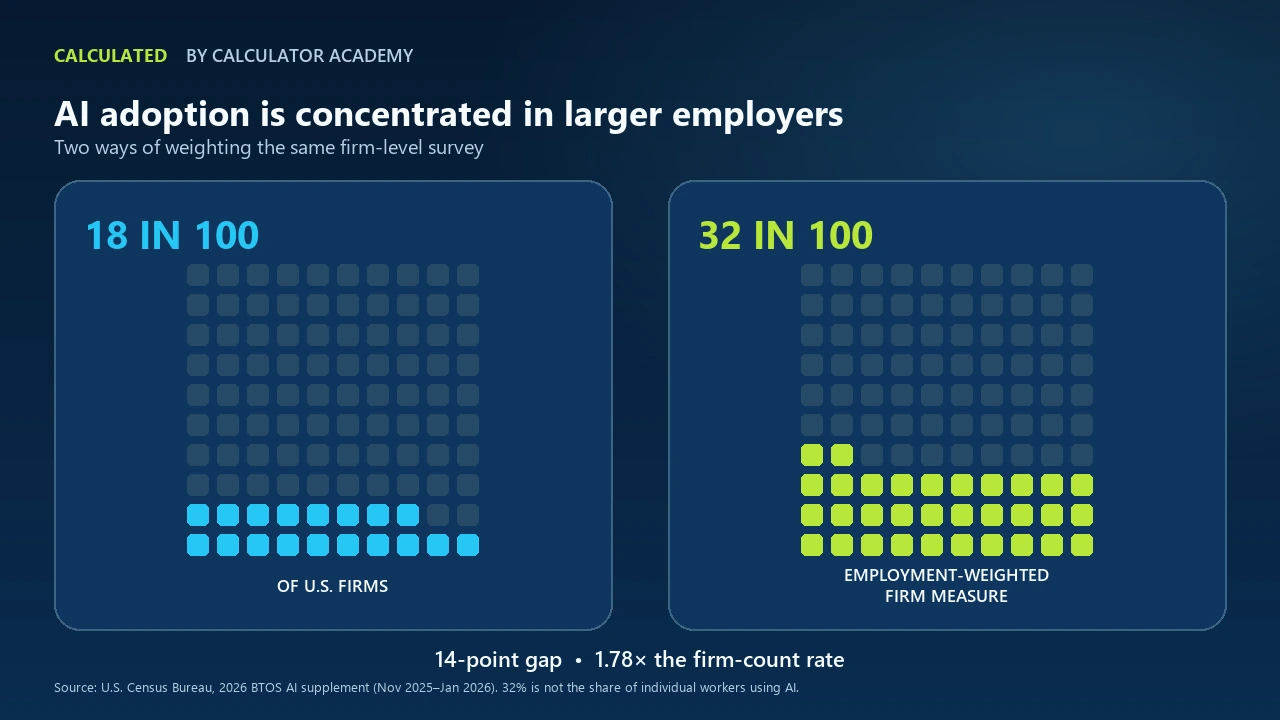
18% of U.S. firms use AI—but they employ 32% of workers
New Census data show why the denominator matters: fewer than one in five firms reported using AI, while nearly one-third of employment was at those businesses.
By Patrick MyersPublished Data as of January 31, 2026The Number Behind the News
Firm-count and employment-weighted estimates tell different stories about where business AI adoption is concentrated. Source: U.S. Census Bureau, 2026 BTOS AI supplement.Related calculations
Put the numbers to work
Explore calculators related to this story, or browse the full topic collection.
The lead visual places two groups of 100 units side by side. Eighteen business icons are highlighted in the firm-count view. Thirty-two person-shaped units are highlighted in the employment-weighted view. A 14-percentage-point arrow and 1.78-times label connect the measures, with a note that employment-weighted does not mean every worker personally uses AI.
Context
Why this matters
A single adoption percentage can hide where a technology is concentrated. Counting firms says AI use is still a minority behavior; weighting those same firms by employment shows that adopting businesses account for a much larger share of the workforce. That does not mean every worker at those firms personally uses AI.
At a glance
What the numbers show
AI use was reported by 18% of firms, but the rate was 32% when firms were weighted by employment—a 14-point gap and 1.78× ratio.
Among adopters, 57% used AI in three or fewer business functions; Sales and Marketing was most common at 52%.
Firms expected adoption to reach 22% within six months, four percentage points above the 18% current-use measure.
Watch the data story
See why AI adoption changes when employment is counted
AI adoption remains a minority by firm count, but it is concentrated in larger employers. Census measured 18% of firms reporting AI use versus a 32% employment-weighted firm measure. The 32% figure is not the share of individual workers using AI.
AI adoption looks different when you count firms and when you weight those firms by employment.
Eighteen in one hundred U.S. firms reported using AI in a business function.
The employment-weighted firm measure was thirty-two in one hundred.
That is a fourteen-point gap, or one point seven eight times the firm-count rate.
Among adopters, AI appeared most often in Sales and Marketing at fifty-two percent, Strategy and Business Development at forty-five percent, and IT at forty-one percent.
The thirty-two percent figure is not the share of individual workers who personally use AI. It shows that adoption is concentrated in larger employers.
Explore the numbers at Calculator Academy.
Artificial intelligence is not yet used by most U.S. businesses. In the Census Bureau’s 2026 Business Trends and Outlook Survey AI supplement, 18% of firms reported using AI in a business function during the prior two weeks.
But the same result changes when each business is weighted by the number of people it employs. On that basis, firms using AI represented 32% of employment. The gap is 14 percentage points, and the employment-weighted rate is 1.78 times the firm-count rate. That is evidence that adoption is concentrated among larger employers—not that 32% of individual workers personally use AI.
Most adopters still use AI narrowly
Adoption is not the same as organization-wide integration. Among firms that reported using AI, 57% used it in three or fewer of the 15 business functions measured by the supplement. The complement—43%—used it in four or more.
Among AI adopters, 57% used the technology in no more than three business functions. Sales and Marketing was the most common measured function.
Sales and Marketing led at 52% of adopting firms, followed by Strategy and Business Development at 45% and Information Technology at 41%. These categories overlap: one business can report AI use in several functions, so the percentages should not be added together.
Four similar-sounding measures answer different questions
The supplement also found worker-task AI use at 23% of firms, or 41% when weighted by employment. This is a firm respondent’s report that workers used AI for tasks supporting business functions; it is not a direct survey of individual employees. The paper explicitly warns against reading it as the percentage of workers who personally use AI.
Current use, expected use and worker-task use are separate measures with different denominators and reference periods.
Respondents expected firm adoption to reach 22% within six months. That is four percentage points above the 18% current-use rate, or a 22.2% relative increase. It is best treated as reported intent, not as a Census forecast of what adoption will actually become.
What this does—and does not—show
The Census results make the concentration of adoption visible, but they do not establish that AI caused higher productivity, growth or employment changes. Firms choose whether and how to adopt the technology, and those choices differ by size and industry. The survey covers U.S. employer businesses outside farming and relies on self-reported responses.
There is also a break in the historical series: in November 2025, Census changed the core question from AI used in producing goods or services to AI used in any business function. For that reason, this story treats the 2026 supplement as a cross-section and does not splice it into a continuous trend with earlier adoption estimates.
Make the numbers yours
Change the inputs with a related Calculator Academy tool or inspect the underlying data.
We transcribed the national estimates published in Census working paper CES-26-25 for the November 2025–January 2026 supplement reference period. Original calculations subtract 18 from 32 for the 14-percentage-point weighting gap; divide 32 by 18 for the 1.78× ratio; divide that gap by 18 for the 77.8% relative difference; subtract 18 from 22 for the four-point expected-use gap; and subtract 57 from 100 for the 43% complement using four or more functions. Values are descriptive and use the published rounded estimates.
Assumptions and limitations
The 32% employment-weighted result is the share of employment at firms reporting AI use, not the share of individual workers personally using AI. BTOS covers employer businesses excluding farms, and responses are self-reported. The current-use question refers to the prior two weeks, while expected use is respondent intent rather than a forecast. Business-function percentages among adopters can overlap. Census revised the core AI question in November 2025, so these estimates should not be joined into a continuous trend with earlier figures. The data describe adoption and do not prove that AI caused productivity or employment changes.