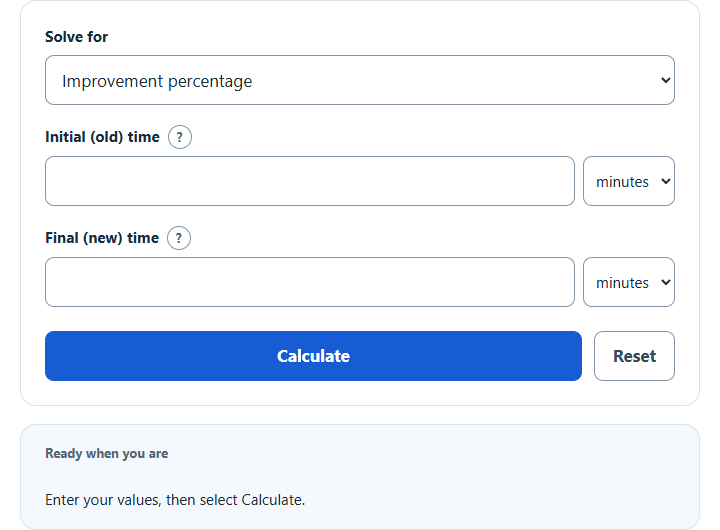
Calculate time improvement percentage, time saved, initial time, or final time from two known values in hours, minutes, or seconds.
Related Calculators
- Improvement Percentage Calculator
- Time Per Test Question Calculator
- Fold Decrease Calculator
- Average Rate Calculator
- All Math and Numbers Calculators
Calculator Functions
| Function | What it does | What it requires |
|---|---|---|
| Improvement percentage | Finds the percentage of time saved between an old time and a new time | Requires the initial (old) time and the final (new) time |
| Final time from improvement % | Finds the new time after a percentage improvement | Requires the initial (old) time and the improvement percentage |
| Initial time from improvement % | Finds the old time that a percentage improvement started from | Requires the final (new) time and the improvement percentage |
Times go in as a number of seconds, minutes or hours, or as a clock time such as 5:30 (minutes and seconds) or 1:05:30 (hours, minutes and seconds). Every result also lists the time saved, the speed-up factor and the speed (rate) increase. A negative improvement means the new time is longer than the old one.
Time Improvement Formulas
| I | Time improvement (percent less time) |
| IT | Initial (old) time |
| FT | Final (new) time for the same task or distance, in the same unit as IT |
Improvement percentage
The formula above applies directly. A lap that drops from 50 seconds to 45 seconds improves by (50 − 45) ÷ 50 × 100 = 10%. A run that drops from 5:30 to 4:57 is 330 seconds to 297 seconds, also 10%. A task cut from 4 hours to 30 minutes improves by (240 − 30) ÷ 240 × 100 = 87.5%, saving 3:30:00.
Final time from improvement %
A 2 hour task done in 30% less time takes 2 × (1 − 0.30) = 1.4 hours, which is 1:24:00. The improvement must be below 100%, because a 100% improvement would mean no time at all.
Initial time from improvement %
A 45 second time that came from a 10% improvement started at 45 ÷ 0.90 = 50 seconds.
Less time versus faster
The speed (rate) increase is (IT ÷ FT − 1) × 100, the percentage more work done per unit of time. It is not the same number as the time improvement. Cutting 4 hours to 30 minutes is 87.5% less time, an 8× speed-up and a 700% increase in rate. Going the other way, a rate that is 30% faster divides the time by 1.30, so a 2 hour task takes 2 ÷ 1.30 = 1.54 hours. That is 23.08% less time, not 30% less.
Limits of This Estimate
- Both times must be for the same task or distance. Comparing a 5 km time with a 10 km time does not measure improvement.
- A clock time with two parts is read as minutes and seconds, so 5:30 means five and a half minutes, not five and a half hours.