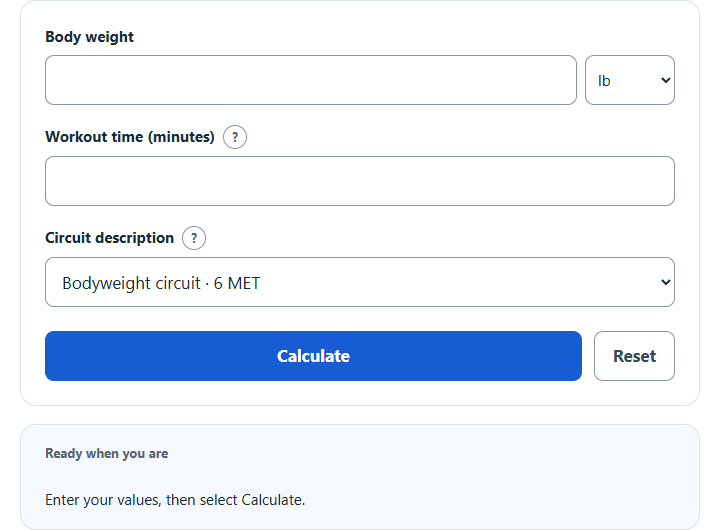
Estimate calories burned in a calisthenics circuit of push-ups, squats, burpees or jumping jacks from your body weight, workout time and intensity.
Calisthenics Circuit Calories Burned Formula
The calculator uses MET values from the 2024 Adult Compendium and the standard approximation of 1 MET = 1 kcal/kg/hour:
- C = estimated total energy in kcal, including resting energy
- BWkg = body weight in kilograms
- t = workout time in minutes
- MET = activity intensity: bodyweight circuit 6.0, light circuit 3.5, moderate circuit 5.0, vigorous calisthenics 7.5, or vigorous HIIT 11.0. HIIT describes vigorous burpees, mountain climbers, squat jumps or Tabata.
The default is bodyweight circuit at 6 MET. Choose another activity in Circuit description. The previous unsourced pace factors have been replaced with these activity-specific MET values.
Calories Burned per 10 Minutes
These rounded estimates use the same activity MET values as the calculator. They describe average adult activity costs, not guaranteed individual burn.
| Body Weight | Bodyweight circuit | Light circuit | Moderate circuit | Vigorous calisthenics | Vigorous HIIT |
|---|---|---|---|---|---|
| 130 lb | 59 kcal | 34 kcal | 49 kcal | 74 kcal | 108 kcal |
| 155 lb | 70 kcal | 41 kcal | 59 kcal | 88 kcal | 129 kcal |
| 185 lb | 84 kcal | 49 kcal | 70 kcal | 105 kcal | 154 kcal |
What Is a Calisthenics Circuit?
A calisthenics circuit rotates through bodyweight exercises with limited rest. Common movements include push-ups, air squats, lunges, sit-ups, mountain climbers, jumping jacks, burpees, planks, and pull-ups. Because multiple muscle groups work back to back, circuit training can drive up calorie burn quickly.
Example Calculation
A 155-lb person weighs approximately 70.3 kg. For a 25-minute bodyweight circuit at 6 MET:
The model estimates about 175.8 kcal in total, including about 146.5 kcal above resting expenditure. Actual effort and rest breaks vary. The Adult Compendium targets ages 19–59 and is not an individual measurement.
What Raises Calorie Burn in a Circuit?
- More full-body movements like burpees, jump squats, and mountain climbers
- Shorter rest periods between exercises
- Longer continuous rounds
- Faster pace and higher total reps
- Higher body weight