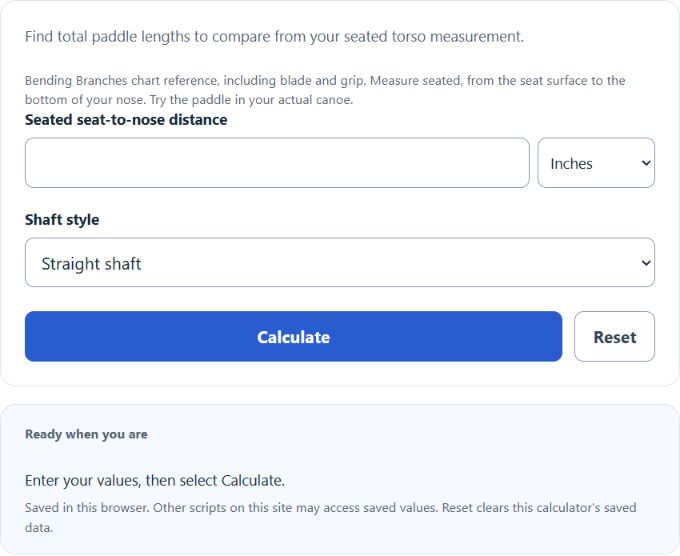
Find straight or bent canoe paddle lengths from a seated torso measurement and compare nearby chart sizes.
Canoe Paddle Sizing from Torso Length
Use the published seat-to-nose torso chart. Between listed measurements, this calculator shows the two adjacent chart lengths to try; that trial range is a calculator interpretation rather than a manufacturer-specified interpolation rule.
Measure the Correct Torso Distance
Sit upright on a flat chair. Measure from the seat surface between your legs to the bottom of your nose. Enter that seated distance in inches or centimeters. Standing height, inseam, shoulder height, and the distance from seat to the top of your head describe different measurements and should not be substituted. A second person can help keep the tape vertical and read the endpoints consistently.
Straight and Bent Shaft Charts
The Bending Branches 2025 chart provides straight-shaft sizes for torso measurements from 26 through 38 inches, and bent-shaft sizes from 26 through 34 inches. The listed straight sizes run from 52 to 64 inches. The bent sizes run from 48 to 56 inches. Blank bent-shaft cells at larger torso measurements are not zero-length paddles and are not permission to extrapolate the pattern.
How Intermediate Measurements Work
At a listed torso value, the calculator returns its exact listed paddle length. Between two points, it returns both neighboring lengths as a trial range. For example, a 31-inch torso lies between the 30- and 32-inch rows, giving 56–58 inches for a straight paddle or 52–54 inches for a bent paddle. It does not assert that a 57-inch straight paddle is manufactured or necessarily the best fit.
Worked Example in Two Units
A seated torso of 81.28 cm equals 32 inches because 81.28 ÷ 2.54 = 32. The straight-shaft chart returns 58 inches, or 147.32 cm. Selecting bent shaft with the same torso measurement returns 54 inches, or 137.16 cm. The different recommendation reflects the shaft-style chart, not a unit-conversion discrepancy.
Total Length Versus Shaft Length
These values refer to total paddle length, including the blade and grip. A paddle with a longer blade can leave less shaft above the water than another paddle with the same total length. Check the throat, where blade and shaft meet, in the intended canoe. Blade shape, seating, and paddling position matter alongside a chart number.
Choosing the Paddle to Try
The chart is a starting point for general paddling fit. Low seats or a narrow canoe may favor a shorter shaft; high seats or a wide, flared canoe may require more reach. Straight and bent paddles also suit different stroke preferences. Try the actual paddle and canoe combination when possible, especially if your measurement is between sizes or near the end of the published range.
Unsupported Measurements and Rounding
The tool rejects torso values outside the selected shaft-style chart instead of extending its arithmetic. A valid 36-inch torso can therefore return a straight-shaft result but has no bent-shaft recommendation from this source. The comparison row says so explicitly. Input conversion preserves fractional measurements; display rounding does not move a measurement to a different chart point. Reset clears the previous result when you want to measure another paddler.
Reference Table
| Seat-to-nose torso (in) | Straight paddle (in) | Bent paddle (in) |
|---|---|---|
| 26 | 52 | 48 |
| 28 | 54 | 50 |
| 30 | 56 | 52 |
| 32 | 58 | 54 |
| 34 | 60 | 56 |
| 36 | 62 | — |
| 38 | 64 | — |
Sources
Bending Branches, Canoe Paddle Sizing Guide (updated September 2026; originally 2021) and 2025 Canoe Sizing Chart.