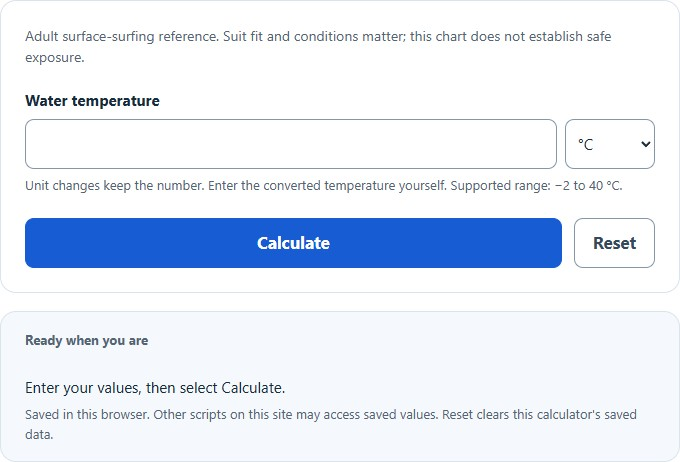
Find an adult surfing wetsuit thickness reference from water temperature, with Celsius and Fahrenheit inputs.
Wetsuit Thickness by Water Temperature
Convert °F to °C with (°F − 32) × 5/9, then look up the temperature band.
How the Lookup Works
This calculator uses a temperature chart rather than an equation that predicts body warmth. Choose the unit and enter a measured or reported water temperature. Changing the unit leaves the entered number unchanged; enter the converted quantity yourself. The result identifies the matching adult surface-surfing band. It also shows the temperature in both units, so you can compare a local forecast with a suit label or another chart without treating a Fahrenheit number as Celsius.
Understanding 3/2 and 4/3 Labels
Two-number thickness labels describe neoprene thickness at different parts of the suit. In a 3/2 mm suit, the torso is generally 3 mm and the limbs 2 mm. The smaller limb thickness permits movement. A displayed 3/2–4/3 mm range means compare those two suit constructions; it is not a decimal thickness or a request to add the numbers together. A UV top in the warmest band is a clothing reference, not equivalent thermal protection to a neoprene suit.
Temperature Boundaries
The original manufacturer guide lists whole-degree Celsius ranges. This tool extends each band continuously up to, but excluding, the next starting temperature: for example, 12°C through just below 18°C. Exactly 18°C enters the next band. The calculation compares the entered decimal and exact unit conversion before rounding the displayed number. A value extremely close to a boundary may display as that boundary to two decimals while retaining its original band. Below 4°C the tool assigns no automatic thickness range.
Worked Conversion Example
Water reported at 59°F converts to (59 − 32) × 5/9 = 15°C. That matches the 12°C to below 18°C band and returns 3/2–4/3 mm. Water at 64.4°F is exactly 18°C and returns the 2 mm reference. Converting units does not change the recommendation for the same physical temperature.
Choosing Within a Range
Fit, seams, lining, suit condition, wind, air temperature, session length, and individual cold response can affect the choice. Compare the specific manufacturer’s product guidance and check that the suit fits without large gaps that admit water. Accessories and the entire exposure system matter in cold conditions. This lookup does not select a size, calculate how long someone can remain immersed, or decide whether a surf session is appropriate.
Use in Paddling and Other Water Sports
The lookup is scoped to adult surface surfing. Paddling and sailing can involve prolonged unexpected immersion, different movement demands, and different protective clothing. Diving requires a separate equipment assessment. Competition wetsuit rules concern permitted equipment and may use other temperature thresholds; this comfort chart does not establish triathlon eligibility.
Cold-Water Limitations
Warm air can coexist with dangerous cold water. Sudden immersion can impair breathing and movement before someone expects hypothermia, so a thickness result is not a safety clearance. Plan for the actual water conditions, appropriate flotation, communication, and the possibility of immersion. Local conditions or personal circumstances can justify staying out of the water. Consult the relevant manufacturer and local water-safety guidance for the intended activity.
Reference Table
| Water temperature | Chart reference | Reading the result |
|---|---|---|
| Below 4°C | No automatic range | Specialist setup assessment |
| 4 to <8°C | 5/4–6/5 mm | Compare cold-water full suits |
| 8 to <12°C | 4/3–5/4 mm | Compare full suits |
| 12 to <18°C | 3/2–4/3 mm | Compare the two thickness options |
| 18 to <21°C | 2 mm | Light-suit reference |
| 21 to <26°C | 1 mm | Warm-water reference |
| 26°C and above | UV top / light suit | Not a safe-exposure threshold |
Sources
O’Neill UK, What Thickness Wetsuit Do I Need at Which Water Temperature?, 2022. National Weather Service, Cold Water Hazards and Safety, accessed 2026.