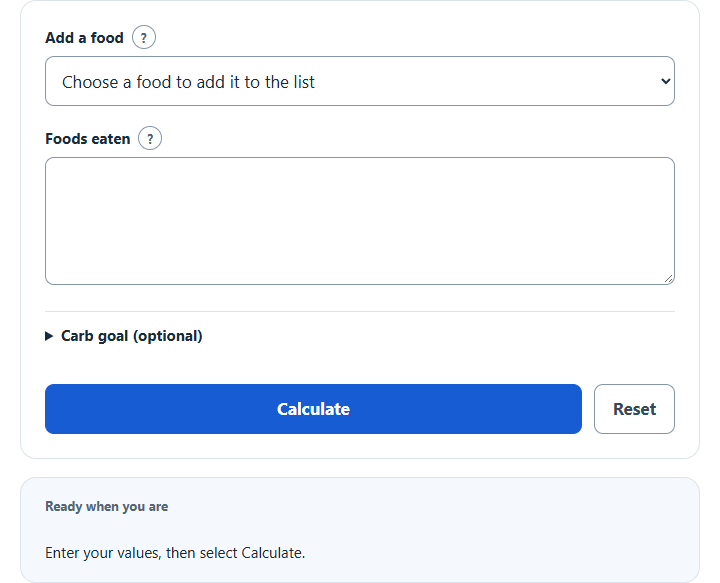
Count the carbs in a meal or a day: pick foods from a list of USDA servings or type in label values to get total carbs, fiber, net carbs and carb servings.
- All Food and Cooking Calculators
- Net Carbs Calculator
- Carbs Calculator (Carbohydrates per Day)
- Carb to Insulin Ratio Calculator
- Carbohydrate To Fiber Ratio Calculator
- Macro Calculator
Calculator Functions
The carb counter adds up the carbohydrate in the foods you list for a meal or a whole day. It shows total carbs, fiber, net carbs and the number of 15-gram carb servings.
| Function | Use it when | You enter |
|---|---|---|
| Foods from the list | You ate common foods in everyday servings | Each food, picked under Add a food, and the number of servings |
| Foods from a label | A packaged food or recipe isn’t on the list | A line such as 1 x granola bar = 23 g carbs, 4 g fiber |
| Carb goal | You’re tracking a target for the meal or the day | Your goal in grams, in the optional section |
Picking a food adds one serving of it to the list. Change the number at the start of a line for more or fewer servings, so 2 x means two servings and 0.5 x means half. To work out how many carbs to eat in a day, use the Carbs Calculator. For a label with sugar alcohols, use the Net Carbs Calculator.
Carb Counting Formulas
| C | Total carbohydrate, grams |
| S | Servings of a food |
| c | Carbohydrate in one serving of that food, grams |
| F | Total fiber, grams: servings × fiber per serving, added over the foods |
| N | Net carbs, grams |
| CS | Carb servings of 15 grams |
Take a breakfast of two slices of whole wheat bread, a banana, a cup of 2% milk and a tablespoon of jam. The carbs are 2 × 13 + 28 + 12 + 14 = 80 g. The fiber is 2 × 1.9 + 2.8 + 0 + 0.2 = 6.8 g, so net carbs are 80 − 6.8 = 73.2 g. For diabetes meal planning one carb serving is about 15 grams of carbs [2], which makes this breakfast 80 ÷ 15 = 5.3 carb servings.
Carbs in common foods
| Food and serving | Carbs | Fiber |
|---|---|---|
| White bread, 1 slice | 12 g | 0.6 g |
| Whole wheat bread, 1 slice | 13 g | 1.9 g |
| White rice, cooked, 1 cup | 45 g | 0.6 g |
| Spaghetti, cooked, 1 cup | 40 g | 2.4 g |
| Oatmeal, cooked, 1 cup | 25 g | 4.0 g |
| Apple, 1 medium | 21 g | 3.7 g |
| Banana, 1 medium | 28 g | 2.8 g |
| Orange juice, 1 cup | 26 g | 0.5 g |
| Baked potato with skin | 51 g | 4.8 g |
| Black beans, cooked, 1 cup | 41 g | 15.0 g |
| Milk, 2%, 1 cup | 12 g | 0 g |
| Cola, 12 fl oz | 38 g | 0 g |
| Cheese pizza, 1 slice | 21 g | Not listed |
The food list holds 60 foods, each with the carbohydrate and total dietary fiber in an ordinary household serving, taken from the U.S. Department of Agriculture’s Nutritive Value of Foods [1]. The table shows a sample of them. The USDA figures are averages for each kind of food, with carbohydrate rounded to the whole gram.
Net carbs and fiber
Carbohydrate comes as sugars, starches and fiber. Sugars and starches raise blood sugar, but fiber doesn’t [2]. Net carbs here are the total carbs minus the fiber. On packaged foods the total carb grams are on the Nutrition Facts label [2], so a label food goes into the list as its carbs and fiber per serving.
Limits of This Estimate
- The listed values are averages for typical foods. Brands, recipes and ripeness change them, and the serving on your plate may be larger or smaller than the one listed. A label or a kitchen scale is more exact.
- The USDA table gives no fiber figure for cheese pizza [1], so its net carbs are counted the same as its total carbs.
- Sugar alcohols and other sweeteners are not subtracted. The total is arithmetic for tracking and does not replace advice from your diabetes care team about what to eat or how to dose insulin.
Sources
- U.S. Department of Agriculture, Agricultural Research Service, Nutritive Value of Foods (Home and Garden Bulletin 72, 2002): the carbohydrate and total dietary fiber in a household serving of each food on the list
- Centers for Disease Control and Prevention, Carb Counting: the 15-gram carb serving, the three types of carbs, and that fiber doesn’t raise blood sugar