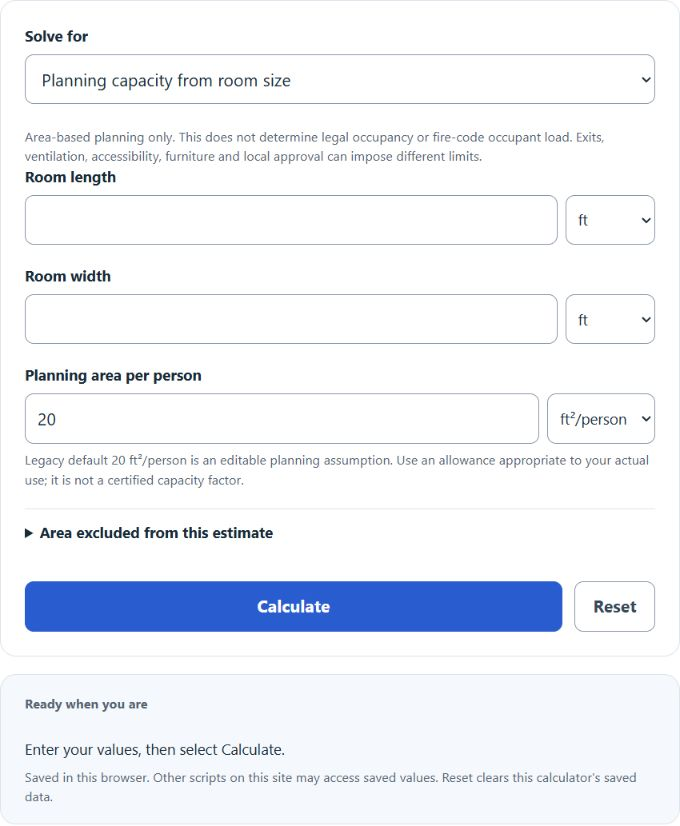
Estimate an area-based classroom planning capacity from room dimensions and an editable area allowance, or find required net floor area. This does not establish legal or safe occupancy.
Related Calculators
- Seating Capacity Calculator
- Hall Capacity Calculator
- Room Volume Calculator
- Ceiling Height Clearance Calculator
- All Construction Calculators
Classroom Occupancy Formula
The following relationship gives an area-based planning ratio; the calculator rounds capacity down to whole people.
- Where O is the area-based planning count (whole people)
- A is the net planning area: room length × width minus any excluded area (sq ft or sq m)
- RA is the selected planning area allowance per person (sq ft/person or sq m/person)
For this planning estimate, divide net area by the entered area allowance and round down to whole people. Required net area is occupants × allowance. Code occupant load is a different calculation: use the locally adopted requirements and authority approval, including the correct area basis, factor and rounding.
What is Classroom Occupancy?
Definition:
Classroom occupancy describes the people using a classroom. This calculator estimates only space allocation. It does not assess exit capacity, fire safety, ventilation, accessibility or compliance; the permitted limit must be established separately.
How to Calculate Classroom Occupancy?
Example Problem:
The following example outlines the steps and information needed to calculate the Classroom Occupancy.
First, determine the net planning area. A 20 ft by 25 ft rectangular room with no excluded area has 500 sq ft.
Next, choose the planning allowance. This example assumes 25 sq ft per person; it is not a universal or legally approved factor.
Finally, calculate the occupancy using the formula above:
O = floor(A / RA)
O = 500 / 25
O = 20 people
FAQ
What factors can affect the recommended classroom occupancy?
Recommended occupancy can be influenced by local building codes, the amount of space needed for equipment or materials, the type of seating (e.g., desks vs. tables), and any distancing guidelines that may be in place. Ventilation, exits, and pathways also play a critical role in determining safe occupancy levels.
How can I ensure compliance with classroom occupancy limits?
To ensure compliance, always follow local fire and safety regulations, perform regular inspections, and keep layouts unobstructed. Label room capacity clearly, and adjust seating or furniture arrangements as needed to maintain safe pathways and avoid overcrowding.
Can classroom occupancy limits change depending on the activity?
Yes, classroom occupancy limits can vary based on the type of activity. Rooms used for labs or physical activities may require additional space for equipment or movement, thus lowering the occupant capacity. Always factor in the specific needs of each activity when determining safe occupancy.