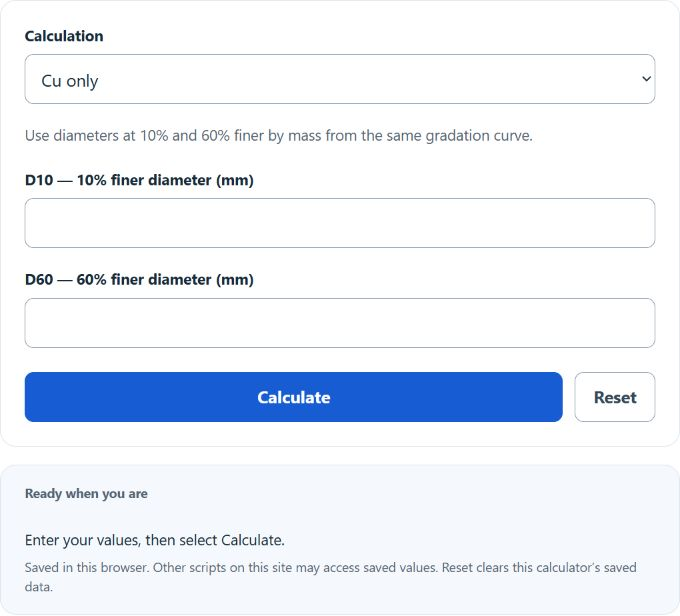
Calculate Cu from D60 and D10, or add D30 for Cc and a limited clean-sand or clean-gravel gradation check. D values come from the same percent-finer-by-mass curve.
Related Calculators
- Degree of Saturation Calculator
- Active Earth Pressure Calculator
- Coefficient Of Variation Calculator
- Ground Temperature Calculator
- Kirpich Equation Calculator
- All Construction Calculators
Coefficient Of Uniformity Formula
The following formula is used to calculate the coefficient of uniformity for a given set of diameters.
Variables:
- CU is the coefficient of uniformity
- D60 is the diameter at 60% finer by mass on the cumulative gradation curve
- D10 is the diameter at 10% finer by mass on the same cumulative gradation curve
Divide D60 by D10 using consistent diameter units. For the full check, Cc = D30² / (D10 × D60). The gradation criteria are Cu ≥ 4 for clean gravel or Cu ≥ 6 for clean sand, together with 1 ≤ Cc ≤ 3. This check assumes less than 5% fines by mass and an independently established sand/gravel category; it does not perform complete USCS identification. See USACE gradation definitions.
What is the Coefficient Of Uniformity?
The coefficient of uniformity (CU) is a measure used in soil mechanics and sedimentology to describe the uniformity of particle sizes in a given sample. It is calculated as the ratio of the diameter at the 60th percentile (D60) to the diameter at the 10th percentile (D10). A higher CU value indicates a wider range of particle sizes, while a lower CU value indicates a more uniform particle size distribution. Cu is one gradation measure. Cu alone cannot establish well-graded soil, construction suitability, slope stability or embankment safety; those assessments require additional soil data and engineering analysis.
How to Calculate Coefficient Of Uniformity?
The following steps outline how to calculate the Coefficient Of Uniformity.
- First, read D60 at 60% finer by mass on the cumulative gradation curve.
- Next, read D10 at 10% finer by mass on the same curve, using the same diameter units.
- Next, calculate the coefficient of uniformity using the formula CU = D60 / D10.
- For the example below, Cu = 0.6 / 0.2 = 3. This ratio alone does not classify the soil.
- After inserting the values and calculating the result, check your answer with the calculator above.
Example Problem :
Use the following variables as an example problem to test your knowledge.
Diameter at 60th Percentile (D60) = 0.6 mm
Diameter at 10th Percentile (D10) = 0.2 mm