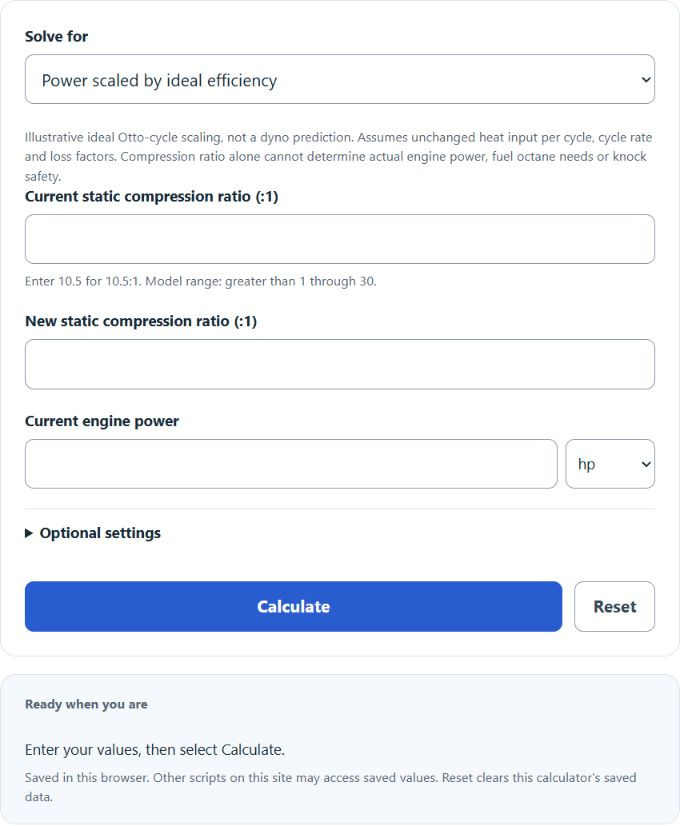
Compare ideal Otto-cycle efficiencies for a static compression change, with an optional illustrative power scaling. Actual horsepower also depends on airflow, fueling, timing, losses and knock; this is not a dyno prediction.
Compression Ratio Horsepower Formula
The calculator compares ideal Otto-cycle thermal efficiency, assuming constant specific heats:
\eta = 1 - CR^{1-k}
The relative ideal-efficiency change is the ratio of efficiencies. Scaling measured power by this ratio is an additional illustrative assumption that holds heat input per cycle, cycle rate and loss factors unchanged:
\%\,change = (\eta_{new} / \eta_{old} - 1) * 100
 HP_{new} = HP_{old} * (\eta_{new} / \eta_{old})
Variables:
- η is the ideal thermal efficiency of the engine cycle
- CR is the static compression ratio, entered as a single number (10.5:1 is entered as 10.5)
- k is the assumed constant specific-heat ratio. Blank optional input uses 1.4, a constant-air approximation. A smaller k lowers absolute efficiencies but increases the relative gain for a fixed compression increase in this model; it is not a dyno correction.
- HP_old is current power; HP_new is the illustrative power obtained by ideal-efficiency scaling, in matching units
Choose power scaled by ideal efficiency or relative ideal-efficiency change. Enter current and new static compression ratios; the power mode also requires current engine power. The optional specific-heat ratio affects both results. These are model comparisons, not predictions of a piston or head change.
Illustrative Ideal-Cycle Changes
This table uses k = 1.4 and the ideal-efficiency ratio. The 400 hp column applies that ratio while holding the stated assumptions fixed; it does not report measured gains.
| From | To | Estimated change | On a 400 hp engine |
|---|---|---|---|
| 8.0:1 | 9.0:1 | +3.55% | +14.19 hp |
| 9.0:1 | 10.0:1 | +2.93% | +11.72 hp |
| 9.0:1 | 10.5:1 | +4.25% | +16.99 hp |
| 9.5:1 | 11.5:1 | +5.04% | +20.15 hp |
| 10.0:1 | 11.0:1 | +2.47% | +9.90 hp |
| 10.0:1 | 12.0:1 | +4.65% | +18.61 hp |
| 11.0:1 | 12.0:1 | +2.13% | +8.50 hp |
| 12.0:1 | 13.0:1 | +1.85% | +7.41 hp |
Example Problems
Example 1: Apply ideal-cycle scaling to an illustrative compression change.
For a 400 hp baseline and compression ratios 9.0:1 and 10.5:1, ideal efficiencies are 0.584756 and 0.609587. Using full precision:
Relative ideal-efficiency change ≈ +4.2463%. Illustrative scaled power ≈ 416.9853 hp.
Example 2: Percent change for a race build.
For 11.0:1 to 12.0:1 at k = 1.4, the ideal-efficiency ratio is 1.021252, a relative change of +2.1252%. A 500 hp baseline would scale to 510.6262 hp under the fixed assumptions.
Frequently Asked Questions
How much horsepower does one point of compression add?
There is no universal horsepower gain per compression point. The table gives ideal-efficiency comparisons for selected ratios; real output depends on the whole engine and operating conditions.
Do I need higher octane fuel after raising compression?
Compression changes can affect knock sensitivity, but this model cannot determine a required octane rating or a safe compression limit. Fuel, boost, chamber design, temperature and ignition calibration matter. Follow the engine manufacturer or qualified tuner’s requirements.
Why is my real-world gain smaller than the calculator says?
The ideal Otto model omits finite combustion time, heat transfer, friction, pumping and calibration changes. There is no verified universal percentage correction from this calculation to dyno power. Lowering k is not an empirical loss correction and actually increases the relative modeled gain for a fixed compression increase. See NASA’s ideal Otto-cycle analysis for the underlying assumptions.