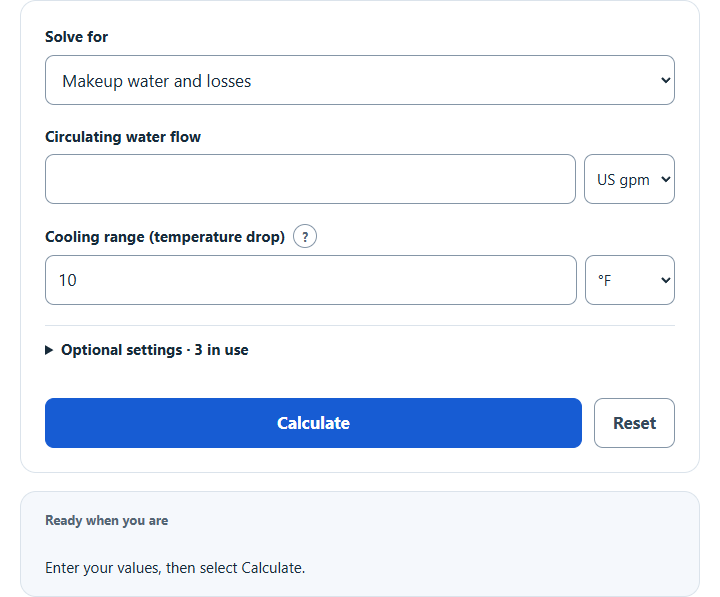
Estimate cooling-tower evaporation, blowdown, drift and makeup water from circulating flow, cooling range and concentration assumptions.
Related Calculators
- Cooling Capacity Calculator
- Water Flow Rate Calculator
- Specific Heat Calculator
- Heat Load Calculator
- Heat Exchanger Duty Calculator
- Water Cooling Wattage Calculator
- All Construction Calculators
Cooling Water Consumption Formula
The calculator estimates evaporation E = 0.00085 × circulation × cooling range in °F, with consistent flow units. In balance mode, drift D = circulation × drift%/100; blowdown B = max(0, E/(cycles − 1) − D); makeup = E + D + B. If the unclamped B is negative, the requested cycles cannot be achieved and the calculator reports that limitation. The following separate heat-balance formula describes circulating flow, not makeup consumption:
Variables:
- V̇ is the cooling-water volumetric flow rate (m³/s)
- H is the heat load (kW)
- ρ is the fluid density (kg/m³)
- c is the specific heat capacity of the fluid (kJ/kg·°C)
- ΔT is the temperature difference between outlet and inlet water (°C)
The background heat balance gives circulation needed to carry a heat load; it is not an input mode above. Recirculated volume is not the same as volume consumed. Multiply makeup rate by operating time to estimate replacement volume. The calculator’s default time is 24 hours and its evaporation factor is an empirical approximation.
What is Cooling Water Consumption?
Cooling towers recirculate water and consume replacement water through evaporation and liquid losses. Makeup covers evaporation, drift and blowdown; leaks or other losses must be added separately. This differs from a once-through system’s required circulation rate. A rate becomes a volume only after specifying operating time.
How to Calculate Cooling Water Consumption?
The following steps outline how to calculate the Cooling Water Consumption.
- First, enter the circulating water flow and its unit.
- Next, enter the hot-to-cold cooling range as a temperature difference in °F or °C.
- For makeup balance, review the target cycles of concentration and specified drift percentage in Optional settings.
- Select Evaporation only when you do not need drift, blowdown or total makeup.
- Select Calculate to estimate the selected water-loss rate. The model uses the disclosed 0.00085 factor, not a detailed weather-dependent heat and mass transfer analysis.
- Review operating time for a total volume; the default assumes 24 hours of constant operation.
- After inserting the values and calculating the result, check your answer with the calculator above.
Example Problem :
Use the following variables as an example problem to test your knowledge.
Circulating flow = 1,000 US gpm; cooling range = 10°F
Target cycles = 4; drift = 0.02% of circulation
Evaporation = 8.5 US gpm; drift = 0.2 US gpm; blowdown ≈ 2.6333 US gpm. Makeup ≈ 11.3333 US gpm. Over 24 hours this is 16,320 US gallons, approximately 61.78 m³.