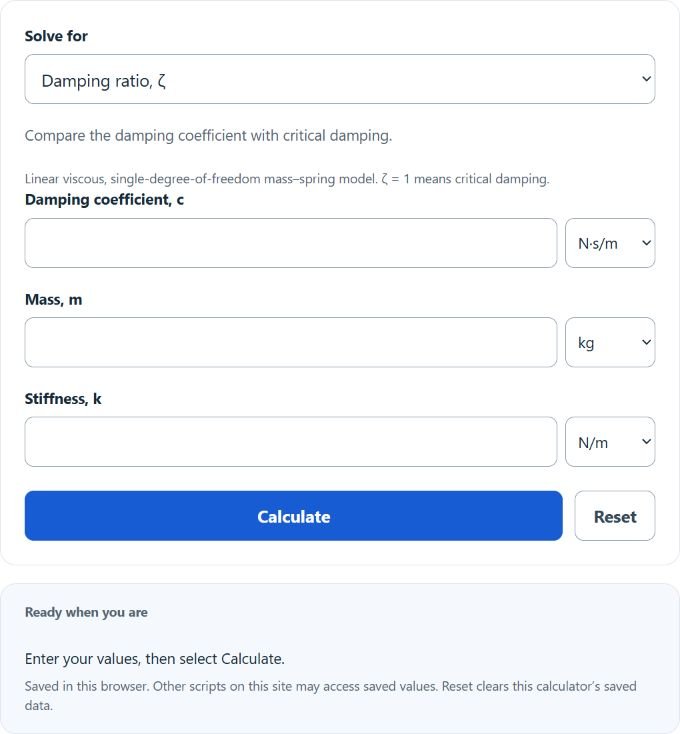
Calculate critical damping ratio, damping coefficient, mass, or stiffness from three known values with metric or imperial units for spring-mass systems.
Related Calculators
- High Pass Filter Calculator
- Square Wave Frequency Calculator
- Motor Constant Calculator
- Deceleration Calculator (w/ formula)
- All Physics Calculators
Critical Damping Ratio Formula
The calculator uses the standard damping ratio equation for a single-degree-of-freedom system with a linear spring and passive viscous damper:
It can also rearrange the same equation to solve for damping coefficient, mass, or stiffness:
- ζ = damping ratio relative to critical damping, dimensionless
- c = damping coefficient, usually in N·s/m
- m = mass, usually in kg
- k = stiffness or spring constant, usually in N/m
Select the unknown, then enter the three known values. Ratio mode calculates ζ from the coefficient, mass, and stiffness. Coefficient mode calculates the damping for the entered ratio. Mass and stiffness modes rearrange the same equation. Mass and stiffness must be positive; zero damping is valid for ζ or c, but c = ζ = 0 cannot determine a unique mass or stiffness.
Damping Ratio Interpretation
| Damping Ratio ζ | Response Type | What It Means |
|---|---|---|
| ζ = 0 | Undamped | The system oscillates without energy loss in the ideal model. |
| 0 < ζ < 1 | Underdamped | The system oscillates while the motion gradually dies out. |
| ζ = 1 | Critically damped | The system returns to equilibrium as quickly as possible without oscillating. |
| ζ > 1 | Overdamped | The system does not oscillate, but returns to equilibrium more slowly than a critically damped system. |
Supported Unit Conversions
| Quantity | Unit | Base Conversion Used |
|---|---|---|
| Damping coefficient | N·s/m | Base unit |
| Damping coefficient | lbf·s/in | 1 lbf·s/in = 175.12683524647636 N·s/m |
| Mass | kg | Base unit |
| Mass | g | 1 g = 0.001 kg |
| Mass | lbm | 1 lbm = 0.45359237 kg |
| Stiffness | N/m | Base unit |
| Stiffness | lbf/in | 1 lbf/in = 175.12683524647636 N/m |
Example Problems
Example 1: Calculate damping ratio
You have a damping coefficient of 80 N·s/m, a mass of 10 kg, and a stiffness of 1000 N/m.
The damping ratio is 0.4, so the system is underdamped.
Example 2: Calculate damping coefficient
You want a damping ratio of 1 with a mass of 5 kg and stiffness of 2000 N/m.
The damping coefficient needed for critical damping is 200 N·s/m.
FAQ
What is the difference between critical damping and damping ratio?
Critical damping is the exact amount of damping that lets a system return to equilibrium without oscillating and without being slower than necessary. The damping ratio ζ compares the actual damping in the system to that critical damping level. When ζ = 1, the system is critically damped.
Why is the damping ratio dimensionless?
The damping ratio is dimensionless because it is a comparison between two damping values: the actual damping coefficient and the critical damping coefficient. Since both have the same units, the units cancel out.
What values can I enter in the calculator?
Select the unknown and enter the three known values. The calculator converts supported units to base SI units, performs the calculation, then converts the result back to the selected output unit where needed.