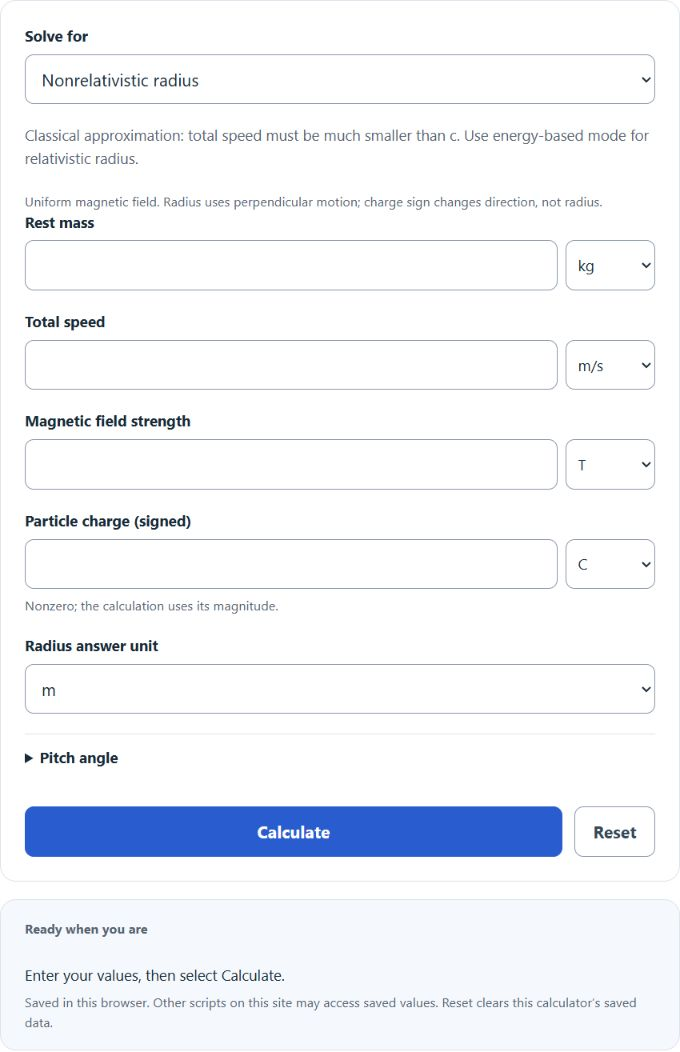
Choose a classical inverse, energy-based relativistic radius, cyclotron frequency or transverse-momentum rigidity calculation. Radius uses the motion perpendicular to a uniform magnetic field.
Related Calculators
- Angular Force Calculator
- Energy Charge Voltage Calculator
- Potential Difference Calculator
- Cavity Resonance Calculator
- All Physics Calculators
Cyclotron Radius Formula
The following classical formula gives the orbit radius for nonrelativistic motion in a uniform field. For pitch angle θ, v⊥ = v sin(θ); charge sign affects rotation direction, not radius.
Variables:
- R is the Cyclotron Radius (m)
- m is the mass (kg)
- v⊥ is the speed perpendicular to the magnetic field (m/s)
- B is the magnetic induction (T)
- |q| is the nonzero charge magnitude (C)
Divide mass times perpendicular speed by charge magnitude times field strength. The classical model requires total speed much smaller than c. Relativistically, R = p⊥/(|q|B), where p = √(K(K + 2mc²))/c and K is total kinetic energy.
How to Calculate Cyclotron Radius?
The following steps outline how to calculate the Cyclotron Radius.
- First, determine the mass (kg).
- Next, determine total speed (m/s) and its angle to the field; a blank pitch angle uses 90°.
- Next, determine the magnetic induction (T).
- Next, determine the charge (C).
- Next, use R = m*v⊥/(B*|q|) for the classical estimate.
- Finally, calculate the Cyclotron Radius.
- After inserting the variables and calculating the result, check your answer with the calculator above.
Example Problem:
Use the following variables as an example problem to test your knowledge.
mass (kg) = 5
velocity (m/s) = 6
magnetic induction (T) = 8
charge (C) = 1.25
At a 90° pitch angle, R = (5 × 6)/(8 × 1.25) = 3 m.