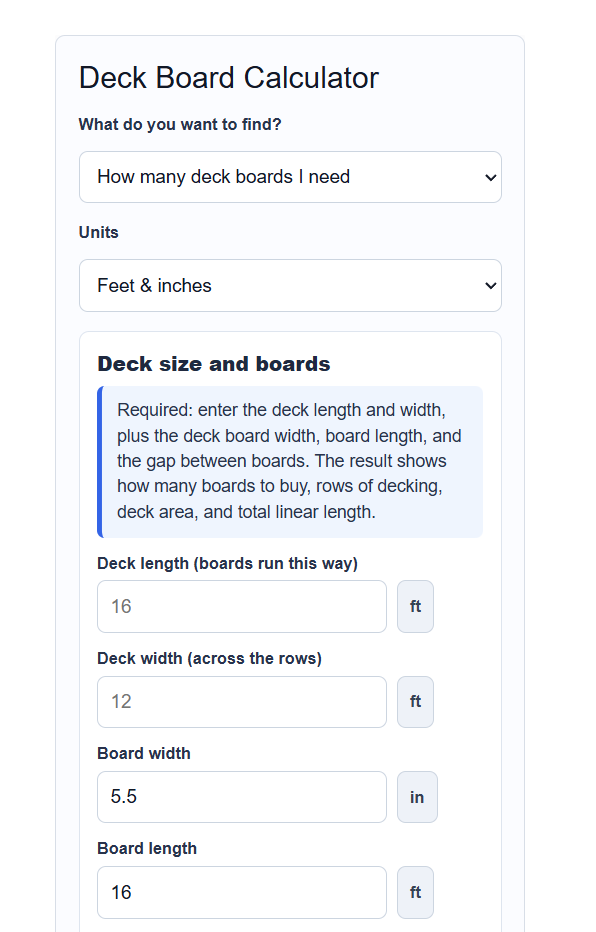
Calculate how many deck boards, screws, and clips you need from your deck size, board width, gap, layout, and waste, or find the area a set of boards will cover.
- All Construction Calculators
- Deck Picket Calculator
- 4X8 Calculator
- Board And Batten Calculator
- 2X6 Calculator
- Board Spacing Calculator
Deck Board Formula
This calculator works in two modes. The board count mode tells you how many boards to buy for a deck of a given size. The coverage mode tells you how much area a set of boards you already have will cover. The mode you choose sets which formulas run.
Rows = ceil( DeckWidth / (BoardWidth + Gap) )
BoardsPerRow = ceil( DeckLength / BoardLength )
TotalBoards = ceil( Rows * BoardsPerRow * (1 + Waste / 100) )
Coverage = Boards * BoardLength * (BoardWidth + Gap)
- DeckLength = the distance the boards run, measured along the board direction
- DeckWidth = the distance across the rows of boards
- BoardWidth = the actual face width of one board, not the nominal size
- BoardLength = the length of a single board you will buy
- Gap = the spacing left between boards for drainage and expansion
- Waste = the extra percentage added for cuts, mistakes, and defects
- ceil = round up to the next whole number, since you buy whole boards
Board width and gap are added together because each board really takes up its own width plus one gap. Dividing the deck width by that combined figure gives the number of rows. The deck length divided by the board length gives how many boards sit end to end in each row. Multiplying the two and rounding up gives the raw board count, and the waste factor adds a margin on top. A diagonal layout adds about 15 percent before waste to cover the angled end cuts. If you turn on the fastener option, the calculator counts joists as floor(DeckLength / JoistSpacing) + 1, then uses two face screws or one hidden clip at each board-over-joist crossing. The optional price field multiplies the final board count by the price per board.
Common Deck Board Sizes and Coverage
Decking is sold by nominal size, but the actual face width is smaller. Use the actual width in the calculator. The coverage width below adds a standard 1/8 inch gap.
| Nominal size | Actual width | Width with 1/8 in gap |
|---|---|---|
| 5/4 x 6 | 5.5 in | 5.625 in |
| 2 x 6 | 5.5 in | 5.625 in |
| 1 x 6 composite | 5.5 in | 5.625 in |
| 2 x 4 | 3.5 in | 3.625 in |
Fasteners depend on how the boards attach and how close the joists sit. The table below lists the common choices the calculator uses.
| Setting | Typical value |
|---|---|
| Face screws per joist crossing | 2 |
| Hidden clips per joist crossing | 1 |
| Standard joist spacing (straight) | 16 in on center |
| Spacing for diagonal boards | 12 in on center |
Example Problems
Example 1. You are surfacing a deck that is 16 ft long and 12 ft wide. You will use boards 5.5 in wide and 16 ft long, with a 1/8 in (0.125) gap, a straight layout, and 10 percent waste. The combined width is 5.5 + 0.125 = 5.625 in. The deck width is 12 x 12 = 144 in, so rows = ceil(144 / 5.625) = 26. Boards per row = ceil(16 / 16) = 1, giving 26 boards before waste. With waste, total = ceil(26 x 1.10) = 29 boards.
Example 2. You already have 50 boards that are 5.5 in wide and 16 ft long, set with a 1/8 in gap. Each board covers 16 x (5.625 / 12) = 7.5 sq ft including its gap. Coverage = 50 x 7.5 = 375 sq ft. Without the gaps, the bare board surface is 50 x 16 x (5.5 / 12) = 366.7 sq ft.
Frequently Asked Questions
Why does the calculator ask for the actual board width instead of the nominal size?
Lumber and composite boards are named by a rounded nominal size, but the real face width is smaller. A 2x6 or 5/4x6 board measures 5.5 in across, not 6 in. The number of rows depends on the real width, so entering the actual width keeps the board count accurate.
How much waste should I add?
For a simple rectangular deck with straight boards, 5 to 10 percent covers normal cuts and the occasional bad board. For a diagonal layout, longer end cuts waste more material, so 15 percent or more is common. The calculator already adds about 15 percent for diagonal boards before your waste figure is applied, so you do not need to double count it.
Does the board count include fasteners and cost?
The board count is separate. If you pick a fastener type and joist spacing, the calculator estimates the screws or clips at each board-over-joist crossing and applies the same waste factor. If you enter a price per board, it multiplies that price by the final board count to give an estimated material cost.