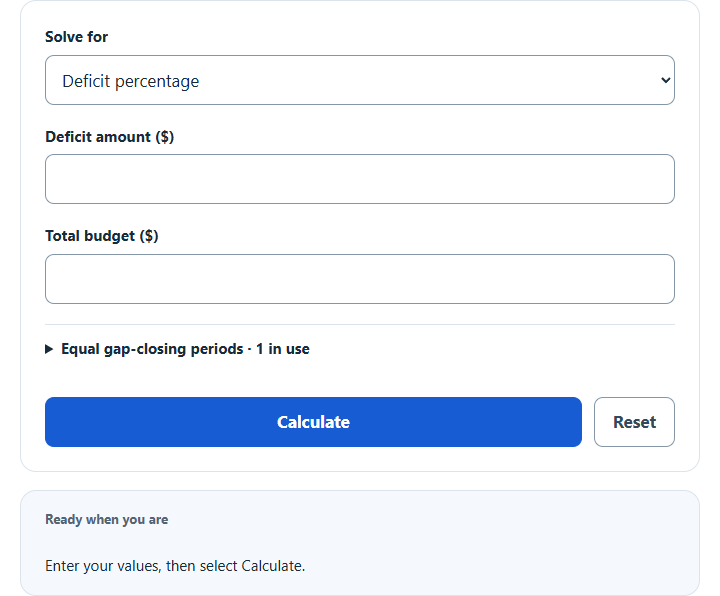
Calculate deficit percentage by dividing a deficit or shortfall by the total budget, or find the deficit amount or budget from a known percentage.
Related Calculators
- Cost Decrease Calculator
- Cancellation Rate Calculator
- Price Impact Calculator
- Price Increase Calculator
- All Business Calculators
Budget deficit from spending and revenue
Choose Budget balance when the deficit is not already known. Enter total spending and revenue for the same period and US-dollar basis. Spending above revenue gives a deficit; revenue above spending gives a surplus. Equal amounts mean a balanced budget.
Signed difference = spending − revenue. A positive difference is a deficit and a negative difference is a surplus. The calculator shows the amount as a positive value with the appropriate label.
Deficit or surplus as % of spending = absolute difference ÷ spending × 100. With zero spending this percentage is undefined, even though the amount can still be calculated. This denominator is spending, not revenue or GDP.
For example, $120,000 of spending and $100,000 of revenue gives a $20,000 deficit, or 16.6667% of spending. Reversing those amounts gives a $20,000 surplus, equal to 20% of spending.
This compares one period. It does not calculate accumulated public debt or forecast future balances. For a government budget, use outlays and receipts on a consistent basis; borrowing is financing, not revenue. See the Congressional Budget Office explanation of budgetary terms.
Deficit Percentage Formula
The deficit percentage shows a shortfall relative to the budget you enter. Choose percentage, deficit amount or implied total budget; the inverse is B = D / (DP/100). Use a consistent period and US-dollar basis.
- DP = deficit percentage
- D = deficit amount
- B = total budget
- D = deficit amount
- DP = deficit percentage
- B = total budget
Find Deficit %: Enter the deficit amount and the total budget. The calculator divides the deficit by the budget, then multiplies by 100 to convert the result to a percentage.
Find Deficit $: Enter the deficit percentage and the total budget. The calculator converts the percentage to a decimal, then multiplies it by the budget to find the dollar shortfall.
Deficit Percentage Meaning
The table gives arithmetic comparisons only. These percentages are not universal severity thresholds; financial impact depends on context.
| Deficit percentage | General meaning |
|---|---|
| Less than 1% | Less than 1 dollar shortfall per 100 dollars of budget. |
| 1% to under 3% | At least 1 but less than 3 dollars shortfall per 100 dollars of budget. |
| 3% to under 10% | At least 3 but less than 10 dollars shortfall per 100 dollars of budget. |
| 10% to under 25% | At least 10 but less than 25 dollars shortfall per 100 dollars of budget. |
| 25% or more | At least 25 dollars shortfall per 100 dollars of budget; this scale has no upper bound. |
Common Deficit Amounts by Budget Size
| Total budget | 2% deficit | 5% deficit | 10% deficit |
|---|---|---|---|
| $10,000 | $200 | $500 | $1,000 |
| $100,000 | $2,000 | $5,000 | $10,000 |
| $500,000 | $10,000 | $25,000 | $50,000 |
| $1,000,000 | $20,000 | $50,000 | $100,000 |
Example Problems
Example 1: Find the deficit percentage
You have a deficit of $25,000 and a total budget of $500,000.
The deficit is 5% of the total budget.
Example 2: Find the deficit amount
You have a total budget of $800,000 and a deficit percentage of 7.5%.
The deficit amount is $60,000.
FAQ
What is a deficit percentage?
A deficit percentage is the shortfall expressed as a percentage of the total budget. For example, if a budget is $200,000 and the deficit is $10,000, the deficit percentage is 5% because $10,000 is 5% of $200,000.
Can the deficit percentage be more than 100%?
Yes. A deficit percentage can be more than 100% if the shortfall is larger than the total budget. For example, a $120,000 deficit on a $100,000 budget equals 120%.
Is deficit percentage the same as remaining budget percentage?
No. The deficit percentage measures the shortfall. The remaining budget percentage measures what is left after subtracting the deficit. If the deficit is 20% of the budget, the remaining amount is 80% of the budget, assuming the deficit does not exceed the total budget.