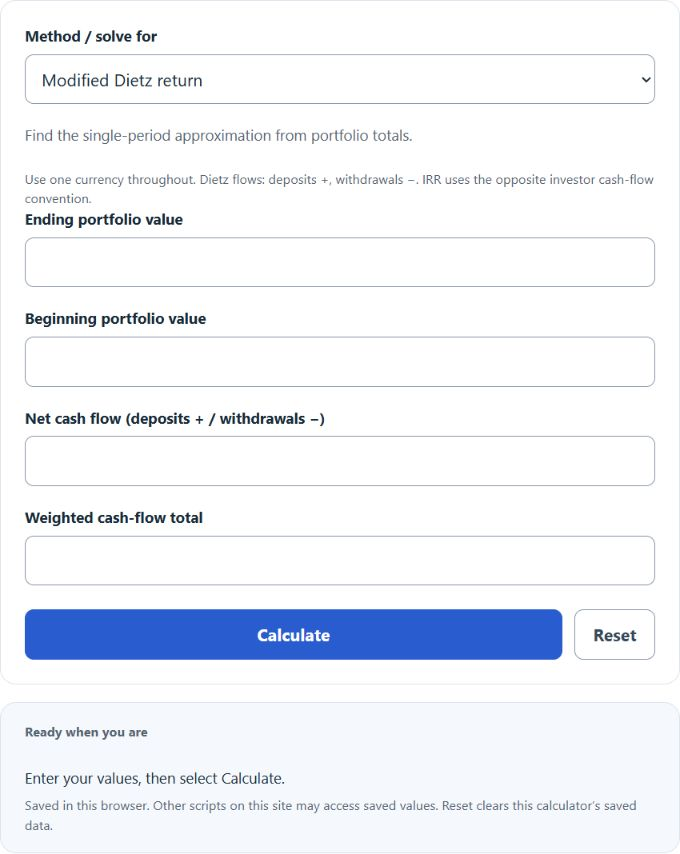
Calculate investment returns with Modified Dietz, money-weighted IRR, or TWR using portfolio values, cash flows, dates, and subperiod returns.
Modified Dietz (Dollar-Weighted Approximation) Formula
The following formula is used to calculate the Modified Dietz return, a common single-period approximation to a dollar-/money-weighted return when you have a beginning value, ending value, and external cash flows during the period.
Variables:
- R is the Modified Dietz return (a dollar-/money-weighted approximation for a single period)
- E is the ending value
- B is the beginning value
- C is the total net external cash flow during the period (deposits/contributions are positive, withdrawals are negative)
- W is the weighted cash flow total, W = Σ(wᵢ × CFᵢ), where wᵢ is the fraction of the period remaining after each cash flow (from 0 to 1)
To calculate the Modified Dietz return, subtract the beginning value and total net cash flows from the ending value. Divide the result by the sum of the beginning value and the weighted cash-flow total. Choose the desired solve mode; return inputs use percentages. Dated weights use the fraction remaining between the entered start and end boundaries. Enter TWR subperiod returns as percentages; the linked TWR is cumulative, not annualized.
What is a Dollar Weighted Return?
A dollar-weighted return (often called a money-weighted return) measures an investor’s return while accounting for the size and timing of external cash flows (contributions and withdrawals). When each cash flow is dated, the money-weighted return is commonly computed as an internal rate of return (IRR/XIRR): an annualized rate that makes the net present value of all cash flows, including the ending value, equal to zero. This calculator uses actual elapsed days divided by 365 and reports multiple solutions when located, rather than choosing an arbitrary IRR. Its bounded rate domain is log(1 + r) from −30 to 30. In contrast, time-weighted return (TWR) neutralizes the impact of external cash flows by linking subperiod returns and is often used to evaluate investment manager performance. The Modified Dietz method shown above is a widely used single-period approximation to a money-weighted return.
How to Calculate a Dollar-Weighted Return (Modified Dietz)?
The following steps outline how to calculate the Modified Dietz single-period approximation.
- First, determine the ending value (E) of the investment.
- Next, determine the beginning value (B) of the investment.
- Next, calculate the total net cash flows (C) during the investment period (deposits/contributions +, withdrawals -).
- Next, calculate the weighted cash flows (W) based on the timing of each cash flow.
- Finally, calculate the return using the formula R = (E - B - C) / (B + W).
- After inserting the values and calculating the result, check your answer with the calculator above.
Example Problem :
Use the following variables as an example problem to test your knowledge (assume cash flows are net deposits/contributions into the portfolio).
Ending Value (E) = 15000
Beginning Value (B) = 10000
Cash Flows (C) = 2000
Weighted Cash Flows (W) = 500
The Modified Dietz return is (15000 − 10000 − 2000) / (10000 + 500) = 0.285714, or approximately 28.5714% for the period.