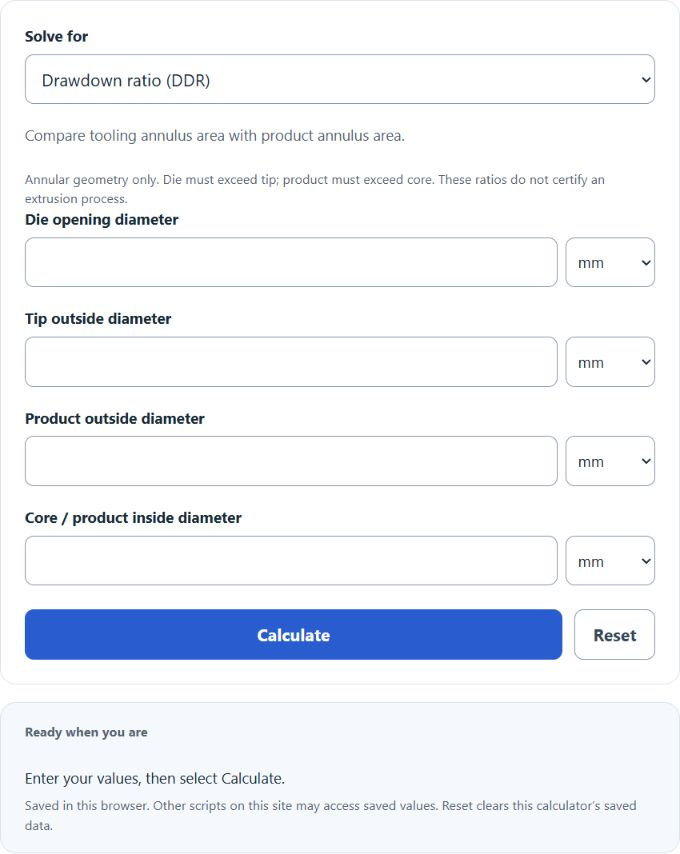
Calculate extrusion drawdown ratio, missing die, tip, product or core diameter, and draw ratio balance from four diameter inputs.
- All Personal Finance Calculators
- All Ratio Calculators
- Extrusion Force Calculator
- Injection Molding Cooling Time Calculator
- Die Cushion Pressure Calculator
- Melt Flow Rate Calculator
Calculator Functions
| Function | What it does | What it requires |
|---|---|---|
| Drawdown ratio (DDR) | Finds the area drawdown ratio of a tube or jacket extrusion | Requires the die, tip, product and core diameters |
| Die diameter | Finds the die opening that gives a target DDR | Requires the target DDR and the tip, product and core diameters |
| Tip outside diameter | Finds the tip diameter that gives a target DDR | Requires the target DDR and the die, product and core diameters |
| Product outside diameter | Finds the product outside diameter a target DDR produces | Requires the target DDR and the die, tip and core diameters |
| Core diameter | Finds the core or product inside diameter a target DDR produces | Requires the target DDR and the die, tip and product diameters |
| Blown film (BUR and DDR) | Finds the blow-up ratio and drawdown ratio of a blown film | Requires the film die diameter, lay-flat width, die gap and single-wall film thickness |
Diameters are entered in mm, cm, m, in or ft, and each one can use a different unit. The die must be larger than the tip and the product larger than its core. The five tube functions also report the draw ratio balance.
Draw Down Ratio Formulas
(PD² − CD²) [1]
| DDR | Drawdown ratio (no unit) |
| DD | Die opening diameter |
| DT | Tip outside diameter |
| PD | Product outside diameter |
| CD | Core diameter: the product inside diameter, or the wire being coated |
The ratio compares the ring-shaped opening between the die and the tip with the ring-shaped cross-section of the finished product [2]. The π ÷ 4 in each area cancels, so only the squared diameters remain.
Drawdown ratio (DDR)
A 5 mm die with a 3 mm tip, drawn down to a 2 mm tube with a 1 mm bore, gives (25 − 9) ÷ (4 − 1) = 5.33. A 10 mm die and 6 mm tip making a 7 mm tube with a 4 mm bore gives 64 ÷ 33 = 1.94.
Die diameter
+ DT²)
A target DDR of 5.333 with a 3 mm tip, a 2 mm product and a 1 mm core needs a 5 mm die.
Tip outside diameter
(PD² − CD²))
The same target with a 5 mm die needs a 3 mm tip. A target too high for the die leaves no real tip diameter and is rejected.
Product outside diameter
+ CD²)
A 5 mm die and 3 mm tip run at a DDR of 5.333 over a 1 mm core produce a 2 mm outside diameter.
Core diameter
÷ DDR)
A 5 mm die and 3 mm tip at a DDR of 5.333 making a 2 mm outside diameter leave a 1 mm core.
Draw ratio balance
(PD ÷ CD) [1]
The balance compares how fast the outside and the inside of the melt cone draw down [2]. The 5, 3, 2 and 1 mm example gives (5 ÷ 3) ÷ (2 ÷ 1) = 0.83. A balance at or near 1 is the usual target [1][2].
Blown film (BUR and DDR)
LF is the lay-flat width, D the film die diameter, G the die gap and T the thickness of one film wall. The lay-flat width is half the bubble circumference, so the bubble diameter is 2 × LF ÷ π, and 0.637 is 2 ÷ π. A 200 mm die with a 600 mm lay-flat has a 382 mm bubble and a blow-up ratio of 1.91. With a 1.5 mm die gap and 50 µm film, the drawdown ratio is 1.5 ÷ (0.05 × 1.91) = 15.7. This film ratio is a different measure from the tube ratio above.
Limits of This Estimate
- The ratios are geometry only. Die swell, resin, air gap, line speed and cooling are not modeled, so a ratio does not show that a process will run well.
- Workable ranges depend on the material. One cable maker quotes drawdown ratios of 50 to 150 for fluoropolymers, and a lower ratio gives a more stable process [2]. The resin supplier gives the range for a specific grade.
- The blown film drawdown ratio is a thin-wall estimate that treats the melt and the finished film as the same density. These estimates are based on the best available data and estimations.
Sources
- U.S. Patent 7,558,454, Optical fiber cable and method for making the same: drawdown ratio and draw balance formulas, and the target near 1
- Wiring Harness News, Altering Design Parameters to Strip Fluoropolymer Cable Jackets: what the two ratios measure, and fluoropolymer values
- U.S. Patent 10,752,759, Methods for forming blended films with high blow up ratios: blow-up ratio from lay-flat width