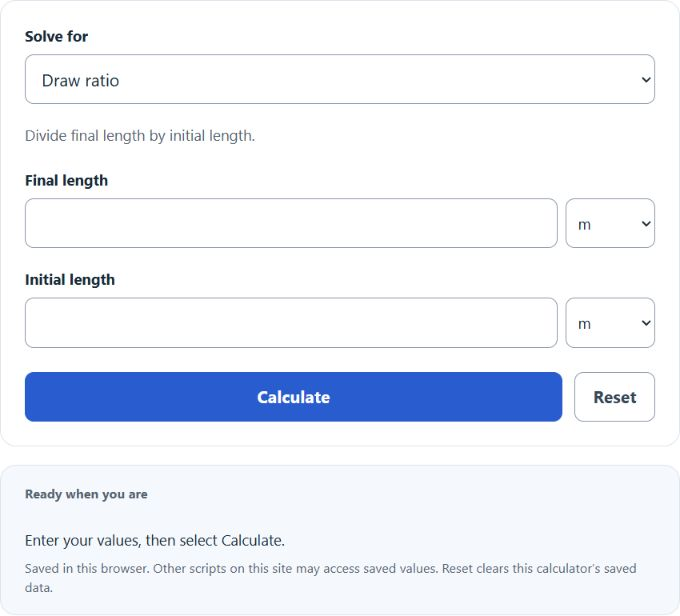
Calculate draw ratio, final length, or initial length from any two values, with length inputs in meters, centimeters, millimeters, or inches.
Related Calculators
- Stretch Factor Calculator
- Scale Factor Dilation Calculator
- Scale Calculator
- Common Ratio Calculator
- Constant of Proportionality Calculator
- Inverse Ratio Calculator
- All Chemistry Calculators
Draw Ratio Formula
The draw ratio is the final length divided by the initial length. It is unitless, but the final length and initial length must be in compatible length units before calculating.
- DR = draw ratio, unitless
- Lf = final length
- Li = initial length
Select draw ratio, final length, or initial length as the value to solve for, then enter the two known values.
If the two length fields use different units, the calculator first converts both lengths to meters internally, performs the calculation, then converts a calculated length to the selected result unit.
Length Unit Conversions Used
The calculator uses meters as the base unit for length conversion.
| Unit | Symbol | Equivalent in meters |
|---|---|---|
| Meter | m | 1 m |
| Centimeter | cm | 0.01 m |
| Millimeter | mm | 0.001 m |
| Inch | in | 0.0254 m |
How to Interpret Draw Ratio Values
| Draw ratio | Meaning |
|---|---|
| Less than 1 | The final length is shorter than the initial length. |
| 1 | No change in length. |
| Greater than 1 | The final length is longer than the initial length. |
| 2 | The final length is twice the initial length. |
Example Draw Ratio Calculations
Example 1: Calculate draw ratio
You start with an initial length of 4 m and end with a final length of 10 m.
The draw ratio is 2.5.
Example 2: Calculate final length
You have a draw ratio of 3 and an initial length of 25 cm.
The final length is 75 cm.
FAQ
Is draw ratio a percentage?
No. Draw ratio is usually written as a unitless ratio, such as 2.5 or 3. A draw ratio of 3 means the final length is 3 times the initial length. If you want to express it as a percentage of the original length, multiply the draw ratio by 100. For example, a draw ratio of 3 equals 300% of the initial length.
Do final length and initial length need to use the same unit?
No, but they must both be length units. The calculator can handle meters, centimeters, millimeters, and inches. For example, you can enter final length in centimeters and initial length in inches, and the unit conversion is handled before the draw ratio is calculated.
Why can initial length or draw ratio not be zero in some calculations?
Initial length cannot be zero when calculating draw ratio because division by zero is not valid. Draw ratio cannot be zero when calculating initial length because the formula divides final length by draw ratio.