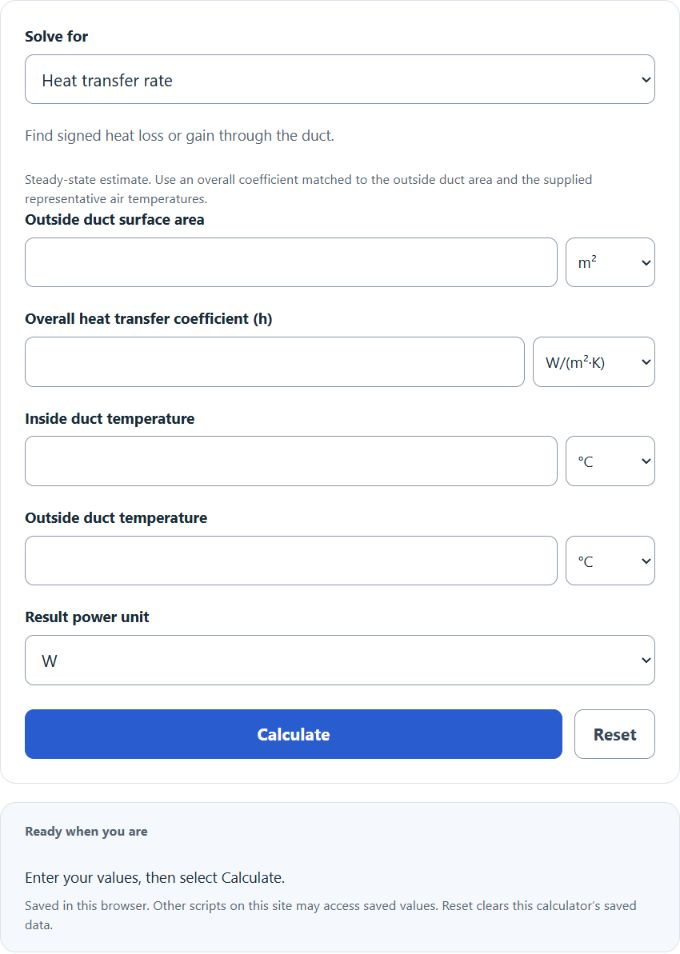
Calculate duct heat loss, surface area, heat transfer coefficient, or inside/outside duct temperature from four known values in metric or imperial units.
Related Calculators
- Ventilation Heat Loss Calculator
- Heat Load Calculator
- Thermal Resistance Calculator
- Duct Velocity Calculator
- Return Air Duct Size Calculator
- Air Flow Calculator
- All Construction Calculators
Duct Heat Loss Formula
The duct heat loss calculation uses the basic steady-state heat transfer equation:
- Q = duct heat loss, in watts (W) or BTU/h
- A = outside surface area of the duct, in m² or ft²
- h = overall heat transfer coefficient matched to the outside duct area, in W/m²K or BTU/h·ft²·°F
- T_i = temperature inside the duct
- T_o = temperature outside the duct
- T_i - T_o = temperature difference between the duct air and the surrounding air
Select the quantity to solve for and enter the other four values. It rearranges the same formula as needed:
If you calculate duct heat loss, the surface area, heat transfer coefficient, and temperature difference are multiplied together. If you calculate surface area or heat transfer coefficient, the heat loss is divided by the other known terms. If you calculate an inside or outside temperature, the formula uses the heat loss per unit conductance to find the required temperature difference.
A positive result means heat is leaving the duct when the inside temperature is higher than the outside temperature. A negative result means the duct is gaining heat from warmer surroundings.
Common Duct Heat Loss Inputs and Unit Conversions
| Quantity | Metric unit | Imperial unit | Conversion used |
|---|---|---|---|
| Heat loss | W | BTU/h | 1 BTU (IT)/h ≈ 0.293071070172 W |
| Duct surface area | m² | ft² | 1 ft² = 0.09290304 m² |
| Heat transfer coefficient | W/m²K | BTU/h·ft²·°F | 1 BTU (IT)/(h·ft²·°F) ≈ 5.678263341 W/(m²·K) |
| Temperature | °C or K | °F | Temperatures are converted before the calculation |
| Duct condition | Coefficient selection | Use note |
|---|---|---|
| Uninsulated metal duct in still air | Use a project-specific overall coefficient | Higher values give larger heat loss. |
| Lightly insulated duct | Use the actual wall and insulation resistance | Include insulation, wall and surface-film effects on the stated area basis. |
| Well-insulated duct | Use the actual wall and insulation resistance | A generic duct description alone does not determine the coefficient. |
Example Calculations
Example 1: Calculate duct heat loss
You have a duct surface area of 12 m², a heat transfer coefficient of 1.2 W/m²K, an inside temperature of 40°C, and an outside temperature of 10°C.
The duct heat loss is 432 W.
Example 2: Calculate the required inside duct temperature
You have a heat loss of 1500 BTU/h, a duct surface area of 200 ft², a heat transfer coefficient of 0.2 BTU/h·ft²·°F, and an outside temperature of 50°F.
The inside duct temperature needed for that heat loss is 87.5°F.
FAQ
How do you find the surface area of a duct?
For a round duct, use the outside circumference times the duct length:
For a rectangular duct, use the outside perimeter times the duct length:
Use consistent units. If the calculator is set to m², enter dimensions in meters before finding area. If it is set to ft², enter dimensions in feet.
Does duct insulation affect heat loss?
Yes. Insulation lowers the effective heat transfer coefficient. A lower coefficient reduces heat loss for the same duct area and temperature difference. If you are comparing insulated and uninsulated ducts, keep the area and temperatures the same and change only the heat transfer coefficient.
Why is my duct heat loss result negative?
A negative result means the outside temperature is higher than the inside duct temperature, so heat is moving into the duct instead of out of it. The size of the number still shows the heat transfer rate, but the sign indicates the direction of heat flow.