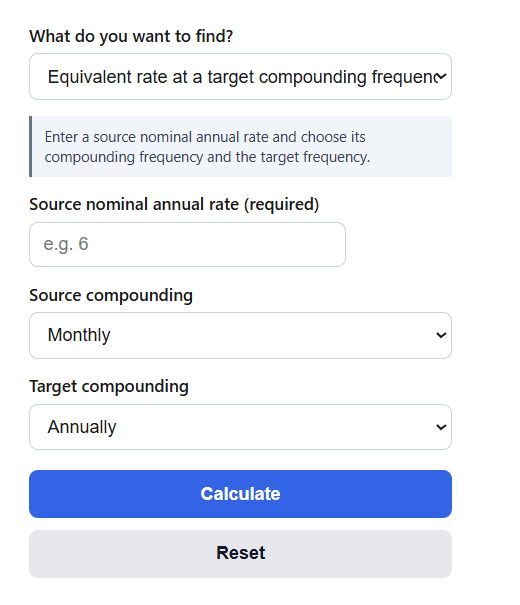
Use the Equivalent Interest Rate Calculator to convert nominal rates across annual, monthly, daily, and continuous compounding frequencies.
Equivalent Interest Rate Formula
Two nominal interest rates are equivalent when they produce the same effective annual rate after their different compounding frequencies are considered. First convert the source nominal annual rate to an effective annual rate:
EAR = (1 + r_s / m_s)^(m_s) - 1
Then convert that effective annual rate to a nominal annual rate at the target compounding frequency:
r_t = m_t * ((1 + EAR)^(1 / m_t) - 1)
For continuous compounding, the corresponding formulas are:
EAR = e^r - 1
 r = ln(1 + EAR)
Variables:
- EAR is the effective annual rate
- rs is the source nominal annual rate
- ms is the number of source compounding periods per year
- rt is the equivalent target nominal annual rate
- mt is the number of target compounding periods per year
Select whether you want the equivalent target rate or the source rate that matches a known target rate. The calculator preserves the effective annual return, not the displayed nominal percentage. That is why equivalent nominal rates can differ even though the economic result is the same.
Equivalent Interest Rate Reference Table
A 6% nominal annual rate compounded monthly has an effective annual rate of about 6.1678%. The following nominal rates are equivalent to it at other compounding frequencies.
| Target compounding | Equivalent nominal annual rate | Effective annual rate |
|---|---|---|
| Annually | 6.1678% | 6.1678% |
| Semiannually | 6.0755% | 6.1678% |
| Quarterly | 6.0301% | 6.1678% |
| Monthly | 6.0000% | 6.1678% |
| Weekly | 5.9885% | 6.1678% |
| Daily | 5.9855% | 6.1678% |
| Continuously | 5.9850% | 6.1678% |
More frequent compounding requires a slightly lower nominal rate to produce the same effective annual result. This comparison assumes identical balances, timing, and no fees.
Example Problems
Example 1: Convert a monthly-compounded rate to a quarterly-compounded rate.
A lender quotes 6% nominal interest compounded monthly. Its effective annual rate is (1 + 0.06 / 12)12 – 1 = 6.1678%. The equivalent quarterly nominal rate is 4 * ((1 + 0.061678)1/4 – 1) = about 6.0301%.
Example 2: Find the monthly-compounded source rate.
A target rate of 5% compounded annually has an EAR of 5%. The monthly-compounded nominal rate that matches it is 12 * ((1.05)1/12 – 1) = about 4.8889%.
Frequently Asked Questions
Is an equivalent rate the same as an effective annual rate?
No. The effective annual rate is the one-year growth rate after compounding. An equivalent nominal rate is a stated annual rate at a particular frequency that reproduces that same effective annual rate.
Why does the nominal rate fall when compounding becomes more frequent?
More frequent compounding credits interest sooner, allowing interest to earn additional interest within the year. A lower nominal rate is therefore sufficient to reach the same one-year growth.
Do equivalent rates account for fees or taxes?
No. The conversion compares interest mechanics only. Account fees, loan origination costs, taxes, minimum-balance rules, and changing rates can make two otherwise equivalent rates produce different net results.