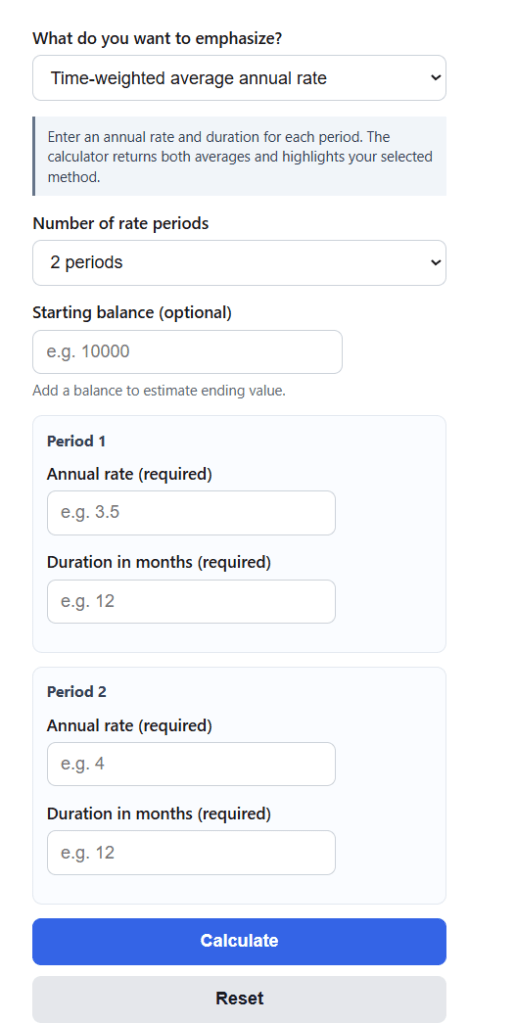
Use the Average Interest Rate Over Time Calculator to find duration-weighted and compound-equivalent rates across two to five periods.
Average Interest Rate Over Time Formula
When an annual rate changes over time, a plain average can be misleading if the periods have different lengths. The time-weighted arithmetic average is:
r_weighted = sum(r_i * months_i) / sum(months_i)
A compound-equivalent average rate is the constant annual rate that reproduces the same total growth:
Growth = product((1 + r_i)^(months_i / 12))
 r_equiv = Growth^(12 / total_months) - 1
Variables:
- ri is the annual rate during period i
- monthsi is the duration of period i
- Growth is the cumulative multiplier across all periods
- rweighted is the duration-weighted arithmetic rate
- requiv is the constant compound-equivalent annual rate
Enter two to five rate periods. The calculator returns both averages because they answer different questions. The time-weighted arithmetic rate summarizes stated rates by duration. The compound-equivalent rate summarizes the actual compounded growth path.
Average Rate Reference Table
These examples compare time-weighted and compound-equivalent averages for several two-period rate paths.
| Rate path | Total time | Time-weighted average | Compound-equivalent average | Total growth |
|---|---|---|---|---|
| 3% for 12 months, then 5% for 12 months | 24 months | 4.00% | 4.00% | 8.15% |
| 2% for 6 months, then 6% for 18 months | 24 months | 5.00% | 4.99% | 10.22% |
| 4% for 12 months, then 4% for 12 months | 24 months | 4.00% | 4.00% | 8.16% |
| -2% for 6 months, then 8% for 6 months | 12 months | 3.00% | 2.88% | 2.88% |
The compound-equivalent average is normally at or below the arithmetic average when rates vary, reflecting the mathematical drag created by volatility. The difference can be small for modest rates but grows as the swings become larger.
Example Problems
Example 1: Unequal rate durations.
An account earns 2% for 6 months and 6% for 18 months. The time-weighted average is (2 * 6 + 6 * 18) / 24 = 5%. The compound growth factor is 1.020.5 * 1.061.5, producing a compound-equivalent average of about 4.99%.
Example 2: Estimate an ending balance.
A $10,000 balance earns 3% for one year and 5% for the next year. The ending balance is $10,000 * 1.03 * 1.05 = $10,815. The total two-year growth is 8.15%, and the constant annual rate that produces the same result is about 4.00%.
Frequently Asked Questions
Should I use the time-weighted or compound-equivalent average?
Use the time-weighted average to summarize quoted rates across unequal durations. Use the compound-equivalent average when you need one constant rate that recreates the same cumulative balance growth.
Is this the same as a weighted average rate on several loans?
No. A loan portfolio usually weights each rate by outstanding principal. This calculator weights a sequence of rates by time and can also account for compounding across the timeline.
Does the order of rates matter?
With a fixed balance and no cash flows, multiplying the same growth factors gives the same ending value regardless of order. With deposits, withdrawals, amortization, fees, or balance-dependent tiers, order can materially affect the result.