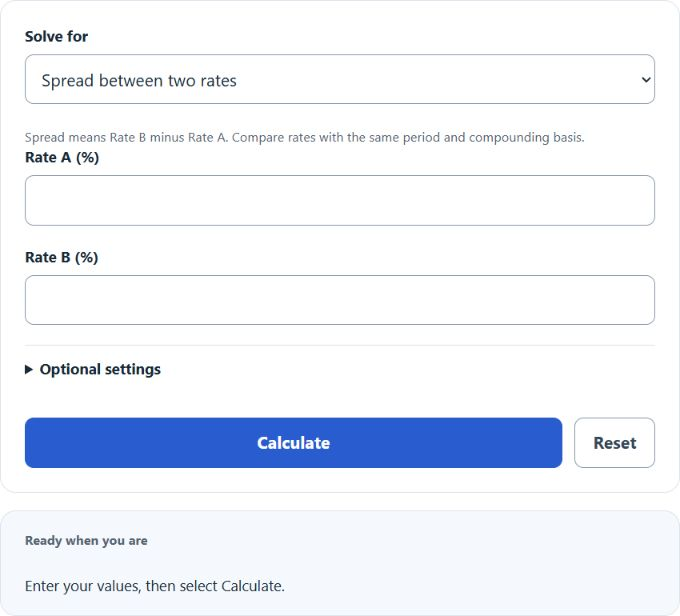
Use the Interest Rate Spread Calculator to find the difference between two rates in percentage points, basis points, and estimated dollars.
Interest Rate Spread Formula
An interest rate spread is the signed difference between two rates. This calculator defines the spread as Rate B minus Rate A:
Spread = Rate B - Rate A
To express the same difference in basis points:
Basis Points = Spread in percentage points * 100
The formula can be rearranged to solve for either rate:
Rate A = Rate B - Spread
 Rate B = Rate A + Spread
Variables:
- Rate A is the baseline or first comparison rate; it need not be lower
- Rate B is the new, benchmark, or second comparison rate
- Spread is the signed difference in percentage points
- One basis point equals 0.01 percentage point
An optional constant USD balance and time estimate translates the spread into a simple dollar difference. A blank balance omits this estimate; blank time uses one year. Compare rates with matching periods and compounding conventions:
Dollar Impact = Principal * (Spread / 100) * Years
This dollar estimate does not model compounding or a changing loan balance, but it is useful for quickly understanding the scale of a rate difference.
Interest Rate Spread Reference Table
| Rate A | Rate B | Spread | Basis points | One-year impact per $100,000 |
|---|---|---|---|---|
| 4.00% | 4.25% | +0.25 points | +25 bps | +$250 |
| 4.50% | 5.00% | +0.50 points | +50 bps | +$500 |
| 6.25% | 5.75% | -0.50 points | -50 bps | -$500 |
| 3.10% | 4.35% | +1.25 points | +125 bps | +$1,250 |
| 7.00% | 7.00% | 0.00 points | 0 bps | $0 |
Percentage points and percent change are not the same. A move from 4% to 5% is a spread of 1 percentage point, or 100 basis points, but it is a 25% increase relative to the original 4% rate.
Example Problems
Example 1: Find a spread.
Rate A is 4.75% and Rate B is 5.25%. The spread is 5.25% – 4.75% = 0.50 percentage point, which equals 50 basis points. On a constant $250,000 balance for one year, the simple difference is about $1,250.
Example 2: Find Rate B.
Rate A is 3.90% and the desired spread is 75 basis points. Convert 75 basis points to 0.75 percentage point, then add it: Rate B = 3.90% + 0.75% = 4.65%.
Frequently Asked Questions
What is a basis point?
A basis point is one-hundredth of a percentage point. Therefore, 1 basis point is 0.01 percentage point, 25 basis points is 0.25 percentage point, and 100 basis points is 1 percentage point.
Should the spread be absolute or signed?
A signed spread preserves direction: a positive result means Rate B is higher, while a negative result means Rate B is lower. Use the absolute value when only the size of the gap matters.
Why may the real dollar difference differ from the estimate?
Loans often amortize, accounts compound, and balances can change. Fees, payment timing, term structure, and different compounding conventions also matter. The calculator’s optional dollar figure is a simple constant-balance estimate.