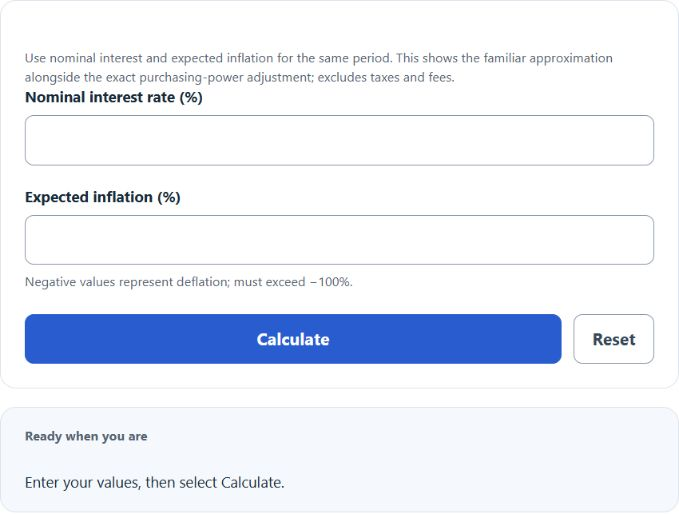
Calculate the approximate real interest rate by subtracting expected inflation from the nominal rate, and compare it with the exact Fisher adjustment for matching periods.
Real Interest Rate Formula
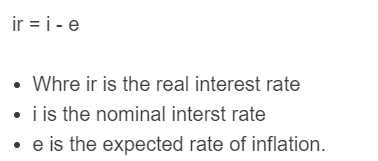
The primary result uses the simple real interest rate formula, also called the Fisher approximation; a secondary result shows the exact finite-period adjustment:
- r = real interest rate, as a percent
- i = nominal interest rate, as a percent
- π = expected inflation rate, as a percent
The nominal interest rate is the stated rate before adjusting for inflation. Expected inflation is subtracted because inflation reduces the purchasing power of the interest you earn or pay. The result is the real interest rate, which estimates the rate after accounting for inflation.
The calculator has two main functions:
- Calculate: subtracts the expected inflation rate from the nominal interest rate and displays the real interest rate.
- Reset: clears the nominal rate, inflation rate, real rate, and calculation steps.
How to Interpret Real Interest Rate Results
| Approximate Real Interest Rate | Meaning | Example |
|---|---|---|
| Positive | The nominal rate is higher than inflation, so purchasing power increases. | 6% nominal rate and 3% inflation = 3% real rate |
| Zero | The nominal rate matches inflation, so purchasing power is roughly unchanged. | 4% nominal rate and 4% inflation = 0% real rate |
| Negative | Inflation is higher than the nominal rate, so purchasing power falls. | 3% nominal rate and 5% inflation = -2% real rate |
Nominal Rate, Inflation, and Real Rate Examples
| Nominal Interest Rate | Expected Inflation | Approximate Real Interest Rate |
|---|---|---|
| 5.00% | 2.00% | 3.00% |
| 7.50% | 3.25% | 4.25% |
| 4.00% | 6.00% | -2.00% |
Example Calculations
Example 1: You have a nominal interest rate of 8% and expected inflation of 3%.
The real interest rate is 5.00%.
Example 2: You have a nominal interest rate of 2.5% and expected inflation of 4%.
The real interest rate is -1.50%. This means inflation is higher than the nominal return.
FAQ
What is the difference between nominal and real interest rate?
The nominal interest rate is the stated rate before adjusting for inflation. The real interest rate adjusts that rate for inflation, so it gives a better estimate of the change in purchasing power.
Can the real interest rate be negative?
Yes. A negative real interest rate happens when inflation is higher than the nominal interest rate. For example, if the nominal rate is 3% and inflation is 5%, the approximate real interest rate is -2%; the exact finite-period adjustment is about -1.904762%.
Is this the exact real interest rate formula?
The primary result uses nominal interest minus expected inflation. The secondary exact adjustment is [(1 + i/100)/(1 + π/100) − 1] × 100. Use comparable effective rates for the same period; inflation must exceed −100%. Expected inflation gives a scenario, not a guaranteed realized return.