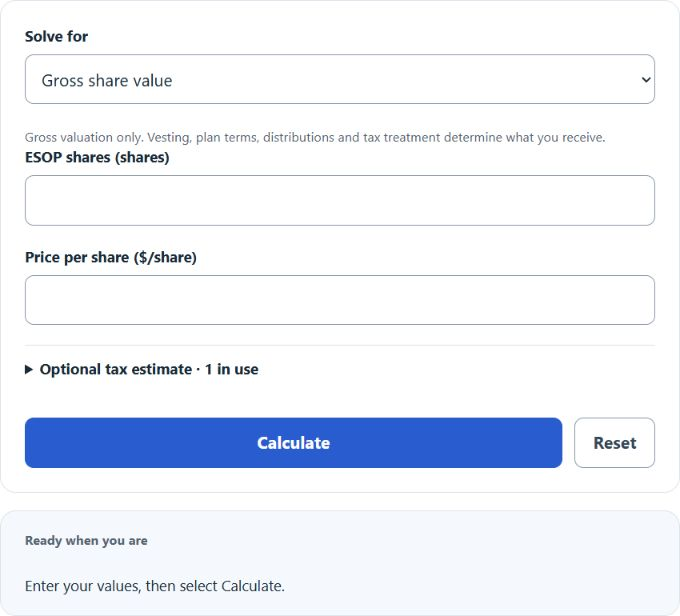
Calculate gross ESOP share value, shares or price per share, with an optional assumed tax estimate. This is not a determination of capital gains tax.
- All Business Calculators
- Option Delta Calculator
- Equity Dilution Calculator
- Conversion Parity Price Calculator
- Share Price Calculator
- ATR (Average True Range) Stop Loss Calculator
ESOP Formula
The ESOP calculator uses the relationship between the number of shares, the fair market value per share, and the total value of the shares. Enter any two of these three values to calculate the missing one.
- Shares = the number of ESOP shares being valued
- Price Per Share = the fair market value of one ESOP share
- Total Value = the total dollar value of the ESOP shares
- Estimated Tax = an optional estimate of tax if the shares are sold or distributed in a taxable way
- Tax Rate = the displayed illustrative effective rate, initially 25%; an entered tax amount overrides it
If you enter shares and price per share, the calculator multiplies them to estimate the total ESOP value. If you enter total value and price per share, it divides total value by the share price to estimate the number of shares. If you enter total value and shares, it divides total value by shares to estimate the price per share.
The tax amount is optional. A blank amount uses the displayed assumed effective rate, initially an illustrative 25%. Actual ESOP tax depends on distribution and rollover rules, income and state tax; this estimate does not apply those rules.
Typical ESOP Value Inputs
| Input | What it means | Where you may find it |
|---|---|---|
| Number of shares | The ESOP shares allocated to you or included in the calculation | ESOP statement, benefit portal, plan administrator |
| Price per share | The current fair market value of one company share | Annual valuation, ESOP statement, plan documents |
| Total ESOP value | The estimated market value of the shares being measured | Calculated from shares × price per share |
| Estimated tax | A rough estimate of tax if the value becomes taxable | Entered manually or estimated at 25% |
Estimated Tax Rate Reference
| Assumed effective tax rate | Estimated tax on $10,000 | Estimated tax on $50,000 |
|---|---|---|
| 15% | $1,500 | $7,500 |
| 25% | $2,500 | $12,500 |
| 35% | $3,500 | $17,500 |
A blank tax amount uses the displayed assumed rate. Change that rate or enter your own tax estimate; an entered amount takes precedence. The reference table is illustrative.
ESOP Calculation Examples
Example 1: Calculate total ESOP value
You have 1,200 ESOP shares, and the fair market value is $18.50 per share.
The estimated ESOP value is $22,200. With a blank tax amount and the illustrative 25% rate:
The estimated tax is $5,550.
Example 2: Calculate price per share
Your ESOP shares have a total value of $36,000, and you have 2,000 shares.
The estimated price per share is $18.00.
ESOP Calculator FAQ
What does an ESOP calculator tell you?
An ESOP calculator estimates the value of employee stock ownership plan shares using the number of shares and the fair market value per share. It can also work backward to find the number of shares or the price per share if you already know the total value.
Is the ESOP value the same as the amount you will receive?
Not always. The calculated ESOP value is the gross value before any taxes, withholding, plan rules, distribution timing, or repurchase terms. The actual amount you receive may be lower if taxes are withheld or if the plan pays distributions over time.
How is ESOP tax calculated?
This calculator applies an entered tax estimate or an assumed effective rate to gross value. The initial 25% is illustrative. ESOP distributions may involve ordinary income, rollover or net unrealized appreciation rules and state tax; gross value alone cannot determine tax.