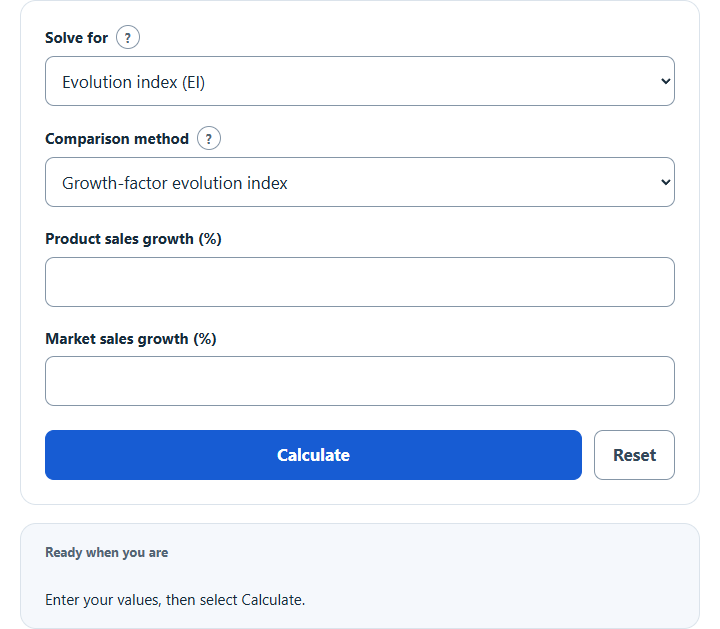
Calculate evolution index (EI) from product and market sales growth, or find the product or market growth rate that gives a target index.
- All Business Calculators
- Economic Growth Calculator
- GDP Growth Rate Calculator
- Sales Growth Calculator
- Growth Rate Calculator
- Population Growth Calculator
- Appreciation Rate Calculator
- Rate of Change Calculator
Evolution Index Formula
The growth-factor evolution index compares the product and market sales factors over the same period. With positive starting sales and a positive current market,100 points means equal growth, above100 means a higher product growth rate, and below100 means a lower rate. Higher growth can mean a slower decline. Use consistent scope, currency and value-versus-unit sales measures.
- EI = Evolution Index (dimensionless index points)
- GP = Growth Rate of the Product (%)
- GM = Growth Rate of the Market (%)
Choose a solve target and method, then enter the visible required values. Sales growth cannot be below−100%; the growth-factor method requires market growth above−100%. A zero index may leave an inverse solution undetermined:
- Calculate Evolution Index: uses100 times the product growth factor divided by the market growth factor. The separate legacy option uses100 ×GP/GM and is undefined when GM is zero.
- Calculate Growth Rate of the Product: uses the evolution index and market growth rate to find the product growth rate needed to match that index.
- Calculate Growth Rate of the Market: uses the product growth rate and evolution index to estimate the market growth rate implied by those values.
Evolution Index from Sales or Market Share
Choose Evolution index from sales to enter prior and current product sales and total market sales. Use the same two periods, market definition, and currency or unit basis for all four values. Product sales must be included in the total market. Prior product sales and both market totals must be positive; current product sales may be zero.
The calculator also shows product and market sales growth, both market shares, the share change in percentage points, and relative market-share change. Market share is product sales divided by total market sales, multiplied by 100.
If the market shares are already known, choose Evolution index from market shares. The prior share must be above zero and both shares must be at most 100%.
For example, product sales rising from 100 to 120 while the total market rises from 1,000 to 1,100 give product growth of 20%, market growth of 10%, and EI ≈ 109.090909 points. Market share rises from 10% to about 10.909091%: a gain of about 0.909091 percentage points, or 9.090909% relative to the prior share. These are different measures.
Evolution Index Interpretation
This table applies to the growth-factor index. The legacy rate ratio can reverse the100 benchmark in a declining market: GP =−20% and GM =−10% gives a ratio of200 even though the product is declining faster. Read the growth-rate gap for that comparison.
| Evolution Index | Meaning | Simple interpretation |
|---|---|---|
| Above 100 | Product growth is faster than market growth. | The product is gaining relative momentum. |
| 100 | Product growth equals market growth. | The product is keeping pace with the market. |
| Below 100 | Product growth is slower than market growth. | The product is lagging the market. |
Common Product and Market Growth Comparisons
| Product Growth | Market Growth | Evolution Index | Result |
|---|---|---|---|
| 12% | 8% | 103.703704 | The product growth factor is about1.037037 times the market factor. |
| 8% | 8% | 100 | Product growth matches the market. |
| 5% | 10% | 95.454545 | The product growth factor is about95.454545% of the market factor. |
Example
Example 1: Calculate the evolution index
If the product growth rate is 15% and the market growth rate is 10%, then:
The growth-factor index is approximately 104.545455 points. Product growth is higher than market growth. The legacy ratio for these inputs would be150 points and answers a different arithmetic comparison.
Example 2: Calculate the product growth rate
If the growth-factor evolution index is125 points and market growth is8%, then:
The required product growth rate is 35%.
FAQ
What does an evolution index of 100 mean?
An evolution index of 100 means the product is growing at the same rate as the market. For example, if the product grows by 6% and the market also grows by 6%, the evolution index is 100.
Can the market growth rate be zero?
Yes for the growth-factor method: zero market growth gives a market factor of1, so GP =12% produces112 points. Market growth of−100% is undefined for this index. The separately labeled legacy rate ratio is undefined at zero market growth.
Is a higher evolution index always better?
For the growth-factor method with a positive market factor, above100 means higher product growth, which may still be negative. The index does not establish profitability or future performance. A small remaining market after a large decline can amplify it. The legacy rate ratio needs a separate growth-rate comparison when market growth is negative.