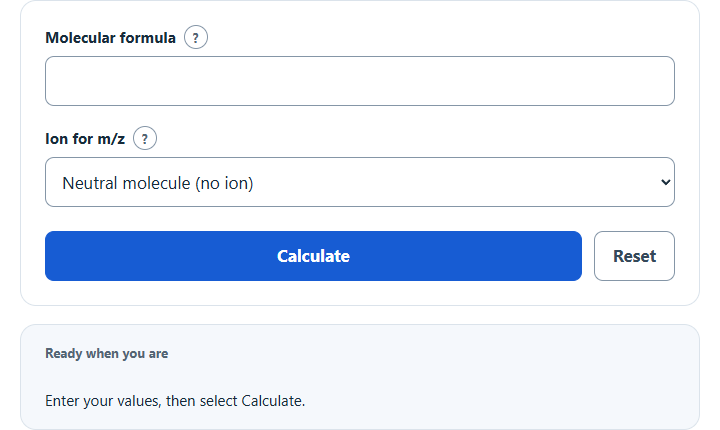
Calculate the exact (monoisotopic) mass of a molecule from its formula, with the average molecular mass, nominal mass and the m/z of common ions.
- All Chemistry Calculators
- Isotope Mass Calculator
- M/Z Calculator
- Mass Error Calculator
- ppm Error Calculator
- Average Atomic Mass Calculator
- Isotopic Distribution Calculator
Calculator Functions
The calculator reads a molecular formula and gives its exact mass, also called the monoisotopic or accurate mass: the mass of one molecule made only from the most abundant isotope of each element. It also gives the average molecular mass, the nominal mass and, if you pick an ion, its m/z.
| Function | Use it when | You enter |
|---|---|---|
| Exact mass from a formula | You need the mass a high-resolution mass spectrometer would show for a compound | The molecular formula, such as C6H12O6 |
| m/z of an ion | You want the peak position for a protonated, sodiated or other common ion | The formula and the ion, such as [M+H]+ |
Formulas can use round and square brackets, such as Ca(OH)2 or K4[Fe(CN)6], and a dot for a hydrate, such as CuSO4.5H2O. Capital letters matter, because Co is cobalt and CO is carbon monoxide. D stands for deuterium and T for tritium. To compare a measured mass with the result, use the Mass Error Calculator.
Exact Mass Formulas
| M | Monoisotopic (exact) mass of the molecule (Da) |
| n | Number of atoms of one element in the formula |
| m | Mass of the most abundant isotope of that element (u) |
For glucose, C6H12O6, the exact mass is 6 × 12.000000 + 12 × 1.007825 + 6 × 15.994915 = 180.06339 Da. The isotope masses come from the NIST table of atomic weights and isotopic compositions [1]. These are the ones used most often:
| Element | Isotope | Mass (u) |
|---|---|---|
| Hydrogen | ¹H | 1.007825 |
| Carbon | ¹²C | 12.000000 |
| Nitrogen | ¹⁴N | 14.003074 |
| Oxygen | ¹⁶O | 15.994915 |
| Fluorine | ¹⁹F | 18.998403 |
| Sodium | ²³Na | 22.989769 |
| Silicon | ²⁸Si | 27.976927 |
| Phosphorus | ³¹P | 30.973762 |
| Sulfur | ³²S | 31.972071 |
| Chlorine | ³⁵Cl | 34.968853 |
| Potassium | ³⁹K | 38.963706 |
| Bromine | ⁷⁹Br | 78.918338 |
| Iodine | ¹²⁷I | 126.904472 |
Average molecular mass and nominal mass
Here a is the average atomic mass of an element, which weights every natural isotope by its abundance. This is the molar mass used for weighing out a compound: 180.156 g/mol for glucose. The nominal mass uses whole mass numbers instead, 6 × 12 + 12 × 1 + 6 × 16 = 180.
m/z of an ion
X is the exact mass of the atoms the ion gains, negative for atoms it loses, z is its charge and mₑ is the mass of an electron, 0.000549 u [2]. Caffeine, C8H10N4O2, has an exact mass of 194.08038 Da, so its [M+H]+ ion appears at (194.08038 + 1.00783 − 0.00055) ÷ 1 = 195.08765.
Limits of This Estimate
- The exact mass always uses the most abundant isotope of each element, which is not always the lightest one. For selenium it is ⁸⁰Se [1].
- Average masses are worked out from the isotopic compositions in the same table. Natural samples vary a little, which is why NIST lists the atomic weights of hydrogen, lithium and some other elements as a range [1].
- Elements with no natural isotopic composition in the table, such as technetium and promethium, are not supported.
- The calculator adds up atoms. It does not check that the formula is a real compound or that the chosen ion would actually form.
Sources
- National Institute of Standards and Technology, Atomic Weights and Isotopic Compositions for All Elements: the relative atomic mass and isotopic composition of every isotope used
- National Institute of Standards and Technology, CODATA Value: electron mass in u: the electron mass used for ions