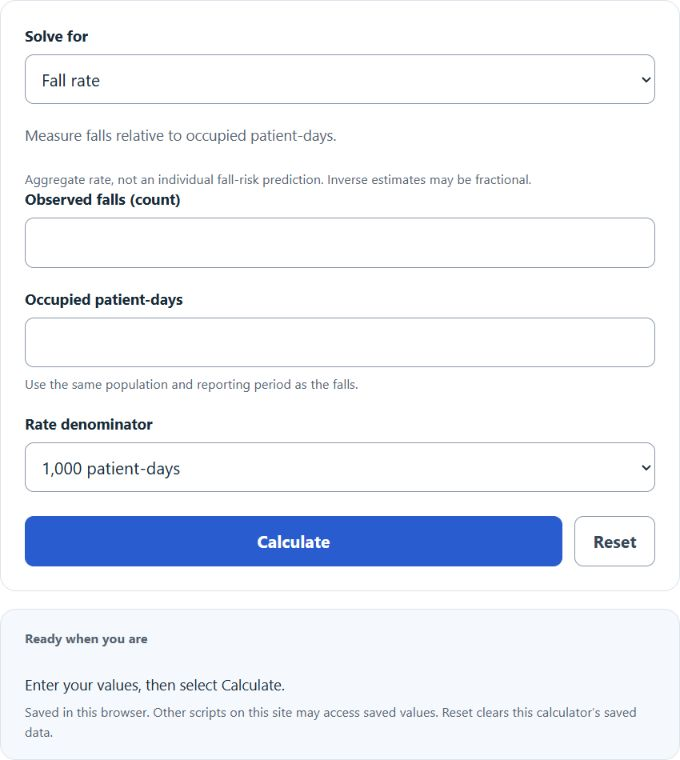
Calculate fall rates per 1,000 patient-days from falls and patient-days, or estimate patient-days from average daily census and period length.

Fall Rate Calculator

Use falls and patient-days, or estimate patient-days from average daily census.

Patient-days
Census estimate
Fall rate
Copy result

Fall Rate Formula

The calculator standardizes fall counts against exposure time so you can compare units, periods, and benchmarks on the same scale.

Fall Rate = (Falls / Patient-Days) * 1000

When you do not have patient-days, the calculator estimates them from census:

Patient-Days = Average Daily Census * Period Days
  • Falls: count of fall events in the period (total, injury, assisted, or unassisted).
  • Patient-Days: sum of days each patient was on the unit during the period.
  • Average Daily Census (ADC): mean number of patients on the unit each day.
  • Period Days: length of the reporting window in days.
  • 1000: scaling constant so the result is per 1,000 patient-days.

The Patient-days tab uses your direct exposure data and is the preferred input for NDNQI-style reporting. The Census estimate tab multiplies ADC by the period length when patient-day data is not available. The optional target rate compares your result against a benchmark and shows the expected fall count at that target.

Reference Tables

Typical inpatient benchmarks vary by unit type. Use these as orientation, not as a hard standard.

Unit Type Typical Total Falls / 1,000 PD Injury Falls / 1,000 PD
Critical care1.0 – 2.00.2 – 0.4
Medical-surgical3.0 – 4.50.8 – 1.2
Step-down2.5 – 3.50.6 – 1.0
Rehabilitation5.0 – 8.01.0 – 1.5
Behavioral health3.0 – 5.50.5 – 1.0
Long-term care6.0 – 12.01.5 – 3.0

Quick conversion between the most common rate denominators:

Per 1,000 PD Per 100 PD Per 10,000 PD
1.00.110
3.00.330
5.00.550
8.00.880

Example and Common Questions

Example 1. A med-surg unit logs 12 falls in a month with 4,250 patient-days. Rate = (12 / 4250) * 1000 = 2.82 per 1,000 patient-days. Against a target of 3.0, the unit is 0.18 below target.

Example 2. A rehab unit had 9 falls in 30 days with an average daily census of 22. Patient-days = 22 * 30 = 660. Rate = (9 / 660) * 1000 = 13.64 per 1,000 patient-days. That is above the typical rehab range, signaling a need for review.

What counts as a patient-day?

One patient on the unit for one calendar day equals one patient-day. Day of admission counts; day of discharge usually does not. Follow your facility’s definition for consistency across reports.

Should I use total falls or injury falls?

Report both. Total fall rate measures overall prevention performance. Injury fall rate aligns with CMS hospital-acquired condition reporting and reflects harm severity.

Why per 1,000 patient-days instead of a percentage?

Falls are infrequent relative to exposure time. Per 1,000 patient-days produces readable numbers (typically 1 to 10) and is the standard used by NDNQI and most quality registries.

Is ADC-based estimation accurate enough?

It is acceptable for internal trending when patient-day data is unavailable. For external benchmarking or regulatory submission, use actual midnight census or charge-based patient-days.