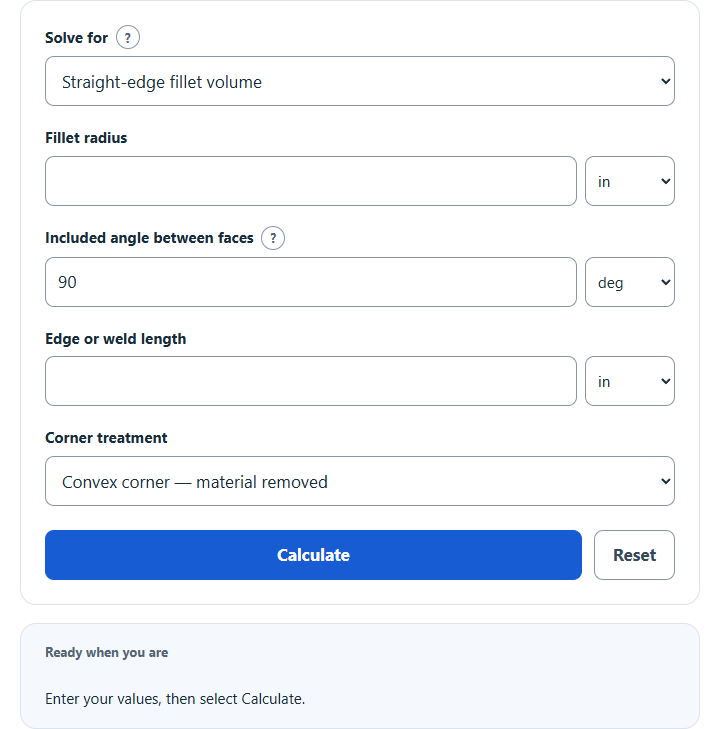
Calculate fillet volume and cross-section area from fillet radius, corner angle and edge length, with arc-path, fillet weld and mass options.
Related Calculators
- X Factor (Welding) Calculator
- Rolling Offset Calculator
- Sandblasting Calculator
- Working Load Limit Calculator
- All Construction Calculators
Calculator Functions
| Function | What it does | What it requires |
|---|---|---|
| Straight-edge fillet volume | Finds the volume a circular fillet removes from a convex corner or adds to a concave corner along a straight edge | Requires the fillet radius, the included angle between the faces, the edge length and the corner treatment |
| Arc-path fillet volume | Finds the volume of a fillet that follows a circular edge, such as the rim of a round part | Requires the fillet radius, the included angle, the radius of the path traced by the centroid of the fillet cross-section, the sweep angle and the corner treatment |
| Fillet weld volume | Estimates the weld metal in an equal-leg fillet weld | Requires the weld leg size, the weld length, a weld volume factor and a single or double fillet count |
| Mass and cost from volume | Converts a volume to mass, with optional cost by mass and cost by volume | Requires a volume and a material density. A price per mass and a price per volume are optional |
| Fillet radius | Finds the radius of a circular fillet from a measurement of the corner | Requires the included angle plus either the tangent setback or the fillet cross-section area |
Lengths can be entered in in, ft, cm or m and angles in degrees or radians. The included angle starts at 90°, a square corner. The two fillet volume functions also report the cross-section area, the fillet path length and the curved surface area, and every volume is shown in both in³ and m³. After a volume result, Mass and cost from volume opens with that volume already filled in.
Fillet Volume Formulas
| A | Fillet cross-section area: the area between the two straight faces and the tangent arc |
| r | Fillet radius |
| β | Arc angle of the fillet in radians, β = π − α |
| α | Included angle between the two faces, greater than 0° and less than 180° |
The two tangent points, the sharp corner and the arc center form a kite with area r² × tan(β/2). The fillet arc cuts a circular sector of area r² × β ÷ 2 out of that kite [1], and A is what remains. Because tan(β/2) equals cot(α/2), the same area is often written r² × [cot(α/2) − (π − α)/2]. For a square corner, α = 90° and A = r² × (1 − π/4), or about 0.2146 × r².
Straight-edge fillet volume
L is the edge length. A 2 in radius on a 90° corner has A = 4 × (1 − π/4) = 0.858407 in², so a 10 in edge gives V = 8.584073 in³. The corner treatment only labels the result: rounding a convex corner removes that volume, and filling a concave corner adds it. The curved surface area shown with the result is r × β × L.
Arc-path fillet volume
R is the radius of the circle traced by the centroid of the fillet cross-section and ψ is the sweep angle in radians, so R × ψ is the distance the centroid travels. This is Pappus’s centroid theorem: a flat shape revolved about an axis outside it sweeps a volume equal to its area times the distance its centroid travels [2]. The sweep is limited to 360°. A face radius or centerline radius is not the centroid radius, and using one shifts the answer. The curved surface area in this function uses the same path length and is an estimate.
Fillet weld volume
z is the leg size, L is the weld length, f is the weld volume factor and n is 1 for a single fillet or 2 for a double fillet. An equal-leg fillet weld is treated as a 45° right triangle in cross-section [3], which has area z² ÷ 2. A factor of 1 gives that ideal triangle. A larger factor allows for a convex face or overfill: 1.1 adds 10%. A 1/4 in leg over 12 in gives 0.25² ÷ 2 × 12 = 0.375 in³ per fillet.
Mass and cost from volume
ρ is the material density, entered in g/cm³, kg/m³, lb/in³ or lb/ft³. The mass is shown in kg and lb. Cost by mass is the mass times the price per kg or lb, and cost by volume is the volume times the price per in³ or m³. The two costs are alternatives and are not added together. Inch and foot lengths are converted with the exact factors 0.0254 m per inch and 0.3048 m per foot [4], and a pound is taken as 0.45359237 kg. At a density of 7.85 g/cm³, 10 in³ has a mass of 1.286 kg.
Fillet radius
t is the tangent setback: the distance along either straight face from the original sharp corner to the point where the arc begins. It is measured along the face, not across the arc. On a square corner tan(45°) = 1, so the radius equals the setback.
This second form is the area formula solved for r, for a known fillet cross-section area. On a 90° corner it becomes r = √(A ÷ 0.2146), so an area of 0.858407 in² gives a 2 in radius. Either way the result lists the radius, the setback and the cross-section area together. The chord across the arc, the area of the circular sector and a weld leg size are different measurements and cannot be entered in their place.
Limits of This Estimate
- The fillet must be a true circular arc tangent to both faces, and both faces must be long enough to hold the setback. Chamfers, elliptical blends and variable-radius fillets have different areas.
- Arc-path fillet volume needs the centroid radius of the cross-section, and the cross-section must stay on one side of the axis without overlapping itself [2].
- Fillet weld volume is the ideal triangle between equal legs at a right angle. Root gaps, penetration, unequal legs and spatter are not included, and the volume says nothing about weld strength.
- Costs cover material only. Labor, waste and machining time are left out.
Sources
- Wolfram MathWorld, Circular Sector, Equation 15: area of the circular sector subtracted in the cross-section formula
- Wolfram MathWorld, Pappus’s Centroid Theorem, Equation 2: volume of a swept shape as its area times the distance traveled by its centroid
- University of Memphis, CIVL 3131 Steel Design, Chapter 7.11 Fillet Welds: fillet weld cross-section treated as a 45° right triangle
- NIST, Guide for the Use of the International System of Units (SP 811), Appendix B.8: inch, foot and pound conversion factors