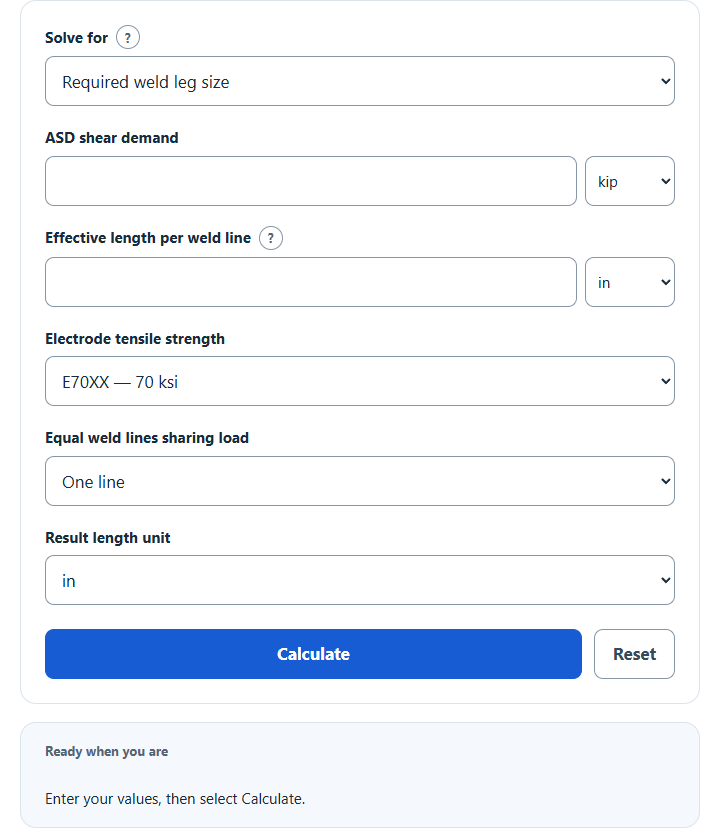
Calculate fillet weld size, length per weld line or weld capacity from load and electrode strength, and convert between leg size and throat thickness.
Related Calculators
- Shear Flow Calculator
- Steel Shrinkage Calculator
- Slenderness Ratio Calculator
- Factor of Safety Calculator
- All Construction Calculators
Calculator Functions
| Function | What it does | What it requires |
|---|---|---|
| Required weld leg size | Finds the leg size whose weld metal carries a shear load at the allowable stress, and lists the next standard size above it | Requires the ASD shear demand, the effective length per weld line, the electrode strength and the number of weld lines |
| Required length per weld line | Finds how long each weld line must be for a chosen leg size | Requires the ASD shear demand, the leg size, the electrode strength and the number of weld lines |
| Allowable weld-metal shear force | Finds the shear force the weld metal can carry at the allowable stress | Requires the leg size, the effective length per weld line, the electrode strength and the number of weld lines |
| Throat thickness from leg size | Converts the leg size of an equal-leg 90° fillet to its theoretical throat | Requires the leg size |
| Leg size from throat thickness | Converts a theoretical throat thickness to the leg size of an equal-leg 90° fillet | Requires the throat thickness |
Loads are entered in kip or kN and sizes in inches or millimeters, converted with the NIST factors [2]. The electrode list runs from E60XX to E110XX and starts at E70XX. One or two equal weld lines can share the load, and the length entered is always the length of one line. The three strength functions also show the theoretical throat in mm, the allowable weld-metal stress in MPa and the combined effective length.
Fillet Weld Size Formulas
| F | Allowable shear force on the weld metal |
| n | Number of equal weld lines sharing the load, 1 or 2 |
| L | Effective length of one weld line |
| a | Theoretical throat, a = w ÷ √2, about 0.707 × w |
| w | Leg size of the equal-leg fillet |
| FEXX | Tensile strength of the electrode: 70 ksi for E70XX |
A fillet weld is assumed to fail in shear on the plane through its throat, so its strength is a stress on the area a × L. With the cross-section taken as a 45° right triangle, the throat is 0.707 times the leg size [1]. The AISC Specification sets the nominal stress of fillet weld metal at 0.60 × FEXX [1]. The calculator divides that by a safety factor of 2 for allowable stress design, which gives 0.30 × FEXX: 21 ksi (144.79 MPa) for E70XX.
Required weld leg size
(n × L × 0.30 × FEXX)
A 20 kip load on one 10 in line of E70XX weld needs w = 20 × 1.4142 ÷ (10 × 21) = 0.1347 in. The result also names the next size up from the list 1/16, 1/8, 3/16, 1/4, 5/16, 3/8, 7/16, 1/2, 5/8 and 3/4 in, here 3/16 in. That rounding is by geometry only. The minimum size a code allows depends on the thickness of the thinner connected part [1] and can be larger than the computed size.
Required length per weld line
(n × w × 0.30 × FEXX)
The same 20 kip load on one line of 1/4 in E70XX weld needs L = 20 × 1.4142 ÷ (0.25 × 21) = 5.3875 in. With two lines the answer is the length of each line, so the total weld length is twice the result.
Allowable weld-metal shear force
This is the main formula used directly. One 10 in line of 1/4 in E70XX weld carries 0.7071 × 0.25 × 10 × 21 = 37.12 kip, or 165.13 kN. Per inch of length, a 1/4 in E70XX fillet is good for about 3.71 kip.
Throat thickness from leg size
The throat is the shortest distance from the root of the weld to its face. For equal legs at 90° that distance is the leg times cos 45°. A 10 mm leg has a 7.07 mm throat. The result also gives the cross-section area of the weld, w² ÷ 2.
Leg size from throat thickness
A drawing that calls for a 5 mm throat needs a 7.07 mm leg. The result repeats the size in the other unit, 0.2784 in, and gives the cross-section area.
Limits of This Estimate
- This is a weld-metal shear estimate, not a code check. The 0.30 factor is the calculator’s allowable-stress value, and the governing AISC or AWS edition should be confirmed before use. These estimates are based on the best available data and estimations.
- The connected steel is not checked. Shear on the base metal cannot exceed the base metal’s own shear strength, which can govern over the weld [1].
- Code limits on weld size and length are not applied: a minimum size set by the thinner part, a maximum size along plate edges, a minimum length of four times the weld size and a reduced effective length for end-loaded welds longer than 100 times the weld size [1].
- The load is assumed centered on the weld group and static. Eccentric loading, fatigue and any strength increase for load direction are left out, and the throat assumes equal legs at 90° with a flat or convex face. A concave weld has a smaller throat.
Sources
- University of Memphis, CIVL 3131 Steel Design, Chapter 7.11 Fillet Welds: throat of 0.707 times the weld size, shear failure through the throat, the 0.60 FEXX nominal stress from AISC Table J2.5, and the AISC size, length and base-metal limits. It does not give the allowable-stress safety factor
- NIST, Guide for the Use of the International System of Units (SP 811), Appendix B.8: kip, ksi and inch conversion factors