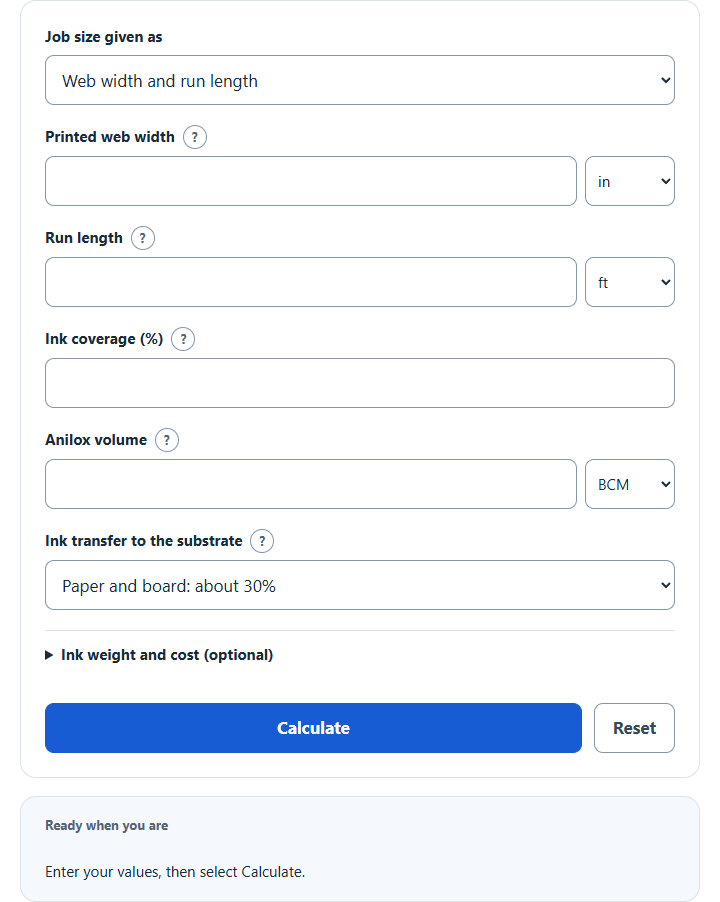
Estimate flexographic ink consumption for a print job from the printed area, ink coverage, anilox volume and transfer rate, in liters, gallons and cost.
- All Business Finance Calculators
- Ink Usage Calculator
- Printing Cost Per Page Calculator
- Label Cost Calculator
- Labels Per Roll Calculator
- Roll Length Calculator
Calculator Functions
The calculator estimates how much ink one color station of a flexographic press lays down over a job, in liters and US gallons. It also gives the wet ink film thickness and, with an ink density or price, the weight and cost of that ink.
| Function | Use it when | You enter |
|---|---|---|
| Ink consumption for a job | You are costing a run or deciding how much ink to mix | Job size, ink coverage, anilox volume and transfer rate |
| Ink weight and cost | You buy ink by weight or want the ink cost of the job | Ink density, ink price per liter or both, in the optional section |
Job size can be entered as the printed web width and run length, or as the print area of one impression and the number of impressions. Anilox volume can be in BCM or cm³/m². Run the calculator once for each color, because each station has its own coverage and anilox roll. For desktop printers that use cartridges, use the Ink Usage Calculator.
Flexo Ink Consumption Formulas
| V | Ink laid on the substrate (L) |
| A | Printed area of the job (m²) |
| C | Ink coverage, as a fraction of the printed area |
| B | Anilox cell volume (cm³/m²) |
| T | Share of the anilox volume transferred to the substrate, as a fraction |
Ink transfer in flexo is predictable and in direct proportion to the anilox volume, which is what makes this estimate possible [1]. A 13 in web run for 10,000 ft is 1,006.45 m². At 35% coverage with a 4 BCM roll (6.2 cm³/m²) and 30% transfer, V = 1,006.45 × 0.35 × 6.2 × 0.30 ÷ 1,000 = 0.66 L.
Anilox volume in BCM
Anilox volume is usually quoted in BCM, billions of cubic microns per square inch [2]. One BCM equals 1.55 cm³/m². Typical volumes by type of work [2]:
| Application | Anilox volume (BCM) |
|---|---|
| Heavy line and solids | 4.0 to 9.0 |
| Line and type | 1.0 to 8.0 |
| Vignettes of matched color | 2.0 to 3.6 |
| Vignettes of process color | 0.9 to 2.8 |
| Process | 0.9 to 2.8 |
Transfer rate and wet film
F is the wet ink film at full coverage in cm³/m², which is the same number as its thickness in microns. Between 25% and 30% of the ink in the anilox roll reaches the substrate, at the low end for film and the high end for paper and board, so a 5 BCM roll lays down about 2 microns [1]. Choose Custom transfer rate when a press test gives you your own figure.
Ink weight and cost
Cost = V × P
W is the ink weight in kg, ρ is the ink density in g/cm³ from its data sheet, and P is the price per liter.
Limits of This Estimate
- These estimates are based on the best available data and estimations. An accurate figure needs a consumption test on the press with the actual ink, substrate and plates [3].
- The result is ink on the substrate only. A station also needs a minimum amount of ink to keep the system flowing, and on a short job that can be more than the ink the job consumes [1] [3].
- The anilox volume on the specification sheet drops as cells wear or plug with dried ink, and the transfer rate shifts with ink viscosity, press speed and substrate [2] [3].
- Coverage is the image area of the color divided by the printed area [3]. The result is in direct proportion to it, so a rough coverage figure gives a rough answer.
Sources
- David Argent, Ink Mileage: Measure and Manage, Paper, Film and Foil Converter, December 2006: ink transfer in proportion to anilox volume, the 25% to 30% transfer rate, the wet film from a 5 BCM roll and ink-up amounts
- Flexopedia, The Ultimate Anilox Volume Reference: the BCM unit, typical anilox volumes by application and loss of volume through wear and plugging
- Luminite, How to Calculate Flexographic Ink Consumption: the inputs an ink consumption estimate needs, what coverage means, and why a press test is still required